
How to write cold email opening lines that get replies
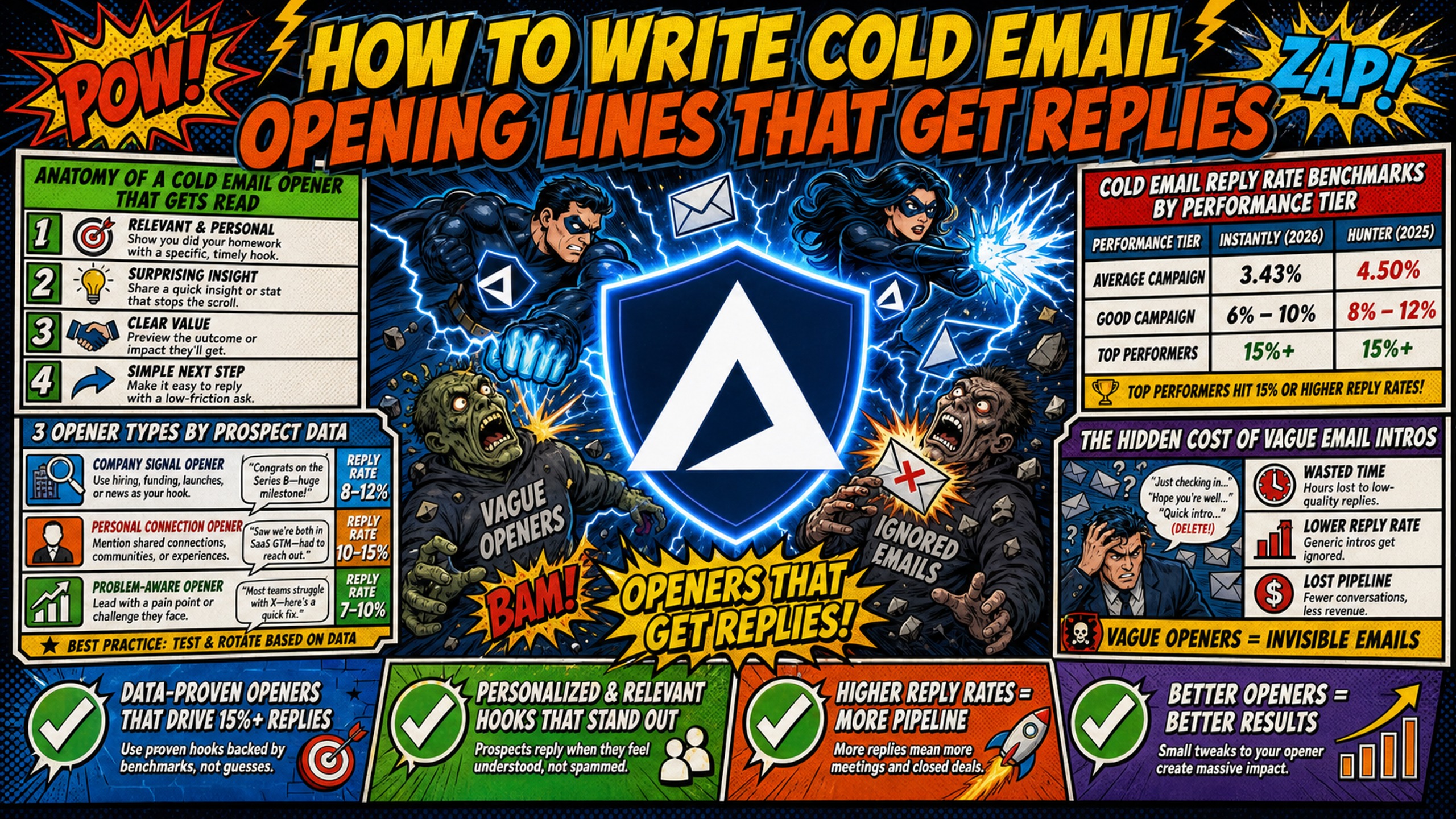
The average cold email reply rate is 3.43% according to Instantly's 2026 benchmarks, while Hunter measured 4.5% in 2025. The best campaigns hit 15% or higher. T
TL;DR: Cold email opening lines earn replies when they combine a specific trigger event, such as a funding round or hiring post, a clear value connection, and a genuine trust signal, all landing within the first three seconds of the preview snippet. Average reply rates sit at 3.43% to 4.5% (Hunter's figure measures sequence reply rate across multi-touch campaigns), with excellent campaigns hitting 10-15% and best-in-class reaching 15% or higher. None of that matters if the opener never reaches the inbox: technical deliverability, including SPF/DKIM/DMARC authentication and dedicated IP reputation, determines whether it gets seen, which is the infrastructure layer Inframail automates.
The average cold email reply rate is 3.43% according to Instantly's 2026 benchmarks, while Hunter measured 4.5% in 2025. The best campaigns hit 15% or higher. The difference starts in the first three seconds, when a prospect scans the preview snippet and decides whether to read or delete.
You can write a perfect opening line and still get zero replies if your email lands in spam. The opener and the infrastructure are one problem.
This playbook covers both. You'll get seven plug-and-play frameworks for writing openers that convert, before/after examples you can test today, and the technical checklist that ensures those openers actually reach the inbox.
Anatomy of a cold email opener that gets read
A cold email opener has one job: earn the next three seconds. If your opening line doesn't hook within that window, the rest of your email doesn't exist.
3 opener types by prospect data
Cold email openers fall into three categories based on what prospect data you have available. Each type determines which signal you lead with, trigger event data, a shared problem, or a trust signal, not how the opener is structured internally. That structural breakdown is covered in the next section.
- Trigger event: Reference a specific, recent event at the prospect's company (funding round, hiring post, product launch).
- Value connection: Lead with a specific problem the prospect likely faces and connect it to a measurable outcome.
- Trust signal: Use a shared contact, relevant praise, or specific observation to reduce skepticism.
Cold email reply rate benchmarks by performance tierHere are four before/after
Reply rates vary by opener quality and targeting precision. Here are the current benchmarks from Instantly's cold email statistics:
| Performance tier | Reply rate | Key contributing factors (among several) |
|---|---|---|
| Average | 3.43% | Broad ICP targeting, unverified data, generic personalization tokens |
| Excellent | 10-15% | Segmented ICP, verified data, trigger event openers, concise value prop, 1-2 follow-ups |
| Best-in-class | 15%+ | High-intent triggers, multi-point personalization, strong inbox placement |
These are ranges to account for industry variance and list quality. Trigger event openers are one factor driving higher tiers. List quality, follow-up cadence, personalization depth, and inbox placement all compound to determine which tier a campaign lands in. For a deeper breakdown of what counts as good, you can read Inframail's cold email reply rate benchmarks.
The hidden cost of vague email intros
Vague openers like "I hope you're having a great week" or "I'm reaching out because" trigger low engagement and spam filters. They waste the preview snippet on filler. If openers are generic, no infrastructure optimization will fix reply rates.
The 4-part anatomy of a high-converting opener
Each element of a high-converting opener serves a specific structural function. The four parts below cover how they work together to earn the read and set up the pitch.
1. Crafting relevant opening hooks
The hook is the first three seconds, and it must be specific enough to earn the read. According to Knak's email preview text guide, preview text should run 40 to 90 characters overall, with the key message in the first 40 characters. Mobile devices can truncate even shorter, to 30-55 characters, so front-load the hook.
A strong hook references something the prospect did, said, or experienced recently. A weak hook talks about you or your company. The difference is measurable: specific, well-targeted campaigns using trigger event openers can reach 10-15% reply rates, compared to the 3.43% average from generic personalization.
2. Connect value to reader pain
The opener must answer "why should I care" within the first sentence. Use buyer terms the prospect already thinks in: cost-per-inbox, inbox placement rate, infrastructure spend. Show how your solution connects to a problem they're already trying to solve.
Value connection differs from feature dumping. Feature dumping lists what your product does. Value connection shows what the prospect gets. For example, "automated DNS setup" is a feature. "Automated DNS configuration that eliminates the 12+ hours of manual panel work required to configure 50 domains" is a value connection.
3. Use trust signals that convert
Trust signals reduce the skepticism that kills reply rates. They include shared professional contacts, relevant personal praise, and specific trigger events. A shared contact works because it borrows trust from an existing relationship. Specific praise works because it shows you did the research.
Avoid manufactured urgency or fake familiarity. Trust signals must be genuine. If you don't have a real shared contact, don't claim one. If you didn't actually read the prospect's blog post, don't pretend you did.
4. Connecting openers to your pitch
The opener earns the read. The pitch earns the reply. The opener must set up the pitch without repeating it. A trigger event opener flows naturally into a value proposition when the trigger event creates the problem your solution solves.
For example, if a prospect just raised a Series A, they're likely hiring SDRs and need to scale outbound infrastructure. Your opener references the funding round. Your pitch connects that growth phase to the infrastructure bottleneck they're about to hit.
7 plug-and-play opening lines for higher replies
Here are seven frameworks you can deploy in Instantly or Smartlead today. Each one includes an example opener and guidance on when to use it.
Here's a quick reference for all seven frameworks:
| Framework | When to use | Example opener |
|---|---|---|
| Recent trigger event | You have current data about a specific company event | Saw you just raised a $12M Series A. Most teams at your stage hit a DNS bottleneck scaling from 20 to 100 domains. |
| Shared professional contacts | You have a genuine mutual connection relevant to their situation | Sarah Chen at [Company] mentioned you're scaling outbound. She ran into the same DNS setup bottleneck last quarter. |
| Problem-based opener | You understand their role well enough to predict pain points | Most agencies managing 50+ domains spend significant time on manual DNS setup. That's time not spent on copy or targeting. |
| Competitor differentiation | You have verified data about their current stack | Noticed you're using [Competitor]. Teams running 100+ domains often see infrastructure costs climb faster than capacity. |
| Customer bottleneck | You have case study data matching their industry or size | An agency managing 50 inboxes was spending $420/month on Google Workspace (at $8.40/seat, Flexible Plan). A switch to flat-rate infrastructure cut that to $147/month flat (before domain costs and warmup tools, which apply on both sides). |
| Personal praise | You actually read or watched content they created | Your post on deliverability testing last week was the clearest SPF/DKIM/DMARC breakdown I've seen. The point about dedicated IPs is exactly what most agencies miss. |
| Pattern interrupt | You want to break expected format while staying relevant | This is a cold email. You probably get 15 weekly. Here's why this one is different: most agencies running 50+ domains hit a blacklist and never know it. Inframail resolves 68.3% of blacklists within 48 hours. |
Framework 1: Recent trigger event
Trigger events are specific, recent company events: funding announcements, hiring posts, product launches, job changes.
Example: "Saw you just raised a $12M Series A. Congrats. Most teams at your stage hit a DNS bottleneck when they scale from 20 to 100 domains."
Use this when you have real, current company data. Trigger events work because they show you're paying attention right now, not running a mail merge.
Framework 2: Leveraging shared professional contacts
Shared contacts borrow trust from existing relationships. Works when you have a genuine mutual connection.
Example: "Sarah Chen at [Company] mentioned you're scaling outbound. She ran into the same DNS setup bottleneck last quarter."
Use this when the connection is genuinely relevant. Don't force it or use weak, outdated connections.
Framework 3: Problem-based openers
Problem-based openers identify a specific bottleneck the prospect likely faces. Works when you don't have a trigger event but understand their role and industry.
Example: "Most agencies managing 50+ domains spend 12+ hours monthly on manual DNS setup. That's time not spent on copy or targeting."
Use this when you don't have specific trigger event data but understand the prospect's role well enough to predict a real bottleneck. Problem-based openers work because they show pattern recognition, not because they reference something time-sensitive.
Framework 4: Direct competitor differentiation
Competitor differentiation openers reference a specific competitor and a specific gap. Requires accurate, current competitor data.
Example: "Noticed you're using [Competitor]. Teams running 100+ domains often see infrastructure costs climb faster than capacity."
Use this only when you have verified stack data. If you're wrong, the opener backfires.
Framework 5: Solving customer bottlenecks
Customer bottleneck openers reference a specific customer problem and outcome. Works when you have case study data matching the prospect's situation.
Example: "An agency managing 50 inboxes was spending $420/month on Google Workspace. A switch to flat-rate infrastructure cut that to $147/month flat (before domain costs and warmup tools, which apply on both sides)."
Use this when you have a customer story matching the prospect's industry, company size, or use case. Specific numbers make outcomes credible.
Framework 6: Crafting relevant personal praise
Personal praise openers reference specific content, talks, or posts the prospect created. Works when praise is specific, not generic.
Example: "Your post on deliverability testing last week was the clearest SPF/DKIM/DMARC breakdown I've seen. The point about dedicated IPs versus shared pools is exactly what most agencies miss."
Use this only when you actually read or watched the content. Generic praise signals automation, not research.
Framework 7: Using pattern interrupts
Pattern interrupts break expected cold email format. Work best when still relevant to the prospect's situation.
Example: "This is a cold email. You probably get 15 weekly. Here's why this one is different: most agencies running 50+ domains hit a blacklist and never know it. Inframail resolves 68.3% of blacklists within 48 hours."
Use sparingly. Pattern interrupts work because they're unexpected, but they still need to connect to a real problem.
Before and after cold email opening line examples
Here are four before/after examples you can test in your next campaign. Each one shows a structural change designed to make an opening line more relevant and compelling.
| Scenario | Before | After | Why it works |
|---|---|---|---|
| SaaS prospect | I hope you're having a great week. I wanted to reach out because I think our platform could help your team. | Saw you just launched your API product. Most SaaS teams at your stage hit a deliverability wall scaling from 1,000 to 10,000 emails daily. | References specific trigger event and connects to predictable problem. Before version wastes preview snippet on filler. |
| Agency lead | I'm reaching out because I think we could help your agency scale. | Most agencies managing 50+ domains spend $420/month on Google Workspace. Inframail cuts that to $147/month flat, with automated DNS setup (before domain costs and warmup tools, which apply on both sides). | Leads with specific cost problem and specific outcome. Before version is vague and self-focused. |
| B2B sales | Hi there. I wanted to introduce myself and see if you'd be open to a quick call. | Saw you moved into the VP of Sales role at [Company] last month. Most teams scaling outbound past 50 domains hit DNS setup bottlenecks before they hit capacity. | References a specific career trigger event and connects to a predictable operational problem. Before version asks for time without giving reason to say yes. |
| General prospecting | Hi {{first_name}}, I see you work at {{company_name}}. I think we could help. | This is a cold email. You probably get 15 weekly. Here's why this one is different: I'll show you the DNS setup that cut one agency's infrastructure costs from $420 to $147/month. | Uses pattern interrupt that stays relevant. Before version uses generic tokens signaling automation, not research. |
Test these improvements in your next campaign. The structural changes are consistent across scenarios: move from self-focused to prospect-focused, from vague to specific, from asking to offering.
A/B testing your openers in Instantly and Smartlead
A/B testing tells you which openers actually work for your audience. Both Instantly and Smartlead support split testing at the sequence level. For the broader methodology behind isolating variables without breaking what already works, see Inframail's email sequence A/B testing framework.
Configuring your A/B test splits
In Instantly, navigate to the Sequences section and add a variant using the A/Z testing feature. Keep all other sequence steps identical. Go to Campaign Options, then Advanced Options, then "Auto optimize A/Z testing," and select reply rate as the winning metric. Instantly will analyze variant performance and deactivate lower-performing versions when auto-optimization is enabled.
In Smartlead, after adding the variants, click "A/B Configuration". In the A/B Testing Settings popup, keep "Manual Distribution" selected, choose "Split the variant percentage equally", and save the manual distribution settings.
Calculating data needs for A/B tests
You need adequate sample sizes to detect meaningful differences. At a 3% baseline reply rate, 250 contacts per arm can only detect enormous differences. With 500 contacts you can learn qualitatively: read every reply, note objections, check deliverability signals.
Small reply rate differences, typically under 1-2 percentage points, are difficult to distinguish from random variation. To detect a 2-percentage-point difference (say, 5% vs 7%), standard two-proportion formulas put the requirement at roughly 2,200 recipients per variant at 95% confidence and 80% power.
Tracking success for cold openers
The metrics that matter are reply rate, positive reply rate, and meeting booked rate. Open rate is unreliable due to privacy protections in Apple Mail and other clients. Focus on replies and meetings, not opens.
Connect your testing to the metrics you report on: cost-per-lead and meeting-booking rates. If an opener improves reply rate but doesn't improve meeting booked rate, it's not a win.
Validating your best opening lines
Run the winning variant in a new campaign to confirm results. Openers that work for one audience may not work for another. Validate across segments before you scale.
Check deliverability first, or in parallel with any opener test. If inbox placement and authentication are healthy and reply rates are still below 3%, the messaging is the more likely cause: test openers next. If deliverability is unverified, fix that before trusting any A/B test result, since undelivered emails make every variant look equally bad.
Avoid these 5 common cold email blunders
Here are the five most common opener mistakes and how to fix them.
Fixing self-focused email greetings
"I'm the Head of Growth at [Company] and we help businesses like yours..." and "I wanted to introduce myself and share what we've been building" fail for the same reason: they open with your role and your product, not the prospect's situation. The preview snippet is gone before the prospect has a reason to care.
Fix: Lead with the prospect, not yourself. Reference something they did, said, or experienced.
Personalization tokens that signal spam
Generic personalization tokens like {{first_name}} and {{company_name}} can appear automated when used without a specific trigger event. They show mail merge, not research.
Fix: Use personalization tokens only when combined with a specific trigger event or observation. "Hi {{first_name}}" is weak. "Saw {{company_name}} just raised a Series A" is strong.
Why question openers kill reply rates
Question openers like "Have you ever wondered..." or "Are you struggling with..." typically underperform because they feel rhetorical rather than genuine. They read as manufactured.
Fix: Use statements, not questions. "Most agencies managing 50+ domains spend 12+ hours a month on manual DNS setup" is stronger than "Are you struggling with DNS setup?"
Prioritize prospect intent over vanity
Vanity metrics like open rate and click rate don't matter as much as reply rate and meeting booked rate. Open rate is unreliable due to privacy protections. Click rate doesn't correlate with meetings booked.
Fix: Track reply rate, positive reply rate, and meeting booked rate. Report on cost-per-lead and meeting-booking rates, not opens.
The deliverability blind spot
Even the best opener fails if the email lands in spam. Technical deliverability (SPF/DKIM/DMARC configuration, dedicated IPs, inbox placement rate) determines whether openers get seen. Most cold email advice ignores this.
Fix: Secure the technical foundation first. Inframail automates SPF/DKIM/DMARC configuration and provisions dedicated IPs, so your openers actually reach the inbox.
How Inframail automates DNS authentication
Inframail provisions SPF, DKIM, and DMARC records automatically when you add a domain. For a 50-domain setup, that means skipping panel-by-panel configuration across multiple registrars, a process that typically runs 12+ hours per cycle. It doesn't eliminate DNS propagation itself, which can still take 24 to 48 hours across registrars.
How to scale personalized openers across campaigns
Scaling personalized openers requires a system for finding trigger events, segmenting audiences, and automating dynamic fields.
Leveraging Apollo data for custom openers
Use Apollo or ZoomInfo to find trigger events: funding rounds, hiring posts, product launches, job changes. Export the data to CSV, then import it into Instantly or Smartlead as custom fields.
The process matters more than the specific tool. Set up a weekly workflow: pull new trigger events, segment by type, write opener variants, load into your sending platform.
Segmenting openers by target audience
Segment openers by industry, role, company size, and trigger event type. Openers that work for SaaS prospects may not work for agency leads. Openers that work for VPs may not work for individual contributors.
Create a simple segmentation framework: one opener variant per segment, tested against a control. Track reply rates by segment to identify which frameworks work best for which audiences.
Automating openers with dynamic fields
Use dynamic fields in Instantly or Smartlead to scale personalized openers. Combine dynamic fields with specific trigger events, not as a replacement for research.
For example, use {{company_name}} with a trigger event: "Saw {{company_name}} just raised {{funding_amount}}." Don't use tokens as a substitute for research: "Hi {{first_name}}, I noticed we're both in the {{industry}} space."
Get your openers into the inbox with Inframail
Inframail is a flat-rate Microsoft email infrastructure platform built for agencies and sales teams running cold email at scale. It automates SPF/DKIM/DMARC configuration, provisions dedicated IPs (1 IP on the Unlimited Plan at $147/month, 3 IPs on the Agency Pack at $387/month), and delivers a 98%+ deliverability rate with 68.3% blacklist delisting success within 48 hours.
Watch this case study video and see how Inframail helped the agency book 10 to 30 qualified appointments per client while keeping deliverability strong and costs low.
Sign up to Inframail and get started today.
FAQs
How long should a cold email opening line be?
Keep the opening line to one to two sentences. Preview text should run 40 to 90 characters overall, with the key message in the first 40. Mobile devices can truncate to as few as 30 to 55 characters, so front-load the hook.
Should I personalize every opening line?
Personalize when you have a specific trigger event or shared contact. Generic personalization tokens without a trigger event signal automation and reduce reply rates.
What reply rate should I expect from a good opener?
3.43% is average according to Instantly's 2026 benchmarks, 10-15% is excellent, and 15%+ is best-in-class. Hunter measured 4.5% average in 2025. These ranges account for industry variance and list quality.
Can I reuse the same opener across different campaigns?
Reuse the framework, not the exact wording. The same trigger event opener structure works across campaigns, but the specific trigger event must change for each prospect.
How do I write openers when I have limited data on prospects?
Use problem-based openers that reference a common bottleneck in the prospect's industry or role. These work without specific trigger event data.
Key terms glossary
Opening line: The first sentence of a cold email that determines whether the recipient reads the rest of the message. It functions as a secondary subject line within the preview snippet.
Reply rate: The percentage of delivered emails that receive a reply. Average is 3.43% according to Instantly's 2026 benchmarks, excellent is 10-15%, and best-in-class is 15%+.
Personalization token: A dynamic field like {{first_name}} or {{company_name}} that inserts prospect data into an email. Works best when combined with a specific trigger event.
Trigger event: A specific, timely event in a prospect's business or career, such as a funding round, hiring post, or product launch, that creates a relevant opening for outreach.
Pattern interrupt: An opener that breaks the expected cold email format to capture attention. Works best when the interrupt is still relevant to the prospect's actual situation.