
Cold email reply rate benchmarks: what's good in 2026?
A cold email reply rate of 5.5% or higher puts a 2026 campaign in the top quartile, against a B2B average of about 3.4% and a top-10% threshold of 10.7%, per Th
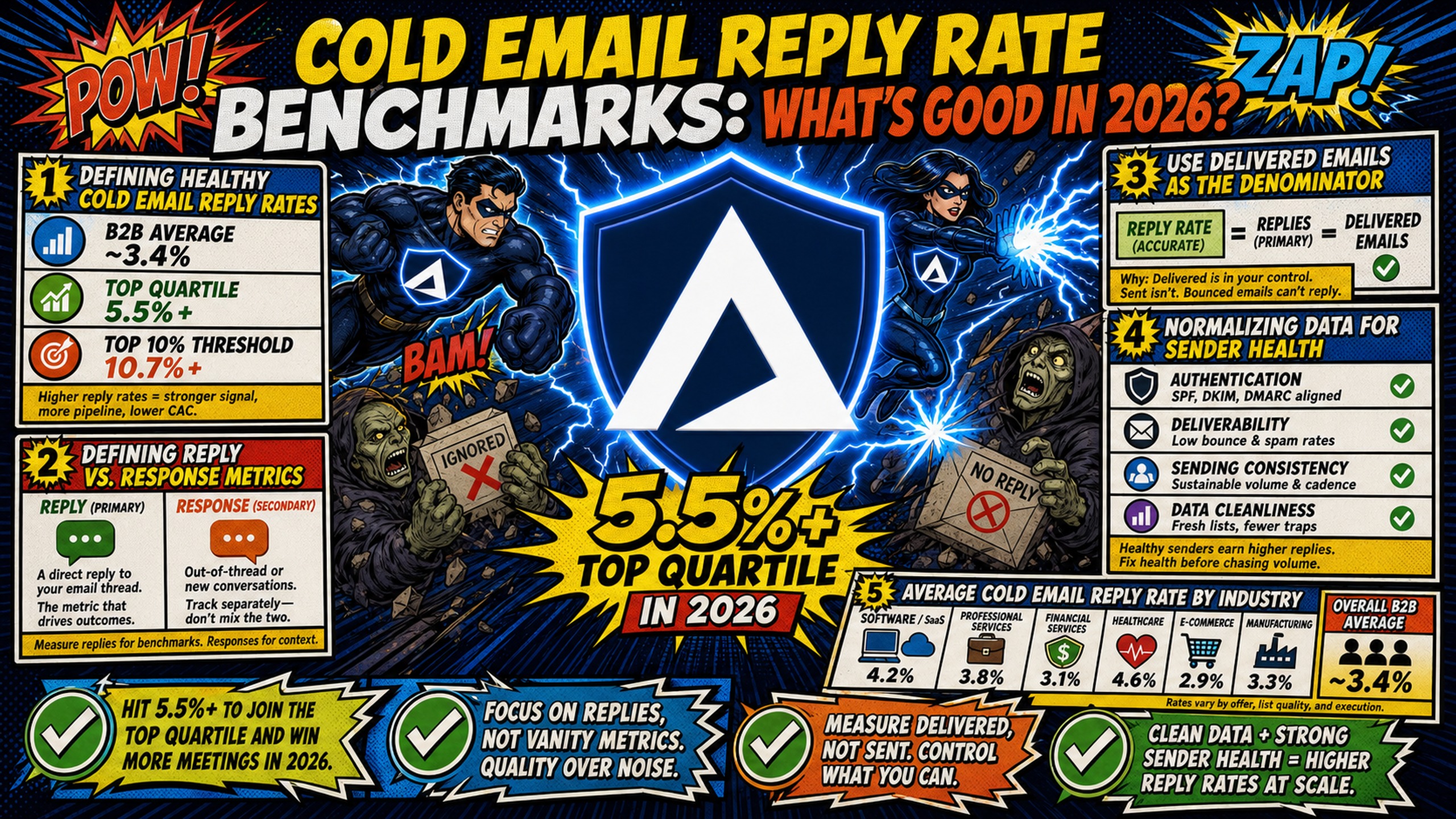
TL;DR: A cold email reply rate of 5.5% or higher puts a 2026 campaign in the top quartile, against a B2B average of about 3.4% and a top-10% threshold of 10.7%, per Thinkable Group's 2026 benchmark roundup. Reply rate (unique human replies divided by delivered emails) varies by industry, from up to 10% in legal to 2-4% in B2B SaaS per Cleverly, and by seniority, from a 1.4% median for C-suite contacts to 5.5% for SMB owners per B2B Data Index. Signal-based openers are expected to reach 15-25%, per Prospeo. A reply rate below 2% on a well-targeted list almost always points to deliverability or targeting, not copy, per SalesHive, so check SPF/DKIM/DMARC, IP reputation, and inbox placement first. Inframail automates DNS setup and provides dedicated IPs, so shared-IP contamination and DNS errors can be ruled out before rewriting copy.
When a reply rate drops sharply, check inbox placement before rewriting the opener.
Reply rate is the metric campaign managers report up on, and it is also one of the easiest to misread. A 3% reply rate can be strong in one vertical and a red flag in another, and a deliverability problem can make a great opener look broken. Diagnosing the wrong cause sends testing in the wrong direction.
This article breaks down 2026 cold email reply rate benchmarks by the variables that move the number: industry, seniority, list size, and opener type. Then it shows how to fix the infrastructure ceiling before touching a single line of copy.
Defining healthy cold email reply rates
Reply rate is the percentage of delivered cold emails that receive a human reply. Most practitioners calculate it as (unique replies ÷ delivered emails) × 100, typically excluding auto-responses, bounces, and unsubscribes.
Defining reply vs. response metrics
Campaign managers conflate three metrics constantly:
- Reply rate: Typically measured as all unique human replies divided by delivered emails, including negative ones. This measures engagement.
- Positive reply rate: Generally defined as replies showing interest divided by delivered emails. This measures campaign health.
- Meeting-booked rate: Meetings booked divided by unique prospects contacted. This is the metric leadership cares about most.
Track positive reply rate alongside total reply rate, because a campaign generating mostly "stop emailing me" responses has a targeting problem even if the raw reply number looks fine. Some practitioners argue meeting-booked rate is the only number that counts, and they are right about the end goal, but reply rate is the first human signal in the chain and the one that tells you whether the opener works.
Use delivered emails as the denominator
Using sent emails instead of delivered emails mixes list-quality problems into the reply-rate calculation and makes campaign performance harder to interpret. If you send 500 emails, 480 get delivered, and 24 people reply, your reply rate is 5%.
Normalizing data for sender health
Reply rate data is only valid if emails reach the inbox. Open rates have become unreliable because Apple Mail Privacy Protection downloads remote content, including tracking pixels, in the background through relay servers whether or not the recipient opens the email. In Omeda's data, total and unique open rates nearly doubled after MPP rolled out. Reply rates require human action, which makes reply rate the more trustworthy engagement metric in 2026.
Average cold email reply rate by industry
A 3% reply rate is close to the reported 2026 B2B cold-email average, which ranges from roughly 3.4% to 3.7%. Thinkable Group cites thresholds of 5.5% or higher for the top quartile and 10.7% or higher for the top 10%. However, industry comparisons, such as higher rates for legal services or lower rates for SaaS, should be treated cautiously because vendor datasets use different sender populations, campaign sizes, and definitions of "reply."
Industry is one of the strongest predictors of reply rate. These figures come from Cleverly's industry benchmarks and Reachoutly's response rate data.
| Industry | Average reply rate |
|---|---|
| Legal | ~8-10% |
| Consulting | ~4-6% |
| Staffing | 5-8% |
| IT services | 3-4% |
| B2B SaaS | 2-4% |
| Financial services | 1.5-3.5% |
| Healthcare | 2-4% |
| Real estate | ~5-7% |
*Legal, consulting and real estate: Cleverly. Staffing, healthcare and financial services: Reachoutly. IT services and SaaS: both.
B2B SaaS cold email reply standards
SaaS and software sit near the bottom of the table, with most sources placing average campaigns in the 2-4% range. SaaS decision-makers receive 15+ cold emails a week, compared with about two for a legal professional, per Cleverly, and they recognize template patterns instantly, so opener quality and targeting carry more weight here than anywhere else.
Benchmarks for consulting email campaigns
Consulting benchmarks run 4-6% for average campaigns. Segment consulting benchmarks by seniority and practice area, and by whether you are selling to consultants versus selling consulting services.
2026 staffing cold email performance
Staffing and recruitment reply rates land between 5% and 8%, per Reachoutly's benchmarks. For client acquisition, well-targeted cold emails achieve around 3-10% reply rates, with top performers above 10%, per Outbound System's recruiting outreach data. Segment campaign benchmarks by audience type rather than averaging passive candidate outreach with client acquisition campaigns.
Reply rates for outbound agencies
Agency-run campaigns generally sit in the mid-single digits, and strict list hygiene plus dedicated IP infrastructure are the common threads behind the campaigns that clear it, since both keep sender reputation intact at volume.
"My campaigns on Inframail have hit 9%+ and 25%+ reply rates, which is really good. The team also responded very quick in the support chat to answer my questions." - Verified user review of Inframail
Average reply rates for finance
Financial services reply rates run 1.5-3.5%, the lowest range in Reachoutly's industry table. Finance buyers are risk-averse and heavily prospected, and seniority weighs heavily in this vertical because junior contacts rarely hold budget authority.
Reply rate benchmarks: junior vs senior leads
Decision-maker seniority has the largest single impact on reply rate, per B2B Data Index (LeadsBlue). Published figures vary by sample size and methodology, so use these ranges as directional targets and segment your own data by seniority to build campaign-specific benchmarks.
| Seniority level | Reply rate range | Median |
|---|---|---|
| C-suite | 0.8-2.5% | 1.4% |
| VP/Director | 1.5-4% | 2.5% |
| Manager/Senior Manager | 2.5-6% | 4% |
| Owner/Founder (SMB) | 3-8% | 5.5% |
C-suite reply rate benchmarks
C-suite contacts have the lowest reply range in B2B Data Index's data (0.8-2.5%). They receive high volumes of outreach and have gatekeeping systems in place, per Belkins' 2026 study. A 2% reply rate from CEOs is not a problem if the list is tightly targeted, because C-suite contacts "convert to high-value deals when they do," while managers are more accessible but may lack budget authority, per B2B Data Index.
VP and director reply rate benchmarks
Directors balance reply rate against budget influence. They are hands-on with vendor evaluation and still hold budget sway, though they reply less often than managers. Expect 1.5-4% (median 2.5%) for the VP and director tier, with well-targeted campaigns running toward the top of that range.
Warmer.ai's 2025 study of 2,847 cold emails sent by consultants found that emails reaching director-level contacts drew a 17.8% response rate, against 4.2% for the C-suite. Those figures are specific to consultant-sent emails and sit well above the B2B Data Index ranges in the table above. The gap reflects the sender and audience, not a universal seniority effect.
Owner and founder reply rate benchmarks
SMB owners and founders reply at 3-8% (median 5.5%), per B2B Data Index above. Founders who run their own outreach tend to send lower volume and personalize more per lead. The main constraint is infrastructure scale, since spinning up domains and managing DNS manually eats into selling time.
Optimizing list size for higher reply rates
Smaller, tightly targeted campaigns consistently out-reply large blasts, because relevance drops as the list grows.
Reply rates for campaigns under 200 leads
Campaigns under 200 leads tend to generate higher reply rates when each lead is highly qualified and the sender personalizes deeply. This is the standard for high-ticket B2B offers where one meeting justifies the research time.
Reply rate benchmarks for 200-2,000 leads
Mid-size lists of 200-2,000 leads are the most common tier for agencies and in-house SDR teams. At this size, list quality matters more than list size: purchased, verified B2B lists see 2-5% reply rates against 0.2-1.2% for scraped, unverified lists, per B2B Data Index's 2026 benchmark.
Scaling lists: reply rate norms at 2,000+
Large lists over 2,000 leads generate lower reply rates because relevance drops as the list grows. Scaling volume also requires more domains and inboxes to protect sender reputation, which compounds infrastructure costs as client count grows.
Reply rate benchmarks by opener strategy
Opener strategy is the variable you control most directly, but its performance depends on list quality and sender health underneath it. The table below is based on Prospeo's opening lines data and Autobound's aggregated benchmark (expected rates).
| Opener type | Expected reply rate | Suggested use case |
|---|---|---|
| No personalization | 1-3% | Never recommended |
| Basic personalization (name + company) | 5-9% | Standard B2B outreach |
| Advanced personalization (specific pain point) | 9-15% | High-ticket, researched lists |
| Signal-based (trigger event) | 15-25% | Warm intent, timed outreach |
Impact of question openers on reply rates
Question openers invite a response by design and work best when the question is specific to the lead's role. "Struggling with outbound?" is generic. "How are you handling SDR ramp time after the Series B?" is a question that earns a reply.
When problem-statement openers work
Problem-statement openers work for leads who already know they have a problem and fall flat for leads who are not problem-aware, so match the opener to the awareness level of the list segment.
Personalized openers: 2026 reply benchmarks
Emails with advanced personalization (industry-specific pain points, recent triggers, company news) are expected to reach 9-15%. Signal-based campaigns built on trigger events are expected to reach 15-25%, per Prospeo's opening lines data and Autobound's aggregated benchmark, a significant improvement over the overall average. First-name-only personalization typically does not move the number. The 5-9% range for basic personalization reflects name-plus-company relevance signals, not first-name insertion, and one likely reason the overall average sits below that range is the volume of generic campaigns with no personalization at all.
When to use direct openers
Direct openers work for high-intent leads who already know the sender or the offer, but they underperform on cold lists where no context exists yet.
Diagnosing sudden drops in reply performance
A sudden reply rate drop is a diagnostic signal, and the cause is usually one of three things: sender health, lead quality, or copy. Work through them in that order.
Diagnosing low reply rates
- Check inbox placement first. If your reply rate falls below 2% on a well-targeted list, the problem is almost always deliverability or targeting, not copy, per SalesHive. Run a seed test before touching copy, and the Inframail help center's spam diagnostics guide covers which metric ranges are healthy.
- Audit lead quality. "Wrong person" replies and high bounce rates point at the list, not the opener.
- Test openers last. Only after placement and list quality check out does A/B testing copy make sense.
Identifying poor lead quality signals
Poor lead quality shows up as high bounce rates, low open rates, and replies saying "wrong person" or "not interested." Stale data sends you to bounced inboxes and damages sender reputation, which then suppresses reply rates on your good leads too. Bounce rates above 2% are considered high and a sign to check list hygiene. In one Cold Email Manifesto case study, the same email copy sent to two 4,200-lead lists booked 4 calls from a standard Apollo list and 41 from an intent-signal list. The difference was who the emails went to, not what they said.
Impact of sending volume on reply rates
Volume affects reply rates through two mechanisms: list fatigue (hitting the same leads too often) and sender reputation (high volume from a new domain triggers spam filters). Google and Yahoo began requiring DMARC for bulk senders in February 2024, per Google's email sender guidelines and Yahoo's sender best practices, so authentication is now a deliverability requirement rather than an optional safeguard. If you are scaling volume, Inframail's sending capacity guide shows how to match daily volume to a plan, including the share of each inbox's sends that goes to warmup.
How to improve your cold email reply rate
Improving reply rate means fixing the ceiling first, then testing openers, then optimizing timing. In that order.
Fix sender health to boost replies
Shared IP pools work like carpool lanes where one bad actor gets the whole range flagged. Dedicated IPs work like private lanes where your behavior alone determines reputation.
That distinction starts with authentication. SPF declares which IPs can send from your domain, DKIM signs messages cryptographically, and DMARC checks that SPF or DKIM passes and aligns with the From domain, as defined in NIST's email authentication publication and the DMARC specification. Domains without correct records may find their emails quarantined as spam or not delivered at all, per Cloudflare's email security overview, and no opener survives that.
This is where infrastructure choice sets the ceiling. Inframail automates SPF/DKIM/DMARC configuration at domain setup, provisions 1 dedicated US IP on the Unlimited Plan ($129/month) and 3 on the Agency Pack ($327/month), and reports a 98%+ deliverability rate with a 68.3% blacklist delisting success rate within 48 hours. This breakdown of the 2026 deliverability rules covers the same ground from an agency running inboxes at scale: domain rotation, warmup, and sending volume.
Competitors take different approaches to the same problem. Maildoso sends campaigns from rotating IPs on its own infrastructure and automatically replaces IPs that stop working. Inframail provides dedicated IPs so your sending reputation stays isolated from other users.
Mailforge runs on a shared IP pool, and warmup is not part of its subscription. It runs through the separate Warmforge product. Inframail does not include a built-in warmup tool either, so warmup runs through an external service. Its documented warmup process covers the schedule after migration.
Infrastructure cost comparison
The cost math matters here too. For 50 inboxes, Google Workspace Business Starter costs $420/month at $8.40 per seat on the Flexible Plan, while Inframail's flat rate is $129/month regardless of inbox count. Domain costs ($5-16 per year) and external warmup tools ($15-50 per inbox per month) apply on both sides and are not included in this comparison, as the platform cost comparison details. For agencies weighing per-mailbox alternatives, the Mailreef and Inframail comparison and the Maildoso alternatives guide break down the trade-offs.
Testing openers to boost reply rates
A structured testing cadence prevents chasing noise. Here's a sample framework:
- Weeks 1-2: Establish baseline with your current best email.
- Weeks 3-4: Test hook types (signal-based vs. question vs. social proof).
- Weeks 5-6: Test cadence on the winning hook.
- Weeks 7-8: Test personalization depth.
Aim for 300-500 recipients per variant and let tests run at least 48-72 hours across normal business days. Measure by reply rate and meeting rate, never by open rate alone.
Follow-ups matter as much as the opener: follow-ups account for 58.6% of all replies, according to Belkins' analysis of 7.5 million emails. Sending four or more follow-ups can increase unsubscribe and spam complaint rates by over 3x, so cap sequences at three follow-ups, per Belkins. This breakdown of follow-up performance shows how the third email in a sequence books more meetings than the first two combined, and this guide to CTAs that lift reply rates covers the ask itself. For the copy side, this guide to writing B2B outreach emails covers the fundamentals, and Alex Berman's walkthrough on writing cold emails that get responses is worth the watch.
Reply rate norms by job level and field
Set cold email performance benchmarks from your specific context, not the global average:
- SaaS, C-suite, large list: 1-2% is realistic, 3% is strong.
- Consulting, director level, mid-size list: 3-5% is a realistic target, between Cleverly's 4-6% consulting average and B2B Data Index's 1.5-4% VP/Director tier.
- Staffing, mid-size list: 5-8% is the industry-wide target, per Reachoutly.
- Any industry, list under 200, signal-based opener: 10%+ is achievable.
For a deeper dive on realistic targets by vertical, the guide to B2B cold email response rates covers eight improvement tactics, and the infrastructure monitoring guide shows how to catch domain health problems before they hit reply rates. If a Microsoft block is the issue, the blacklist removal guide walks through delisting.
Schedule sends for peak reply rates
Mid-week mornings show the highest open rates, with 9-11 AM sends on Tuesday through Thursday peaking at 43.5-44.3%, per Focus Digital's timing data. Tuesday and Thursday early afternoons (12-2 PM) follow at around 42%.
Once domains are warm and authenticated, connecting inboxes to your sending platform is the last step, and the Smartlead integration guide covers the CSV export workflow. Teams running AI-assisted outbound can also see how reply management fits the stack in this AI-powered outbound session.
Start running campaigns on dedicated infrastructure
Inframail is a flat-rate Microsoft email infrastructure provider built for agencies and SDR teams running 50-200 cold email domains. It automates SPF/DKIM/DMARC configuration at domain setup, provisions dedicated US IPs (1 on the Unlimited Plan at $129/month, 3 on the Agency Pack at $327/month), and reports a 98%+ deliverability rate with a 68.3% blacklist delisting success rate within 48 hours. Domain costs and external warmup tools apply in addition to the platform fee.
See how Inframail helped this client build and scale its outbound email infrastructure, generating 90%+ open rates, 20-30+ leads, and more than $20,000 in new revenue within the first 30 days in this case study video.
Sign up to Inframail and get started today.
FAQs
What reply rate means I should change my opener?
If your reply rate is below 3% on a mid-size list (200-2,000 leads) with confirmed inbox placement, check for weak list quality, vague offers, or missing follow-ups before changing the opener. Reply rates consistently above 5% suggest the opener and list are working, and infrastructure or timing adjustments will deliver more gain than copy tweaks.
How do I know if low reply rates are a deliverability problem?
Run a seed test using the spam diagnostics guide. If emails land in spam or fail delivery, reply rate is suppressed regardless of opener quality.
What's the difference between reply rate and meeting-booked rate?
Reply rate measures unique human replies divided by delivered emails. The B2B average is 3.4%, top quartile starts at 5.5%, and top 10% at 10.7%, per Thinkable Group's 2026 benchmark. Meeting-booked rate measures meetings booked divided by unique prospects contacted. Well-targeted campaigns book meetings at 1-3% of emails sent, per Cleverly.
How long should I wait before judging reply rate performance?
Wait 7-14 days after the last email in a sequence. Most replies arrive within a day or two, but follow-ups can generate a substantial portion of total replies.
Do follow-up emails improve reply rates?
Yes. Follow-ups account for 58.6% of all replies, per Belkins' analysis of 7.5 million emails. Beyond three follow-ups, Belkins found unsubscribe and spam complaint rates can rise by over 3x.
Key terms glossary
Reply rate: Unique human replies divided by delivered emails, expressed as a percentage. Excludes auto-replies and out-of-office messages.
Inbox placement rate: The percentage of sent emails landing in the primary inbox rather than spam. This metric acts as the ceiling for reply rates.
SPF/DKIM/DMARC: Email authentication protocols that verify sender identity and prevent spoofing. Correct configuration is required for inbox placement.
Dedicated IP: An IP address used by one sender only, isolating sender reputation from shared pool users.
Sender reputation: A score email providers assign based on sending behavior, including volume, bounce rate, and spam complaints.
Warmup schedule: A gradual increase in sending volume from a new domain or IP to build sender reputation before full-volume sending. Skipping warmup triggers spam filters and suppresses inbox placement, which lowers reply rates regardless of opener quality.
Sequence: An initial email plus up to 3 follow-ups.
List hygiene: Removing invalid, bounced, or unengaged leads to protect sender reputation.