
Formal email salutation examples: when to use them
: Formal email salutation examples include "Dear \[Name\]," "Hello \[Name\]," and "Good morning \[Name\]." Use "Dear" for legal, finance, and executive outreach
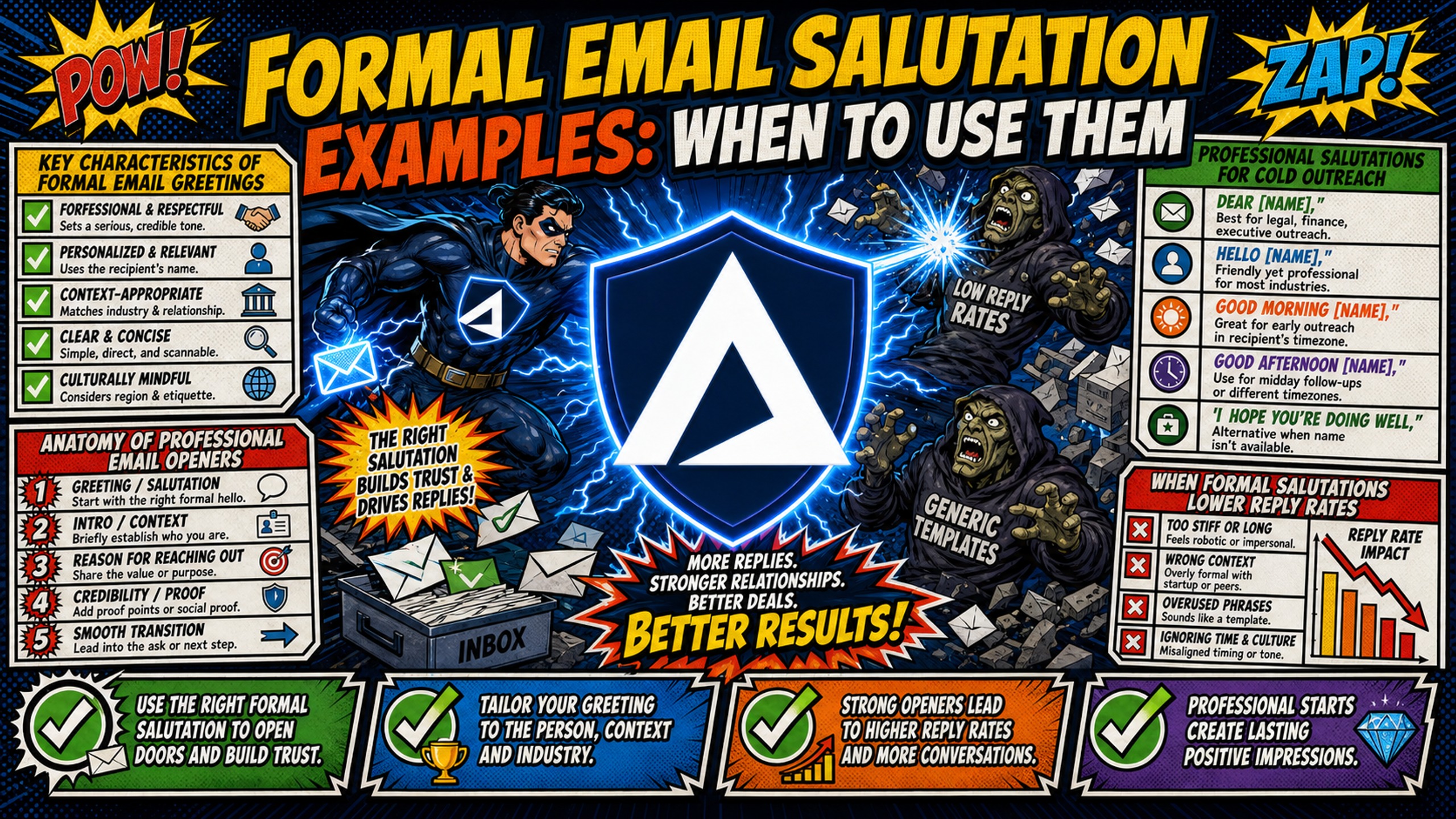
TL;DR: Formal email salutation examples include "Dear [Name]," "Hello [Name]," and "Good morning [Name]." Use "Dear" for legal, finance, and executive outreach where formality signals respect. Use "Hi" for tech and SaaS verticals where casual converts better. The safest default for unknown recipients is "Hello [Name]." Salutation choice affects reply rates less than sender reputation, SPF/DKIM/DMARC alignment, and list quality. Test greetings as variables, but fix your infrastructure first.
Most cold email advice says "Dear" is dead. The data says otherwise, depending on who you're emailing.
Campaign managers waste hours debating "Dear" vs. "Hi" when the real reply-rate killer is sitting in their DNS settings. Formal salutations don't trigger spam filters. Misaligned SPF records do.
A "Dear [Name]" opener won't save a campaign sent from a domain without proper authentication, and a casual "Hey" won't hurt a campaign with dedicated IPs and clean sender reputation. The greeting is a testing variable. The infrastructure is a deliverability requirement, and testing salutations only matters when the infrastructure protects inbox placement first.
This business email salutation guide provides copy-ready formal email salutation examples, a decision matrix for when to use formal email salutations, and A/B testing frameworks so you can choose greetings faster and focus on the variables that actually protect inbox placement.
Key characteristics of formal email greetings
Salutations can signal the level of formality in a business email. “Dear [Title] [Last Name]” is generally more formal than “Hi [First Name].” Grammarly's punctuation guide notes that a colon is the most formal punctuation mark for ending a business-email salutation, for example, “Dear Mrs. Johnson:”, while a comma may be appropriate in a more casual relationship.
"Dear [Name]" is professional but personal, showing respect while addressing the recipient directly. "Hey" is friendly and casual, perfect for someone you know. "Hi [First Name]" is the middle ground between formal and casual.
The salutation "Dear" in combination with a name or a title is by far the most commonly used greeting in both British and US English, in both formal and informal correspondence.
Anatomy of professional email openers
A professional email opener has three components: the salutation word, the recipient's name or title, and punctuation.
Salutation word: "Dear," "Hello," "Hi," "Good morning," or "Greetings."
Name or title: First name only for informal contexts, title plus last name for formal outreach, full name when gender or preferred title is unclear.
Punctuation: In American English style, use a colon after formal salutations ("Dear Dr. Smith:") and a comma after casual greetings ("Hi Sarah,"). British English style uses a comma after both formal and informal greetings.
Example formal opener: "Dear Dr. Smith:"
Example informal opener: "Hi Sarah,"
Example neutral opener: "Hello Alex,"
The salutation reaches the inbox only when the sending domain passes SPF, DKIM, and DMARC authentication checks, which Inframail automates during domain provisioning.
Professional salutations for cold outreach
Copy-ready formal email salutation examples for cold outreach:
- "Dear [First Name] [Last Name]:" Use when you know the full name but not the preferred title. Example: "Dear Sarah Johnson:"
- "Dear Mr./Ms. [Last Name]:" Use for legal and finance recipients when you're confident of the recipient's preferred title. Example: "Dear Ms. Patel:"
- "Hello [First Name]," Neutral middle ground. Works across industries when you're unsure of formality expectations.
- "Good morning [First Name]," Use only when you're certain the recipient will read the email in their morning. Avoid in automated sequences across time zones.
- "Dear [Department] Team:" Use when the name is unknown but the department is clear. Example: "Dear Human Resources Team:"
When formal salutations lower reply rates
Over-formalization makes cold emails sound like templates or bots. "Dear Valued Customer" feels impersonal because it signals the sender made no effort to find a name. If you know they're a customer, you know their name.
Generic openers like "To Whom It May Concern" are associated with lower engagement, and that pattern can train inbox providers to route future sends away from the primary inbox.
In B2B tech and SaaS, casual and direct greetings ("Hi," "Hey") outperform formal greetings ("Dear Mr./Mrs."), according to Instantly's email greeting benchmarks for 2026 industry standards.
High-converting formal salutations for cold outreach
The right formal salutation depends on recipient role, industry norms, and sequence stage. Below are copy-ready examples with decision rules, drawn from reply-rate benchmarks across legal, finance, tech, and SaaS verticals.
Using 'Dear [Name]' in cold outreach
"Dear [Name]" remains appropriate in legal, finance, and executive outreach. In enterprise finance or legal verticals, formal greetings may still be expected, per Instantly's greeting benchmarks.
Use "Dear" when:
- The recipient holds a C-suite or VP title in a traditional industry (banking, law, insurance).
- The company website and LinkedIn presence use formal language.
- You're sending a first-touch email to a recipient in a conservative vertical.
Avoid "Dear" when:
- The recipient works at a startup or tech company with a casual brand voice.
- You're following up in an active thread where prior messages used "Hi."
- The recipient's LinkedIn posts and comments use casual language.
Using time-based greetings in emails
"Good morning" and "Good afternoon" work when you control send timing and know the recipient will read the message at that time of day. Time-based greetings such as "Good morning" can feel off if the message gets opened in a different time zone or much later than expected, per LaGrowthMachine's salutations guide.
Avoid time-based greetings in automated sequences that send across multiple time zones. A "Good morning" email that arrives at 9 PM recipient time reads as automated. If you do not know when your reader will read your email, choose a time-neutral salutation like "Dear," "Hello," or "Hi."
Stop using 'To Whom It May Concern'
"To Whom It May Concern" kills reply rates in 2026. It's considered somewhat old-fashioned and impersonal. Using this salutation suggests you're sending a mass email or couldn't be bothered to learn anything about the recipient, according to Scribbr's to whom it may concern guide.
Finding a first name, last name, and role takes seconds with a decent email finder, so a nameless greeting reads as laziness rather than caution.
Addressing leads without known names
The best alternative to "To Whom It May Concern" is to write to a specific person where possible. When a specific name cannot be found, use a job title or department name to make your salutation more personal.
Alternatives for unknown recipients:
- "Dear Hiring Manager:" For recruitment and HR outreach.
- "Dear [Department] Team:" For company-wide or department-specific emails. Example: "Dear Human Resources Department:" or "Good morning, Accounts Payable Team," per Mail.com's email greetings guide.
- "Hello," Simple and neutral when no name or role is available.
Using Dr. and Professor in emails
If you know the recipient personally and their preferred title, use it: "Dear Dr. Martinez" or "Dear Professor Chen." If you are unsure of gender, marital status, or professional title, use the full name without a title: "Dear Jordan Smith:" per Simply Noted's salutation examples guide.
Once they sign their reply with their first name, switch to "Dear [First Name]" or "Hi [First Name]" in subsequent exchanges.
Which greeting converts? Testing Dear vs Hi
Salutation choice is a testing variable, not a universal rule. Frame "Dear vs Hi in email" as an A/B test, not a debate.
Which salutation drives more replies?
Research from Boomerang's analysis of 300,000+ email threads found that among opened messages, those starting with casual salutations like "Hey" (64% response rate) or "Hi" (63% response rate) earned roughly 35% higher response rates than those without salutations (48% baseline), per Lagrowthmachine's salutations data.
The average cold email reply rate in 2026 is 3.43% per Instantly, down from 5% in 2025, per GrowthEngineer.
Test these hypotheses in your campaigns:
- Hypothesis 1: "Hi [Name]" will outperform "Dear [Name]" in tech and SaaS verticals by 15-20% reply rate.
- Hypothesis 2: "Dear Mr./Ms. [Last Name]" will outperform "Hi [First Name]" in legal and finance verticals by 10-15% reply rate.
- Hypothesis 3: "Hello [Name]" will perform within 5% of the winner in both verticals, making it the safest default.
Reply rate by industry vertical
Reply rates reach up to 10% in legal services and vary by ICP fit, send volume, and follow-up count, not industry alone, per Growthengineer's cold email reply rate benchmarks.
| Vertical | Reply Rate | Recommended Salutation | Context |
|---|---|---|---|
| Legal Services | 6-10% | "Hi [First Name]" | Highest cold email reply rates in 2026 |
| Financial Services | 2-3% broad, 4.5-8% segmented | "Dear [Name]" for executives | Well-segmented CFO campaigns reach 7-9% |
| SaaS-to-SaaS | 2.4% | "Hi [First Name]" | Inbox saturation drives low baseline |
| IT Services | 3.5% | "Hi [First Name]" | High volume of outbound messages daily |
| Recruitment | 6-8% | "Hi [First Name]" | Natural contextual relevance |
Legal services leads with a 10% response rate, while IT services lags at 3.5%, per Cleverly's industry benchmarks. For financial services, well-segmented campaigns targeting CFOs or finance directors on specific regulatory pain points can reach 4.5-8% reply rates, according to Leadriver's fintech cold email benchmarks.
Inframail automates SPF/DKIM/DMARC configuration so campaign managers can test salutation variables without worrying whether authentication is breaking deliverability. The platform provisions domains with zero manual DNS panel work and monitors blacklist status across dedicated US-based IPs (1 IP on Unlimited Plan, 3 IPs on Agency Pack).
At $147/month for unlimited inboxes on the Unlimited Plan versus $420/month for 50 inboxes on Google Workspace Business Starter Flexible Plan ($8.40 per seat), the flat-rate model protects margin while you test whether "Dear" or "Hi" converts better in your vertical. Higher-volume agencies can step up to the Agency Pack at $387/month. Domain costs ($5 to $16 per domain per year) and warmup tools (typically $15 to $50 per inbox per month) apply on both sides and are not included in this comparison.
When to use formal email greetings
Use formal email greetings when:
- The recipient holds a C-suite, VP, or Director title in legal, finance, insurance, or government.
- The company website uses formal language and stock photography of people in suits.
- You're sending a first-touch email and have no prior relationship or thread history.
- The recipient is based in the UK, Germany, Japan, or other regions with higher formality expectations. British business emails often favor a more formal, polite, and indirect style, while American business emails tend to be more direct, concise, and informal-friendly, according to Oki’s business email comparison of UK and US business-email etiquette. These are general tendencies rather than universal rules.
Use informal greetings when:
- The recipient works at a startup, tech company, or creative agency.
- You're following up in an active thread.
- The recipient's LinkedIn presence is casual and conversational.
- The recipient is a Millennial or Gen Z professional in a non-traditional industry.
Best practices for email salutations in cold outreach
This quick-start checklist helps campaign managers choose salutations faster without overthinking.
Best practices for cold outreach sequences
Initial email (Day 0): Use "Hi [Name]" for tech and SaaS, "Dear [Name]" for legal and finance, "Hello [Name]" when unsure.
First follow-up (Day 2-3): Reply in the same thread 2 to 3 business days after the initial email, per Overloop's follow-up guide. Keep the message under 100 words, reference the original context in one line, and ask one clear question.
Second follow-up (Day 5-7): Wait 4 to 5 days, then send a brief check-in maintaining the same tone as the first follow-up.
Breakup email (Day 10-14): Use a friendly, no-pressure tone to close the open loop without guilting the recipient.
In follow-ups within the same thread, the salutation can be dropped or simplified. After two or three emails have gone back and forth on the same email string, drop the salutation entirely and reply directly. Read Inframail's guide on how to follow-up on a cold email to learn more.
Formal email salutation best practices
Don't misspell names. If you are using a person's name in your salutation, always make sure you have spelled it correctly. Misspelling a name is not the type of error to make when building relationships or making a positive first impression, per Net Manners.
Don't use wrong titles. "Dear Mr. Sarah Johnson" reveals you didn't check whether Sarah uses Mr., Ms., or another title. When uncertain, use the full name: "Dear Sarah Johnson."
Don't mix punctuation and tone. "Hey Dr. Martinez" mixes casual salutation with formal title. Pick a formality level and stay consistent throughout the greeting.
Don't use generic greetings. Steer clear of "To Whom It May Concern" or "Dear Sir/Madam." These don't signal respect, they signal you didn't bother finding out who you're writing to, per Prospeo.
Best practices for global email etiquette
Match the formality level of the recipient's region. US and Canadian recipients expect direct, friendly greetings ("Hi [Name]"). UK recipients expect slightly more formality ("Dear [Name]").
APAC recipients expect titles and honorifics. Different cultures have varying levels of formality, so research the appropriate level for the specific culture, per Business Email Etiquette.
For Japanese business correspondence, use the recipient's family name with the honorific "sama" (様) in formal emails. "Tanaka-sama" is the appropriate formal address, while "Tanaka-san" is common among colleagues of equal rank. Default to "Hello [Name]" when sending to international recipients and you're unsure of regional norms.
When informal salutations win: tech, SaaS, and active threads
The sections below explain when casual greetings like "Hi" and "Hey" work best in tech, SaaS, and startup outreach.
Informal greetings for tech leads
"Hi [First Name]" is the default for tech and SaaS outreach. It's friendly without being unprofessional, and it matches the conversational tone most tech companies use in their own communications.
Using casual greetings for outreach
"Hey" is friendly and casual, best for someone you know. For cold outreach, "Hey" can work in creative industries and startup environments, but "Hi" is safer for first-touch emails.
Avoid "Hey" in legal, finance, and executive outreach where it reads as too casual for the relationship stage.
Selecting salutations that boost reply rates
Salutation choice matters for reply rates, and personalizing your greeting lifts response, but infrastructure determines whether the email reaches the inbox at all.
TrulyInbox's deliverability guide reports 85-95% inbox placement for domains with SPF, DKIM, and enforced DMARC, compared with substantially lower placement for domains lacking authentication. The source summarizes the difference as 2.7x, but does not provide enough methodology to independently verify that multiplier.
Inframail automates this authentication during domain provisioning, so campaign managers can focus on testing salutation variables rather than troubleshooting DNS records.
For 50 inboxes, Google Workspace Business Starter costs $420/month on the Flexible Plan ($8.40 per seat). Inframail's Unlimited Plan costs $147/month flat regardless of inbox count, saving $273/month in platform fees alone before adding domain costs ($5 to $16 per domain per year) and warmup tools (typically $15 to $50 per inbox per month) that apply on both sides.
Adapting salutations for executive roles
C-suite outreach requires formality that signals respect without creating distance. Use "Dear [Title] [Last Name]" for first-touch emails to CEOs, CFOs, and Managing Directors in traditional industries.
Once the executive replies and signs with their first name, switch to "Hi [First Name]" in subsequent exchanges to match their tone.
Matching salutations to company style
Match the prospect's tone. If their website, LinkedIn posts, and email signatures use casual language, mirror that with "Hi [Name]." If they use formal language and titles, mirror that with "Dear [Title] [Last Name]."
Opening with a formal "Dear Mr. Smith" and then switching to a casual tone in the body feels off to the recipient, per SiteGround Academy's email salutations guide.
Campaign objective and ask size
Small asks (quick question, feedback request) pair well with casual greetings. Large asks (demo request, meeting booking, partnership proposal) pair better with formal greetings that signal seriousness.
Get your infrastructure right before testing salutations
Inframail is a flat-rate Microsoft email infrastructure provider built for agencies and SDR teams running 50 to 200 cold email domains. It automates SPF, DKIM, and DMARC configuration during domain provisioning, provides dedicated US-based IPs (1 IP on the Unlimited Plan, 3 IPs on the Agency Pack), and monitors blacklist status with a 68.3% delisting success rate within 48 hours.
Domains sent through Inframail reach a 98%+ deliverability rate. The Unlimited Plan costs $147/month flat regardless of inbox count. The Agency Pack costs $387/month. Domain costs ($5 to $16 per domain per year) and warmup tools apply on both sides and are not included in these figures.
Watch this case study video and see how Inframail helped support $42,000 in new sales over four weeks, with cold email infrastructure the client had relied on for more than a year without issues.
Sign up to Inframail and get started today.
FAQs
Is "Dear" too formal for cold email in 2026?
No. "Dear [Name]" remains appropriate in legal, finance, and executive outreach, where formality signals respect and matches recipient expectations. In tech and SaaS, "Hi [Name]" performs better.
Should I use a comma or colon after the salutation?
In American style, use a colon after formal salutations ("Dear Dr. Smith:") and a comma after casual ones ("Hi Sarah,"). British style uses a comma after both.
What if I don't know the recipient's name?
Use a job title or department name: "Dear Hiring Manager," or "Dear [Department] Team." Avoid "To Whom It May Concern" as it reads as impersonal and outdated.
Do formal salutations improve deliverability?
Not directly. Salutation choice does not trigger spam filters, but it does affect deliverability indirectly through engagement signals. SPF/DKIM/DMARC alignment, sender reputation, and list quality all affect inbox placement. Inframail automates authentication and provides dedicated IP infrastructure, while list quality remains the sender's responsibility.
However, salutation choice affects recipient engagement (opens, clicks, replies), and low engagement signals train inbox providers to route future sends away from primary inboxes. Generic greetings like "Dear Valued Customer" reduce personalization and can indirectly harm deliverability by lowering engagement rates.
How do I test salutations in my campaigns?
Run A/B tests with at least 1,000 sends per variant to reach statistical significance. Test one variable at a time (salutation only, not subject line plus salutation). Measure reply rate, not open rate, as the primary metric.
Key terms glossary
Salutation: The greeting phrase at the start of an email. Examples include "Dear," "Hi," "Hello," and "Good morning."
Reply rate: The percentage of delivered emails that receive a human response. Calculated as (replies / delivered emails) x 100, where delivered = sent minus hard bounces.
Inbox placement rate: The percentage of delivered emails that land in the recipient's primary inbox rather than spam or promotions folders. Calculated as (emails reaching inbox / total delivered) × 100.
Sender reputation: A score assigned by email service providers based on sending behavior, authentication, and recipient engagement. Higher scores improve inbox placement.
SPF/DKIM/DMARC: Email authentication protocols that verify sender identity and prevent spoofing. SPF specifies authorized sending servers, DKIM adds a digital signature, and DMARC enforces alignment between the two.
Dedicated IP: An IP address used exclusively by one sender, isolating sender reputation from other users. Inframail provides 1 dedicated US IP on the Unlimited Plan and 3 IPs on the Agency Pack. Contrast with shared IP pools where multiple senders use the same IP.
Sequence: A series of automated emails sent on a schedule. Typically includes an initial email, 2-3 follow-ups, and a breakup email.
Warmup: The process of gradually increasing send volume from a new inbox or domain to build sender reputation before launching full campaigns.