
When to hire SDRs instead of doing founder-led sales
Hire your first SDR when three conditions align: your demo-to-close rate is stable at 30% or higher, your sales process is documented in a playbook another pers
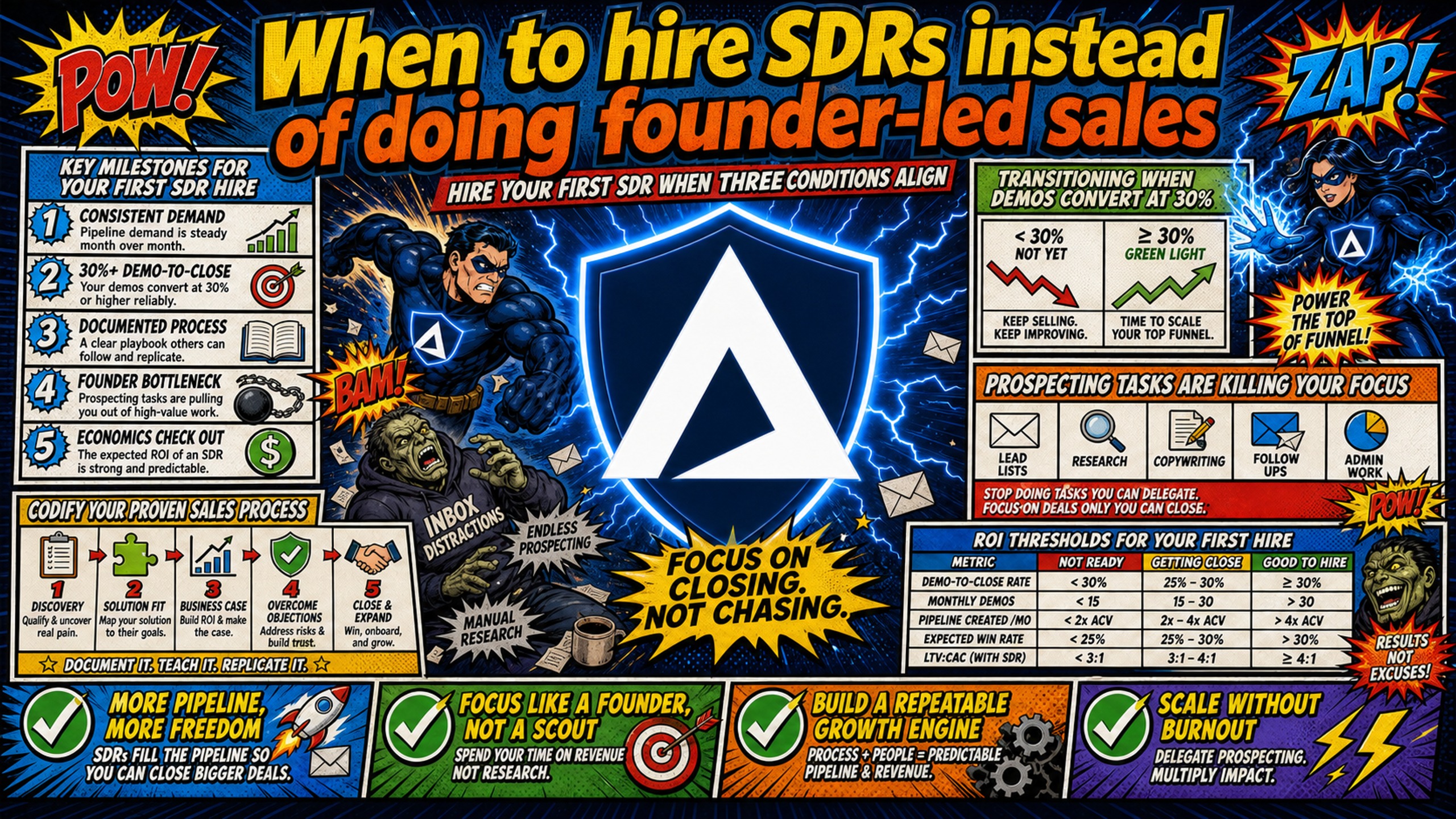
TL;DR: Hire your first SDR when three conditions align: your demo-to-close rate is stable at 30% or higher, your sales process is documented in a playbook another person could execute, and sales tasks take 30% to 40% of your week. Revenue is not the trigger. The first hire costs $50,000 to $68,000 in base salary ($76,000 to $97,000 OTE depending on company stage) plus a 90-day ramp, with first-year costs of $96,000 to $130,000. Hold off if you lack product-market fit, if enterprise deals dominate your pipeline, or if you have under 12 months of runway. Set up dedicated sending domains before the hire starts so outbound volume never touches your primary domain reputation.
A first SDR hire costs $50,000 to $68,000 in base salary before booking a single qualified meeting, and the standard 90-day ramp period often stretches to four months. Most founders make that investment without a documented sales process, which means the SDR spends the first month figuring out what the founder has been doing instinctively, and the second month doing it badly.
The question of when to hire SDRs does not have a revenue answer. A founder at $500k ARR with a documented playbook and consistent demo flow is ready. A founder at $5M ARR still discovering objections on every call is not. The distinction matters because hiring too early burns cash and founder focus, while hiring too late stalls growth on a product that should be scaling.
Key Milestones for Your First SDR Hire
Readiness for a first SDR hire in SaaS comes down to three measurable signals: demo conversion stability, founder time allocation, and process documentation. When all three are true, the hire has a high probability of paying for itself within six months. When any one is missing, the risk of a failed hire jumps significantly.
Transitioning When Demos Convert at 30%
A healthy demo-to-close rate for early-stage B2B SaaS sits between 15% and 30%, with 30% or higher signaling a repeatable close process. The specific threshold matters less than the stability. If the demo-to-close rate fluctuates wildly from month to month, the founder has not yet codified what works, and an SDR cannot feed a process that changes weekly.
Before hiring, confirm three things: a consistent lead source that generates demos without founder heroics, a documented sales script the founder follows on every call, and baseline conversion metrics tracked long enough to show a stable trend. These are the inputs an SDR needs to replicate founder-level results at scale.
Prospecting Tasks Are Killing Your Focus
If prospecting, follow-ups, and demo scheduling consume 30% to 40% or more of your week, you are doing SDR work at founder rates. The opportunity cost is not abstract: every hour spent on sequence management is an hour not spent on product decisions, investor relations, or strategic partnerships.
Track your time for two weeks. If sales tasks account for 30% to 40% or more of your week, you have a measurable case for the hire. The average SDR OTE sits between $76,000 and $97,000 depending on company stage.
Codify Your Proven Sales Process
A documented playbook is the SDR's operating manual. Without one, the first hire spends their first 30 days reverse-engineering what the founder does naturally, and the results will not match. The playbook must cover lead source definition, ICP qualification criteria, outreach sequences, demo scripts, objection responses, and handoff criteria.
As one hiring framework from Talent Bridge puts it, the first SDR should execute a motion, not invent one. If the playbook does not exist, the hire is premature regardless of how busy the founder feels.
ROI Thresholds for Your First Hire
The first SDR hire costs $50,000 to $68,000 in base salary, plus variable compensation, benefits, and tools. Total first-year cost typically runs $96,000 to $130,000 when you include the tool stack and ramp time. With a 90-day ramp period, the SDR must book enough qualified demos once ramped to cover that investment. Payback periods, measured as cost recovered through pipeline value, typically run 4 to 6 months, and quarter two often delivers 1 to 2 times the loaded cost in qualified pipeline for a properly timed hire.
The math below is a revenue-equivalent illustration, not a true break-even or payback calculation, because it compares expected revenue directly with cost. If your average deal size is $25,000 and your demo-to-close rate is 25%, each qualified demo carries $6,250 in expected revenue, so the $96,000 to $130,000 first-year cost equals 16 to 21 qualified demos across the full first year, or roughly 1.3 to 1.8 per month. A ramped SDR's capacity is a separate, monthly figure, with an industry benchmark of 12 to 15 meetings per month, so the annual requirement equals roughly one to two months of ramped output. A true payback calculation would use gross margin, collection timing, and only the incremental revenue the SDR generated, so treat this figure as a sizing guide and not a return forecast.
When to Keep Founder Sales In-House
Not every startup should hire an SDR, even when the founder feels stretched. Four situations argue against the hire, and recognizing them saves more money than any negotiation tactic.
Do Not Hire SDRs Without Market Fit
If you are still discovering your ideal customer profile, an SDR cannot fix that. Product-market fit means consistent inbound interest, repeatable use cases, and customers who renew and refer. Without those signals, outbound prospecting amplifies a message that has not yet found its audience.
Some founders hire SDRs specifically to help discover the ICP. This can work, but it is expensive market research at $80,000+ per year. For most startups, the founder should own ICP discovery directly until the pattern is clear enough to document.
Managing High-Touch Enterprise Deals
Enterprise deals with six- or seven-figure contract values, buying committees with multiple stakeholders, and sales cycles of 6 to 24 months are founder territory. An SDR can support prospecting into these accounts, but the founder should own the relationship until the close process is documented well enough for someone else to follow.
The risk is not that the SDR will lose a deal. The risk is that the SDR will book demos with enterprise prospects and the founder will still be pulled into much of the selling, because enterprise deals involve many stakeholders and long cycles that demand founder-level attention through every stage. Enterprise deals typically take six months to two years to close.
Mastering Objections Before Scaling Sales
If you still hear new objections on every call, the playbook is not ready. An SDR hitting the same objections without the founder's context will either improvise (badly) or stall. Document every objection and the response that works before asking someone else to handle them at volume.
SDR Hiring Triggers for Short Runways
For startups with under 12 months of runway, a failed SDR hire is existential. The conservative trigger: only hire when the pipeline is already full and the founder is the bottleneck, not when the pipeline is empty and the founder hopes an SDR will fill it. An SDR amplifies a working process. It does not create one from nothing.
Calculating the ROI of Your First SDR Hire
The ROI calculation for a first SDR hire extends beyond salary. The full cost includes benefits, tool stack, management time, and the opportunity cost of founder attention during the ramp period. Understanding the complete picture prevents the most common budgeting mistake: underestimating total cost by 40% or more.
Hidden Costs of Scaling Sales Too Fast
The line-item breakdown for a first SDR hire includes several categories most founders miss:
| Cost Category | Monthly Estimate | Annual Estimate |
|---|---|---|
| Base salary | $4,167-$5,667 | $50,000-$68,000 |
| Variable compensation | $2,167-$2,417 | $26,000-$29,000 |
| Benefits and taxes | $1,200-$1,800 | $14,400-$21,600 |
| Tool stack (CRM, sequencer, data, warmup) | $300-$600 | $3,600-$7,200 |
| Sending infrastructure (Inframail platform fee, Unlimited Plan to Agency Pack, before domain costs) | $147-$387 | $1,764-$4,644 |
| Total | $7,981-$10,871 | $95,764-$130,444 |
The salary figures come from Stealth Agents' 2026 SDR hiring cost research, with variable compensation set as the gap between the $50,000 to $68,000 base and the $76,000 to $97,000 OTE range. The infrastructure line uses Inframail's flat-rate model, which is covered in detail below. The tool stack includes a CRM ($25-$100/month), a sequencing platform like Instantly or Smartlead ($37-$358+/month depending on tier), a data provider like Apollo ($49-$149/month per user depending on plan and billing cycle), and an external warmup tool ($15-$50/month per inbox).
A bad hire compounds these costs. SHRM figures, as reported by CRB Workforce, put replacement costs at 50% to 250% of salary, which for an SDR on $80,000 OTE means a $40,000 to $200,000 mistake when you account for recruiting, ramp time, lost productivity, and the second hiring cycle.
Scaling Sales Without Burning Yourself Out
Founder-led sales is not sustainable past a certain volume. The founder who spends 60% of their week on prospecting, follow-ups, and demo scheduling is not spending that time on product, strategy, or fundraising. The SDR hire is an investment in founder longevity as much as pipeline growth.
According to one Series B hiring guide, founder-led prospecting stops scaling past Series B. For a startup where founder time is the scarcest resource, the real question is whether the company can afford not to make the hire once the process is ready.
Signs It Is Time to Hire SDRs
The readiness signals are measurable, not emotional. Use this assessment to self-evaluate in under a minute:
| Dimension | Founder-Led (Not Ready) | SDR-Ready |
|---|---|---|
| Demo conversion | Demo-to-close rate fluctuates from month to month or sits below 30% | Demo-to-close rate stable at 30% or higher |
| Process documentation | Founder improvises on each call and lead flow depends on founder effort | Documented playbook with script, proven objection responses, and a repeatable lead source |
| Time availability | Founder handles everything | Founder spends 30-40%+ of week on sales tasks |
As a rule of thumb, all three dimensions must fall in the SDR-Ready column before the timing signal is strong. If any one does not, the hire is at higher risk of underperforming, because conversion data, the playbook, or founder time may not yet support a new rep. Tools and sending infrastructure are preparation work for the checklist below, not readiness signals.
Ready to Hire? Checklist for Your First SDR
Once the readiness signals align, the preparation work determines whether the hire succeeds. Three deliverables must exist before the SDR's first day: a playbook, a tool stack, and defined benchmarks.
Drafting Your First Sales Playbook
The playbook is the SDR's operating manual. Without one, the hire starts from zero. Cover these elements:
- ICP definition: Industry, company size, title, pain points, and disqualifying criteria.
- Lead source: Where prospects come from (outbound lists, inbound triage, event follow-up).
- Qualification questions: The five to seven questions that determine whether a prospect is worth a demo.
- Outreach sequence: The exact email and call cadence, including tested opener frameworks and follow-up timing.
- Demo script: A written outline of how the founder runs a demo, so the SDR knows what prospects will see after handoff.
- Objection responses: Every objection heard in the last 90 days, with the response that works.
- Handoff criteria: When the SDR passes a prospect to the founder or AE for closing.
Building this document takes 40 to 60 hours of focused founder time, and a comprehensive playbook can take 40 to 80 hours. It is the highest-impact preparation work a founder can do before making the hire.
Ready Your Systems for SDR Hires
The tool stack for a first SDR includes five components: a CRM for pipeline tracking, a sequencing platform for outbound automation, a data provider for prospect lists, an external warmup tool, and dedicated sending infrastructure.
The sending infrastructure piece is where most first-time SDR hires go wrong. Using the founder's domain or a shared IP for SDR outbound creates a sender reputation risk that can blacklist the domain carrying your entire pipeline. A single bad sequence from an untrained SDR can damage deliverability for every email your company sends.
Inframail provisions dedicated sending domains on Microsoft infrastructure with automated SPF, DKIM, and DMARC configuration, eliminating an estimated 15 minutes to 2 hours of manual DNS panel work that initial setup of secondary domains normally requires, while DNS propagation typically adds 1 to 4 hours before domains work. The platform charges a flat $147/month for unlimited inboxes on the Unlimited Plan, which includes one dedicated US-based IP, so SDR sending reputation stays isolated from both the founder's domain and from other users.
For a startup adding its first SDR, this means spinning up two to three dedicated secondary domains with clean sender reputations, separate from the primary brand domain, in minutes instead of hours. The DNS record configuration (SPF, DKIM, DMARC) happens automatically, and IMAP/SMTP credentials export to CSV for direct import into Instantly or Smartlead.
One Trustpilot reviewer described the setup experience: "Their platform did in 10 minutes what would've taken me days to figure out. Maybe weeks."
"Inframail changed the game. Period... We're saving cash and more importantly, we're saving time." - Verified user review of Inframail
The tradeoff is transparent: Inframail does not include built-in warmup, so an external tool like Warmbox or Lemwarm ($15 to $50 per inbox per month) is still required. Factor that into the total cost of ownership alongside domain costs of $5 to $16 per year each.
Define Benchmarks for SDR Success
Set clear numbers before the SDR starts. The common benchmark for a ramped SDR is 12 to 15 qualified meetings per month, with top performers reaching 18 to 25. Define qualified demos booked per week, show rate, conversion to opportunity, and time to first meeting. These benchmarks make the 90-day review objective instead of subjective.
Plan for SDR Success in 90 Days
The first 90 days are an investment period, not a profit period. Communicate this to both the founder and the SDR before day one. The ramp plan below provides the month-by-month framework.
Ramping SDRs: A 90 Day Blueprint for Founders
The 90-day blueprint prevents the two most common ramp failures: expecting full quota in month one, and never transitioning prospecting responsibility away from the founder. Each month has defined milestones and clear handoff points.
Month 1: SDR Onboarding and Setup
The first month covers product training, call shadowing, playbook study, and tool setup. Dedicated sending infrastructure should already be provisioned before day one, and the SDR should not send a single outbound email until those domains are warmed.
| Week | Focus | Milestone |
|---|---|---|
| Week 1 | Product immersion covering features, benefits, and value propositions, plus ICP training and competitive positioning | Explain the product's value proposition and the ICP to the founder in the SDR's own words |
| Week 2 | Shadow founder demos, study the playbook, learn objection handling | Handle the playbook's top objections in a role-play with the founder |
| Week 3 | Finish tool setup (CRM and sequencer setup can start in Weeks 1 to 2), connect the sequencer to the sending domains provisioned before day one, configure sequences, begin list building | Sequencer connected to dedicated domains that have been warming since before day one, so supervised outreach can begin in Week 4 |
| Week 4 | Begin supervised calls and low-volume email outreach, with founder review of every message | Founder-approved sequences live on warmed dedicated domain |
The infrastructure setup before day one is critical. SPF, DKIM, and DMARC records must be configured on every sending domain before the SDR's first day, so warmup can run through Weeks 1 to 3. Warmup must run for at least two weeks before ramping to full send volume.
Month 2: Measuring First Meeting Conversions
The first meaningful metric is meetings booked, but quality matters more than quantity in month one. Track show rate (percentage of booked meetings that actually happen) and qualification rate (percentage of held meetings that meet ICP criteria). A show rate above 70% and a qualification rate above 50% indicate the SDR is targeting the right prospects.
Month 3: Scaling SDR Performance Targets
By month three, the SDR should approach full quota. The industry benchmark for ramped SDRs is 12 to 15 qualified meetings per month. Set a ramp-adjusted target: month two at half quota, month three at full quota.
Teams running a documented 30-60-90 program typically reach productivity in 60 to 90 days with a structured program, and top-performing teams close the gap at the faster end of that range. Most SDRs without that structure need three to six months to hit full quota. The playbook and benchmark work done before the hire directly compresses the ramp timeline.
Phase Out Founder Sales by Month Three
The handoff plan is the point of the entire exercise. The founder should stop doing outbound prospecting once closing, hiring, or running the business starts competing for the same hours, and once the SDR has ramped enough to take over. For many teams that lands around month three, but the timing depends on SDR ramp progress and founder capacity. The SDR owns top-of-funnel: list building, sequence management, initial qualification, and demo booking. The founder owns demos, closes, and high-touch enterprise relationships.
This transition requires discipline. The founder who keeps "helping" with prospecting undermines the SDR's ownership and never reclaims their time. Set a hard date, communicate it to the SDR, and hold the boundary.
4 Mistakes That Derail Early SDR Hires
The failure modes for a first SDR hire are predictable and preventable. Four mistakes account for most early failures.
Hiring for Experience Over Coachability
An SDR with three years of experience at a large company brings habits from a different playbook, a different ICP, and a different sales motion. For the first hire at a startup, coachability matters more than resume. The SDR needs to learn your process, not unlearn someone else's.
Look for candidates who ask sharp questions about your ICP and objection handling during the interview. Those questions signal someone who will absorb your playbook instead of defaulting to a previous employer's approach.
Risks of Bypassing SDR Pilot Programs
A pilot program, whether structured as contract-to-hire or a formal 90-day trial period, reduces the cost of a bad hire. For an SDR on $80,000 OTE, direct costs alone (recruiting fees, onboarding, management time, and exit and replacement search) land between $80,000 and $150,000, and a bad SDR or AE hire can run $150,000 to $400,000 all-in once ramp time, management time, and lost pipeline are counted. Skipping the pilot means committing to a full-time salary before proving the SDR can perform.
The alternative to an internal hire is an outsourced SDR agency, which deploys in days to a couple of weeks but lacks product context and retains knowledge with the vendor after the engagement ends. The tradeoff is speed versus quality: outsourced teams start fast but cannot compound internal knowledge the way an internal hire does.
| Dimension | Internal SDR | Outsourced Agency |
|---|---|---|
| Deployment speed | 90-120 days recruiting plus 60-90 days ramp | Days to first outreach |
| Product context | Deep, compounds over time | Shallow, leaves with vendor |
| Cost | $96,000-$130,000 first year | $3,000-$8,000/month retainer |
| Knowledge retention | Stays in-house | Stays with vendor |
Standardizing the Transition to SDRs
The handoff from founder to SDR must follow a documented process, not ad hoc conversations. When the transition is standardized, the SDR follows the playbook from day one and the founder can measure performance against benchmarks instead of gut feel. Uplift GTM recommends building the playbook first by running outbound yourself or with one founder-led SDR before hiring a dedicated team.
Setting Realistic Early SDR Targets
Unrealistic targets demoralize the SDR and distort the data. A new SDR measured against the founder's historical numbers will look like a failure even when performing well against industry benchmarks. Set ramp-adjusted targets: month one is learning, month two is half quota, month three is full quota. Measure against the ramp plan, not against the founder's peak performance.
The infrastructure piece deserves one final note before moving to FAQs. An SDR without dedicated sending domains puts the founder's domain reputation at risk on every sequence. A single blacklisting event can hurt deliverability, and recovery takes weeks of reduced sending volume. Inframail's dedicated IP model (1 IP on Unlimited, 3 on Agency Pack) isolates SDR sending from both the founder's domain and from other users on shared pools, with 98%+ deliverability and 68.3% blacklist delisting success within 48 hours reported by the platform.
Set Up Dedicated SDR Sending Infrastructure with Inframail
Inframail is a flat-rate Microsoft email infrastructure provider for teams running cold outbound. It provisions dedicated sending domains with automated SPF, DKIM, and DMARC configuration, and includes dedicated US-based IP infrastructure (1 IP on the Unlimited Plan, 3 on the Agency Pack). The Unlimited Plan costs $147/month flat, before warmup tools and domain costs, and the platform reports 98%+ deliverability and 68.3% blacklist delisting success within 48 hours.
In this case study video, watch how Inframail helped a client build a cold email outbound system at 10 times lower cost, scale to 80 domains and over 400 email accounts, achieve 90%+ open rates, and generate 20–30 leads and over $20,000 in new revenue within the first 30 days.
Sign up to Inframail and provision dedicated SDR sending infrastructure before your first hire starts, so the SDR's outbound volume never touches your primary domain reputation.
FAQs
When Should a SaaS Startup Hire Its First SDR?
Hire when demo conversion is stable at 30% or higher, the sales process is documented in a playbook another person could execute, and sales tasks take 30% to 40% of the founder's time. Revenue is not the trigger.
How Much Should I Pay a First SDR Hire?
Base salary typically ranges from $50,000 to $68,000 depending on market and experience, with average OTE between $76,000 and $97,000 depending on company stage. That is the range used in this article's cost model. Other sources report lower figures, as SyncGTM puts first-SDR OTE at $60,000 to $75,000 and mid-level SDRs (1 to 3 years of experience) at $75,000 to $95,000. Total first-year cost including tools, benefits, and ramp time typically falls between $96,000 and $130,000.
Should I Hire an SDR or AE First?
Hire an SDR first if the founder can still close demos effectively. Hire an AE first if the founder is the bottleneck on closing, not on prospecting.
How Long Does It Take an SDR to Ramp?
SDR ramp time averages three to six months, with a median of 3.1 to 3.2 months. Top-performing teams bring ramp down to 60 to 90 days, so 90 days is an achievable target for structured 30-60-90 programs, not a fixed industry standard. In that plan, month one is learning, month two is half quota, and month three is full quota. Unstructured onboarding often stretches to the longer end of the three to six month range.
Can I Hire SDRs Before I Have Product-Market Fit?
Not recommended. An SDR amplifies a working process but cannot fix a product that lacks repeatable use cases and consistent demand. Establish product-market fit before scaling outbound.
Key Terms Glossary
SDR (sales development representative): A sales role focused on outbound prospecting, qualifying leads, and booking demos for account executives or founders. SDRs do not close deals.
Founder-led sales: The stage where the founder handles all sales activities directly, from prospecting to closing, before hiring a dedicated sales team. Common in startups from $0 to $1M-$5M ARR.
Product-market fit: The point where a product has consistent inbound interest, repeatable use cases, and customers who renew and refer without founder involvement in every sale.
Ramp time: The period from an SDR's start date to full productivity, typically three to six months, during which the SDR learns the product, playbook, and tools before reaching full quota.
Qualified demo: A qualified sales meeting is a meeting that actually takes place (not just one that is scheduled) with a prospect from a company that matches the ICP. The attendee has decision-making authority or direct influence, has acknowledged the problem the product addresses, and agrees to the meeting knowing its purpose. Many definitions also require a real buying timeline, not just interest.