
Second reminder email: how to write an effective follow-up
A second reminder email must add fresh value and offer a low-friction exit rather than repeat "checking in." The highest-performing second reminders follow a co
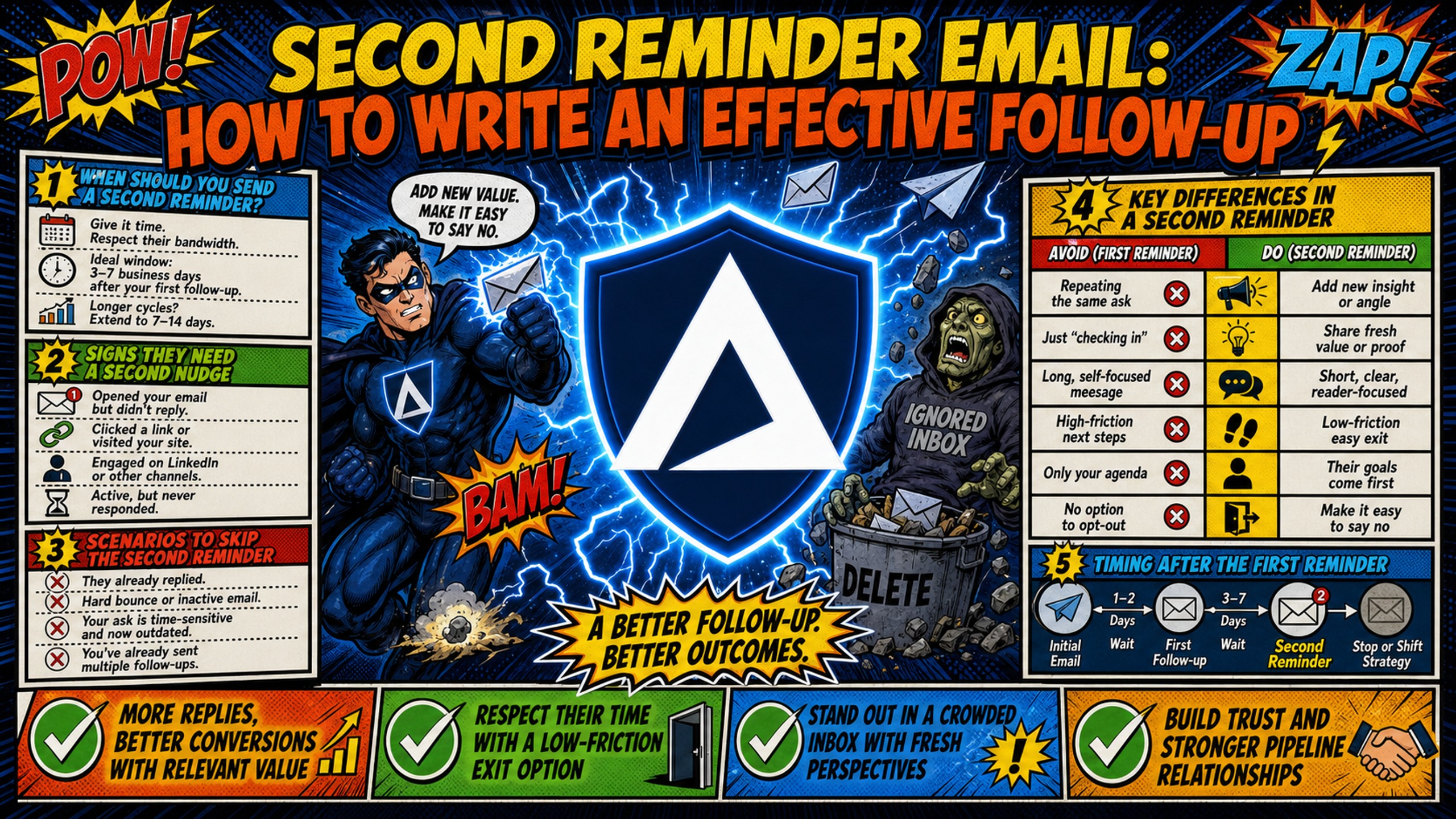
TL;DR: A second reminder email must add fresh value and offer a low-friction exit rather than repeat "checking in." The highest-performing second reminders follow a consistent structure: send at Day 10 after the initial email, open with one new asset or angle not present in the first message, and close with an easy-out line that removes the pressure of committing to a call. To capture reply rate lift without burning domains or compressing margins, agencies running multi-step sequences need flat-rate, dedicated IP infrastructure. Inframail's Unlimited Plan covers unlimited inboxes on one dedicated US-based IP for $129/month, keeping infrastructure costs fixed as sequence volume grows.
Most cold email campaigns fail not because the first email was bad, but because the second reminder was a lazy "just bumping this to the top of your inbox" message. That single phrase signals to the prospect that you have nothing new to say, and it signals to spam filters that you're running a low-effort blast rather than a targeted outreach campaign.
The economics make this problem worse at scale. If you're running 50 inboxes on Google Workspace at $7-8.40 per seat, you're paying $350-420/month just to support the infrastructure for these sequences. When each follow-up step costs real money to send and yields diminishing returns, the second reminder has to work.
This guide covers the exact frameworks, timing, and templates that give that second touchpoint its best chance, and explains why the infrastructure underneath it matters as much as the copy on top.
When should you send a second reminder?
Timing separates a professional follow-up from an annoying one. Send too soon and you appear desperate. Wait too long and the original context has faded, turning the second reminder into near-cold outreach.
Timing after the first reminder
Send the second reminder 5 to 7 days after the first follow-up. A common approach is the 3-7-7 cadence (Day 0 initial, Day 3 first follow-up, Day 10 second follow-up, Day 17 third touch), making the second touch at Day 10 an important step in the sequence if you time it correctly.
The table below shows a common timing and purpose for each step in a three-touch sequence.
Table 1: Cold email cadence best practices
| Step | Timing | Purpose |
|---|---|---|
| Initial email | Day 0 | Introduce offer and primary call to action (CTA) |
| 1st follow-up | Day 3 | Quick threaded bump with the same subject line |
| 2nd follow-up | Day 10 | New angle, value add, easy out |
| 3rd follow-up (if used) | Day 17 | Final breakup line, close the sequence |
Signs they need a second nudge
If your sending platform tracks opens and the prospect opened the first email without replying, that may signal an opportunity to send the second reminder with a different angle. No open at all may indicate a deliverability issue or a subject line that didn't work, which calls for a minor test rather than a direct re-send. The absence of a reply isn't necessarily evidence that your offer is wrong. It may just mean your message hasn't been read yet.
Scenarios for skipping the second reminder
Skip the second reminder in three scenarios: an out-of-office reply indicating extended unavailability (pause the sequence and re-queue for their return date), a soft bounce or delivery failure pointing to an address or DNS issue worth resolving first, or an explicit opt-out or "not interested" reply to the first touchpoint. Continuing past a clear no risks spam complaints, and Google and Yahoo's 2024 bulk sender requirements set the spam complaint ceiling at 0.3%.
Key differences in a second reminder
The first follow-up is typically a brief bump. The second is an opportunity to pivot. If you treat the second reminder as another bump, you've wasted a sequence slot and confirmed to the prospect that you have nothing new to offer.
Acknowledging the first reminder without repeating it
Reference the prior email briefly, then move past it immediately. A single sentence like "I sent a note last week about [topic]" establishes continuity without belaboring the point. Reply to the original email thread to preserve context, so the prospect can scroll up and re-read the first email without searching their inbox. Inframail's cold email follow-up video covers threading and sequence logic in a sending platform if you want a practical walkthrough.
Escalating urgency appropriately
Professional urgency is tied to business context, not artificial deadlines. Instead of "I need to hear from you by Friday," use a context-driven reason: "We're closing out this intake round by the end of the month." That's honest, specific, and creates a natural reason to reply without pressuring the prospect. Jeremy Miner's sales training on non-response reinforces the same point: manufactured urgency damages credibility faster than silence.
Adding new value vs. restating the ask
This is the highest-leverage change you can make in a second reminder. Introducing one new piece of evidence, such as a relevant case study, an industry-specific stat, or a short resource, is the primary driver of second-touch reply lift. Restating the original pitch, even in different words, tells the prospect you have nothing new to offer. Three effective value-add assets to keep in rotation: a one-sentence case study referencing a similar company and a specific result, a short industry stat directly relevant to the prospect's challenge, or a low-commitment resource like a short video or checklist they can review without a meeting.
How to structure your second reminder email
A high-converting second reminder follows a consistent structure: a subject line that preserves thread context, a single-sentence reference to the previous email, a one-paragraph value add, and a low-friction call to action (CTA) with an easy out. The whole email should stay under 90 words for maximum impact.
Subject line approaches that work
The default for a second reminder is to reply within the original thread, which keeps the same subject line and preserves conversation history. It signals continuity rather than a fresh blast. If you're testing a genuinely new angle, a low-pressure alternative subject line can work: "Quick thought" or "One more thing, [First Name]." For a breakdown of which subject line formats drive the highest reply rates in business-to-business (B2B) outreach, Chris Bussing's top subject lines video is worth reviewing alongside your own sequence data.
Opening line that references the first email
The opening line does two things: it establishes this as a follow-up and signals that this email has something new. Effective openers include:
- "Wanted to add one thing to my note from last week."
- "One quick thought I didn't mention before."
- "Following up, and bringing something specific this time."
Avoid "Just following up," "Circling back," or "Touching base." These phrases carry no new information and may reduce the likelihood that second reminders get read.
Body: New angle or additional context
Use a single paragraph of two to three sentences. Lead with the new asset or angle, connect it to the prospect's likely challenge, and link it briefly to your offer. If you're running outreach for a lead generation agency, the new angle might be a specific client result or a benchmark relevant to the prospect's role.
Call to action refinement
Soften the CTA for the second reminder. A first email might ask for a 15-minute call. A second reminder can ask for something smaller: "Would a 2-minute video from me be useful?" or "Can I send over one concrete example?" Inframail's founder covers reply rate CTAs in a dedicated video, specifically how soft CTAs outperform hard asks at the second-touch position.
Run through this checklist before hitting send on any second reminder:
Tone calibration checklist:
- Does this email introduce a new fact, asset, or angle not present in the first email?
- Is the CTA asking for less commitment than the first email requested?
- Does the email include an easy out line ("If the timing is off, no problem at all")?
- Is the total word count under 90 words?
- Does the opening line avoid "just following up," "circling back," or "touching base"?
- Is the email sent as a reply to the original message thread?
- Does the email avoid apologetic language like "Sorry to bother you again"?
Second reminder templates by scenario
Each template below is under 90 words and includes an easy out. Adapt the bracketed fields to your specific offer and prospect context.
Template 1: Agency outreach for new clients
Subject: [Same thread subject]
Hi [First Name],
Sent a note last week about helping [type of company] book more qualified calls through cold email. One thing I didn't mention: agencies using restructured sending infrastructure and follow-up cadences have reported significant increases in booked meetings per month.
If that's relevant to where you are right now, I'd love to show you the exact setup in a 10-minute call.
If the timing isn't right, no problem at all. Just let me know and I'll follow up later.
[Signature]
Template 2: Following up on a proposal
Subject: [Same thread subject]
Hi [First Name],
Following up on the proposal I sent on [date]. One thing I wanted to address directly: most clients at this stage ask about implementation time. For context, automated domain name system (DNS) configuration removes the manual panel work that typically creates setup delays.
Happy to walk through what that looks like for your specific situation if it would help move things forward.
If the timing has changed, just say the word.
[Signature]
Template 3: Payment or deliverable reminder
Subject: [Same thread subject]
Hi [First Name],
Following up on my note from [date] regarding [invoice/deliverable]. I want to make sure this didn't get buried in a busy week.
If there's a delay on your end or you need anything from me to move it forward, I'm happy to help resolve that quickly.
If the timeline has shifted, please let me know and I'll update accordingly.
[Signature]
Template 4: Meeting request follow-up
Subject: [Same thread subject]
Hi [First Name],
Wanted to add one thing to my note from last week. Rather than a full call, would it be useful if I sent over a 2-minute video showing how [specific outcome] works in practice? That way you can review it without blocking calendar time.
If it's not the right moment, no pressure. Happy to reconnect whenever works.
[Signature]
Common mistakes that kill second reminders
The difference between a second reminder that earns a reply and one that earns a spam flag usually comes down to one of four copywriting errors.
Sounding apologetic or desperate
Phrases like "Sorry to bother you again" or "I know you're really busy" can undermine credibility before the prospect reads a single line of your pitch. They signal low confidence and position your offer as an imposition rather than an opportunity, reading as a vendor chasing a reluctant buyer instead of peer-to-peer communication. As Inframail's B2B cold email response rates guide notes, the most effective cold outreach maintains a confident, peer-level tone throughout the sequence.
Repeating the exact same message
Copy-pasting the first email into the second follow-up can generate unsubscribes. The prospect already saw it. If they didn't respond, repeating it confirms you have nothing new. It also risks increasing the spam complaint rate at the domain level, and Google and Yahoo's bulk sender requirements set that ceiling at 0.3%.
Escalating too aggressively too soon
Acting as though the prospect owes you a response can damage the relationship. Demanding a reply, setting ultimatums, or implying frustration all risk ending the conversation and signal to spam filters that recipients are marking your messages to escape pressure. The second reminder is still early in the sequence, and the goal is to earn a reply, not extract one.
Forgetting to update the value proposition
If your second email doesn't introduce a new angle, a new asset, or at minimum a new framing of the original offer, you've given the prospect no reason to respond this time when they didn't respond last time. This is the most common reason second reminders fail, and the fix is simple: pick one new piece of value and lead with it.
How to add value in your second reminder
Adding value doesn't mean writing a longer email. It means giving the prospect one new, specific reason to engage that wasn't in the first message. Build a small library of 3-5 reusable value-add assets tied to your most common prospect types. That prep work saves time across every second reminder and scales as sequence volume grows.
Share a relevant case study or result
A one-sentence case study can be more effective than a paragraph of claims. "Agencies running 50 inboxes on Google Workspace pay $350-420/month, while Inframail's Unlimited Plan costs $129/month plus domain costs, bringing total infrastructure to approximately $156-184/month" is specific, verifiable, and directly relevant to an agency founder who recognizes those numbers from their own billing. Inframail's sales email automation tools guide covers how to build these asset libraries efficiently across high-volume sequences.
Include a useful resource or insight
A short, actionable resource builds trust faster than a repeated ask. A 2-minute video, a one-page checklist, or a relevant benchmark all demonstrate that you understand the prospect's world and are offering something useful before asking for their time. Inframail's video on converting emails to booked calls covers how supporting content, including landing pages and resources, lifts reply-to-call conversion rates significantly.
Address a likely objection proactively
Call out the most common reason a prospect in this category doesn't respond, and answer it directly. For cold email infrastructure, the most common objections are switching risk and upfront budget commitment. Naming them, "I know switching infrastructure mid-campaign sounds disruptive, here's exactly what carries over," shows you understand the concern and have a concrete answer, which is more persuasive than ignoring the objection.
Offer a lower-commitment next step
Shift the CTA from a 15-minute call to a 2-minute video, a single yes/no question, or a simple confirmation of interest. Giving prospects a low-friction exit ("If this isn't a priority right now, just say so and I'll close this out") increases response rates by removing the pressure of committing to a meeting. Breakup-style emails can generate reply rates of 10-33% from prospects who had previously gone silent, based on data from sales teams running structured sequence analysis.
What to do if the second reminder fails
No response to the second reminder means one of three things: the timing is wrong, the offer isn't relevant enough, or the sequence has reached its natural end.
Deciding whether to send a third
The data on a third follow-up is nuanced. Add a third touch only if you have a genuinely new angle or a clean breakup framing that closes the conversation professionally. Otherwise, stop at two.
Changing channels or approach
If two follow-ups yield no response, switching channels is more productive than adding a third email. LinkedIn, a direct message through a relevant community, or a targeted cold call gives you a new surface without increasing your email spam complaint rate. Inframail's cold email infrastructure monitoring guide covers how to track complaint rates at the domain level before they become a deliverability crisis.
Moving on from the sequence
High-frequency follow-up sequences impose real technical costs. Each additional email step can increase per-inbox sending volume, raise the risk of triggering spam filters, and accumulate potential for domain reputation damage. For agencies running multi-step sequences across 50+ inboxes, this risk compounds quickly, especially on shared IP pools where other senders' behavior affects your deliverability alongside your own.
For agencies running sequences across 50+ inboxes, dedicated IP infrastructure protects sender reputation during multi-step campaigns. Inframail's dedicated US-based IPs (one on the Unlimited Plan at $129/month, three on the Agency Pack at $327/month) isolate your sending behavior from shared pool contamination, and the platform's blacklist monitoring auto-submits delisting requests when a domain is flagged. For a complete comparison of how infrastructure affects multi-step sequence deliverability, Inframail's cold email infrastructure comparison guide covers the full total cost of ownership (TCO) math across multiple inbox tiers.
A common stop-out threshold for protecting your domains is two follow-ups (three emails total in the sequence). After that, the spam risk may outweigh the marginal reply rate on most lists.
Second reminder performance comes down to four operational variables: sending at Day 10, not before, introducing one new piece of value rather than restating the original pitch, closing every message with an easy out that removes pressure to commit, and running sequences on dedicated IP infrastructure that isolates sender reputation from shared pool contamination. Agencies that treat the second touch as a pivot rather than a repeat consistently outperform those that treat it as a bump. The copy matters, and so does the infrastructure it runs on.
Sign up to Inframail and get started today, or book a call with an Inframail deliverability consultant to audit your current cold email infrastructure before your next sequence goes live.
FAQs
How long should you wait before sending a second reminder?
Wait 5 to 7 days after the first follow-up before sending a second reminder, Day 10 in a 3-7-7 cadence. This gives the second touch enough time to reach prospects who missed or ignored the first two messages without letting the original context go cold.
Should you change the subject line on a second reminder?
No. Reply within the original thread to preserve the subject line and conversation history. Only use a new subject line if the value angle is completely different and the email reads as a genuinely fresh message rather than a follow-up.
How many reminder emails are too many?
Three emails total in a sequence (initial plus two follow-ups) is the practical ceiling for most B2B outreach. Data on third follow-ups varies, but the pattern is consistent: response rates fall meaningfully at the third touch (one 2024 study of 16.5M emails found a roughly 17% drop) while the risk of hitting the 0.3% spam complaint threshold rises.
How does infrastructure affect second reminder deliverability?
Multi-step sequences increase per-inbox sending volume, raising spam filter risk. Dedicated IP infrastructure isolates your sending reputation from other users, and blacklist monitoring catches domain flags before they affect active campaigns.
What is the "easy out" and why does it increase response rates?
An easy out is a closing line that gives the prospect explicit permission to decline, such as "If the timing isn't right, no problem at all." This framing reduces the psychological pressure of responding, which is why breakup-style emails generate reply rates of 10-33% from prospects who had previously gone silent.
Key terms
Dedicated IP: A single IP address assigned exclusively to one sender, isolating their sending reputation from other users. Inframail's Unlimited Plan includes one dedicated US-based IP, while the Agency Pack includes three.
SPF/DKIM/DMARC: Email authentication protocols that help verify sender identity and can reduce the likelihood of messages landing in spam. Inframail configures all three automatically during domain setup, eliminating manual DNS panel work.
Spam complaint rate: The percentage of sent emails that recipients mark as spam. Google and Yahoo enforce a 0.3% maximum for bulk senders.
Easy out: A closing line in a follow-up email that gives the prospect explicit permission to decline without any negative consequence, used to reduce pressure and increase response rates on second and final reminders.
Shared IP pool: An infrastructure arrangement where multiple senders share the same IP address. One sender's poor sending practices can potentially degrade deliverability for all others on the same pool.
Flat-rate pricing: A fixed monthly cost that does not increase with inbox count. Inframail charges $129/month for unlimited inboxes on the Unlimited Plan, versus per-seat models where costs scale linearly with sending volume.
Total cost of ownership (TCO): The complete cost of operating infrastructure over time, including platform fees, domain costs, warmup tools, and sending platform subscriptions. Inframail's TCO comparisons show savings versus per-seat models across 50, 100, and 200 inbox tiers.