
Reminder email for unpaid invoice: step-by-step guide
A three-stage cadence (soft nudge, firm reminder, final notice) can recover outstanding balances while keeping the client relationship intact. Timing each stage
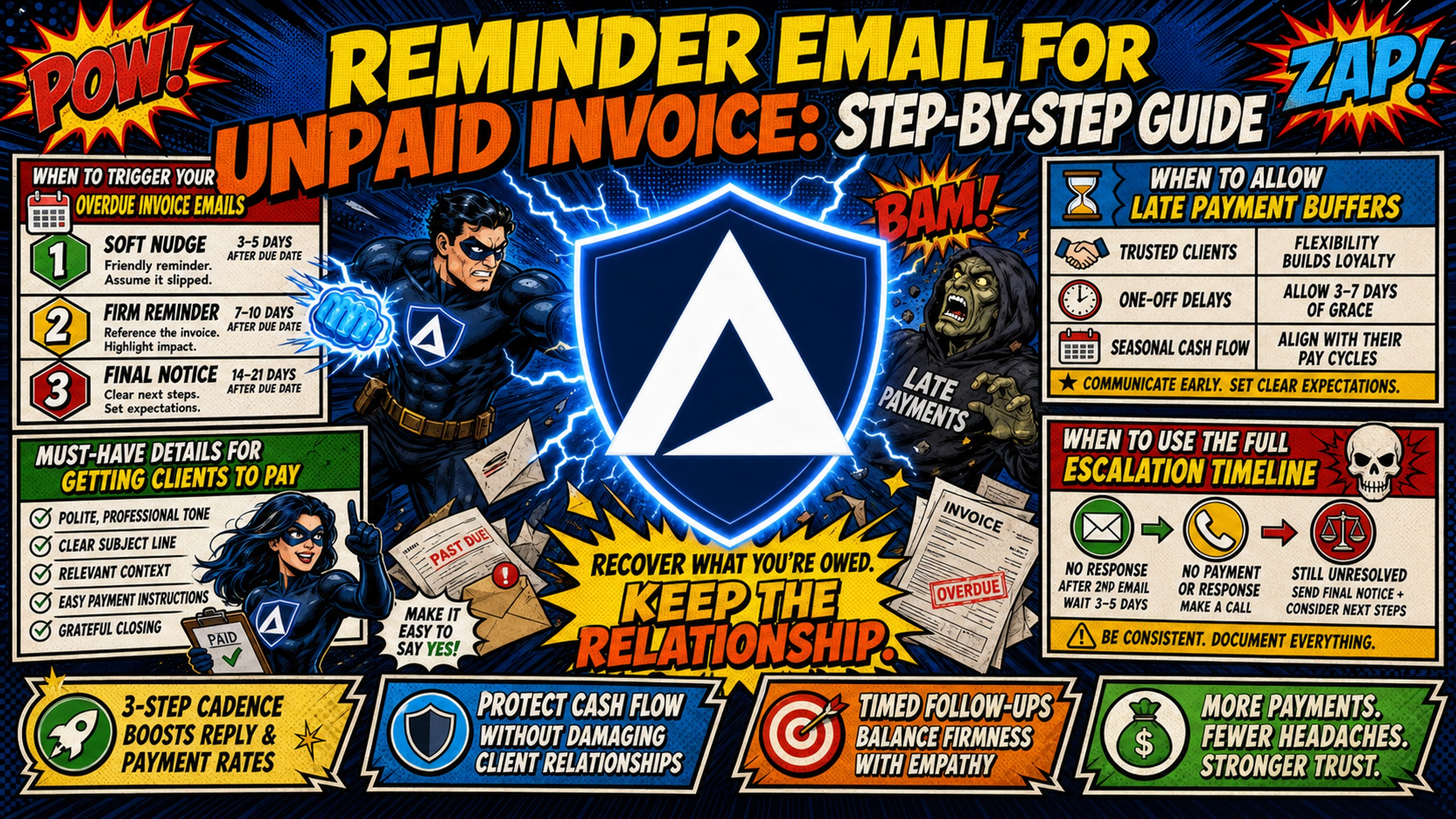
TL;DR: A three-stage cadence (soft nudge, firm reminder, final notice) can recover outstanding balances while keeping the client relationship intact. Timing each stage correctly matters: the first nudge goes out one day past due, the second at 7-21 days overdue, and the final notice at 45-60 days overdue. A clear late fee clause in the initial contract (commonly 1.5%-2% per month) removes ambiguity at the final stage. Inframail provisions a dedicated billing domain with automated SPF, DKIM, and DMARC configuration for $129/month, keeping billing reputation fully isolated from campaign deliverability. Adding a direct Stripe, QuickBooks, or Xero payment link to each email may reduce the steps-to-pay count.
Most guides tell you what to write in an invoice reminder. Few explain where to send it from. If you run a cold email agency and your primary domain is the same one you use to chase unpaid invoices, you may carry a hidden deliverability liability. A client who disputes a bill and marks your email as spam, or a stale payment card that triggers a bounce, can generate complaint signals. That damage may not stay in your billing inbox. It can follow you into campaigns you send that month.
The fix is a structured, warm-to-firm reminder cadence sent from a dedicated, authenticated billing domain. This guide gives you the exact templates, escalation timeline, and technical setup to recover outstanding balances without putting your primary sending reputation at risk.
When to trigger your overdue invoice emails
Timing is the first lever agencies get wrong. Sending a reminder the morning after a due date, with no grace period or context, reads as aggressive, while waiting three weeks hands cash flow back to your client for free.
Net 30 is used in approximately 45% of B2B transactions, making it the most widely used standard payment term. Net 15 is used in some service categories where rapid cash turnover is essential and where client relationships are newer or shorter-term.
Table 1: Reminder cadence calculator
| Payment terms | First nudge | Second reminder | Final notice |
|---|---|---|---|
| Net 15 | Day 16 (1 day late) | Day 22-23 (7-8 days late) | Day 60-75 (45-60 days late) |
| Net 30 | Day 31 (1 day late) | Day 37-44 (7-14 days late) | Day 75-90 (45-60 days late) |
When to allow late payment buffers
Not every client warrants the same clock. High-touch retainer clients on established monthly contracts earn a short grace period before your first nudge. One-off project clients with no payment history do not. Document your grace period policy in the initial contract so clients know the terms before the invoice arrives, removing most of the awkwardness from reminder conversations.
When to use the full escalation timeline
The full escalation path maps to four stages, timed from the invoice due date:
Table 2: Strategic escalation path
| Stage | Days overdue | Action | Tone |
|---|---|---|---|
| Soft nudge | 1-7 days | Email reminder 1 | Polite, helpful |
| Firm reminder | 7-21 days | Email reminder 2 | Assertive, direct |
| Final notice | 45-60 days | Email reminder 3 + pause work | Formal, legal |
| Collections | 75+ days | Handoff to agency | Legal, final |
Must-have details for getting clients to pay
Incomplete invoices drive payment delays. Clients who cannot reconcile an invoice number or who receive a vague "services rendered" line item have a legitimate reason to stall. Remove every possible reason to not pay.
Include required invoice details for faster payment
Every invoice you send must include:
- Invoice number: A unique, sequential reference for both parties' records.
- Issue date: The date the invoice was created.
- Due date: An explicit calendar date, not "Net 30 from receipt."
- Itemized services: A line-by-line breakdown matching the scope of work.
- Total balance due: Displayed prominently.
- Payment methods accepted: Stripe link, ACH (Automated Clearing House) details, wire instructions, or a QuickBooks Pay Now button.
Clearly state the payment deadline
Use a specific date every time. "Due October 15, 2026" leaves no room for interpretation. "Due upon receipt" or "payable within 30 days" creates ambiguity about when the clock started. Vague terms are the most common reason clients push back on late fees later.
Simplify client payment processes
Every extra step between "open email" and "payment submitted" extends time-to-pay. Embed a direct hosted payment link into the email body. Stripe, QuickBooks Online, and Xero all offer payment URL features that simplify the payment process. For agencies managing multiple clients on monthly retainers, Inframail's automation tools guide covers how to structure drip sequences, follow-up timing, and segmentation across client communication workflows.
Provide clear support channels
Include one named contact and one email address for billing discrepancies at the bottom of every reminder. "If you have questions about this invoice, contact billing@your-agency.com or reply directly to this message" is enough. Clients who have a query about a line item need a fast path to resolution. Without it, they wait, and the invoice ages.
Soft-touch follow-ups for overdue accounts
The first reminder stage covers 0-7 days past due. Your working assumption is that the payment slipped through a busy accounts payable (AP) inbox, not that the client is avoiding you. Your tone is helpful, not accusatory.
Best practices for first reminders
- Keep the subject line factual: "Invoice #[Number] - Payment due [Date]" works better than anything clever.
- Avoid any language implying intent to deceive on the client's part.
- Reattach the invoice as a PDF and include the direct payment link.
- Keep the email brief to maintain a professional, non-anxious tone. The same tone principles apply to outreach, as the B2B cold email response rates guide covers.
Sample first reminder email scripts
Replace all bracketed placeholders with your specific information before sending.
Template 1: High-touch retainer client
Subject: Invoice #[Invoice Number] - Quick follow-up

Hi [Client First Name],

Hope things are going well on your end. I wanted to drop a quick note. Invoice #[Invoice Number]
for [Month] retainer services ([Balance Due]) was due on [Due Date].

If it's already in the queue, no worries at all. If you need another copy, I've attached it here.
You can pay directly via [Payment Link].

Let me know if you have any questions.

[Your Name]
Template 2: One-off project client
Subject: Invoice #[Invoice Number] - Payment reminder

Hi [Client First Name],

This is a friendly reminder that Invoice #[Invoice Number] ([Balance Due]) was due on [Due Date].

If you've already processed this, please disregard. If not, you can settle the balance here: [Payment Link].

A copy of the invoice is attached for your reference.

[Your Name]
How to send a firm second invoice reminder
The second reminder covers 7-21 days past due. One unanswered email could be a vacation or a missed notification. Two ignored emails require a firmer, more direct approach.
Timing your second payment follow-up
Send 7-14 days after your first reminder. This interval sets a predictable rhythm clients recognize without reading as pressure or signaling you are not monitoring your receivables.
Balance assertiveness with client care
The shift in tone moves from "you may have missed this" to "this requires your attention today." State the exact amount owed, restate the original due date, and give a new deadline for resolution that matches where the account sits in your escalation sequence. Frame the payment as preventing a negative outcome (service interruption, late fees) rather than completing a positive transaction. Loss aversion, a well-documented bias where avoiding a loss motivates more strongly than gaining an equivalent reward, supports this framing.
Effective second invoice reminder copy
Replace all bracketed placeholders with your specific information before sending.
Template 3: Second reminder (retainer client)
Subject: Invoice #[Invoice Number] - Second notice, [Balance Due] outstanding

Hi [Client First Name],

Following up on my message from [Date of First Reminder]. Invoice #[Invoice Number] ([Balance Due])
is now [X] days past its due date of [Due Date].

I want to make sure this gets resolved quickly for both of us. If there's a dispute about any
line item or a processing issue on your end, let me know and I can help clear it up today.

Otherwise, you can settle the balance here: [Payment Link].

Please respond by [Date 5-7 days from now].

[Your Name]
Template 4: Second reminder (project client)
Subject: Second notice - Invoice #[Invoice Number], [Balance Due] overdue

Hi [Client First Name],

Invoice #[Invoice Number] for [Balance Due] remains unpaid as of today, [X] days past the due
date of [Due Date].

Please arrange payment as soon as possible: [Payment Link].

If there's a reason for the delay, please reply so we can work toward a resolution.

[Your Name]
Final overdue invoice reminder: legal escalation
The final notice stage covers 45-60 days overdue and marks the shift from relationship management to formal process. This email must give the client one final opportunity to pay voluntarily and create a written record that can serve as evidence if the matter escalates.
Drafting legally sound final notices
The Fair Debt Collection Practices Act (FDCPA) governs consumer debt but does not cover B2B commercial debt. B2B debt collection operates under a combination of federal commercial law, state statutes, and industry codes of conduct. Some states have extended consumer-style protections to certain commercial debts. Always verify the commercial debt collection rules for your state before applying late fees or referencing legal action.
For the email itself, use plain, specific language. Name the exact amount, the exact date it was missed, and the exact action you will take if it remains unpaid by a specific date.
Charging late fees on overdue invoices
Your initial client contract should state a specific monthly interest rate, commonly 1.5%-2% per month on the outstanding balance, that activates after a defined number of days past due. Always send one warning before applying the first charge. Be willing to waive the fee for long-standing clients who resolve promptly, because aggressively enforcing late fees on every client can affect how your agency is perceived and put established relationships under strain.
Setting clear service termination terms
This is the appropriate stage to inform a client that campaign work will be paused pending payment. State it factually: "All active campaign services will be paused as of [Date] if this balance remains unresolved." Do not bluff. Clients who know you will pause work take final notices seriously. Clients who have seen you continue working through unpaid balances do not.
Drafting a final overdue invoice notice
Replace all bracketed placeholders with your specific information before sending.
Template 5: Final notice
Subject: Final notice - Invoice #[Invoice Number], [Balance Due] - Action required by [Date]

Dear [Client Full Name],

This is a formal final notice regarding Invoice #[Invoice Number] for [Balance Due], originally
due on [Due Date] and now [X] days overdue.

Despite prior reminders sent on [Date 1] and [Date 2], this balance remains outstanding.

Please arrange full payment by [Final Deadline Date] via the following link: [Payment Link].

If this balance is not resolved by [Final Deadline Date]:

1. All active campaign services will be paused immediately.
2. The account will be referred to a third-party collections agency.

Late fees of [X%] per month have been accruing since [Date] as outlined in our original agreement.

If you believe this invoice is in error or would like to discuss a payment arrangement, please
contact [Billing Contact Name] at [Billing Email] before [Final Deadline Date].

[Your Name]
[Your Title]
[Agency Name]
Escalating unpaid invoices to collections
When a client ignores all three email reminders and does not respond to a phone call by day 75, collections become the appropriate next step. This is a process decision, not a personal one.
Moving unpaid invoices to collections
A third-party commercial collections agency contacts the debtor on your behalf. Collection fees vary by account complexity and debt age, but contingency rates commonly range from 15% to 50%, with newer debt (60-90 days old) at the lower end and older, harder-to-collect debt at the higher end. Compare terms before selecting an agency.
Gathering evidence for unpaid invoices
Build your evidence file from day one, not when collections begins. The documentation recommended for collections commonly includes a copy of the original signed contract, all sent invoices with timestamps, all email correspondence, and a complete account statement. Keep records of any payment links clicked or partially completed, and summaries of any phone conversations.
Drafting the final collections notice
Replace all bracketed placeholders with your specific information before sending.
Template 6: Collections handoff notice
Subject: Account referred to collections - Invoice #[Invoice Number]

Dear [Client Full Name],

As of [Date], Invoice #[Invoice Number] for [Balance Due] (originally due [Due Date]) remains
unpaid after [X] days and multiple unanswered communications.

This account is being referred to [Collections Agency Name] for recovery effective [Date].

To avoid this action, you must submit full payment by [Date, 7-14 days out]: [Payment Link].

After this date, direct all further communication regarding this account to [Collections Agency Name]
at [Agency Contact Information].

[Your Name]
[Your Title]
[Agency Name]
Maintain audit trails for payment disputes
Recovering an unpaid invoice in a dispute requires proof of three things: that the work was completed, that the invoice was properly issued, and that the invoice was received by the client. The third element is harder to prove than most founders expect.
Using read receipts for payment proof
Read receipts are often unreliable because many email clients block them by default, and clients can decline them without notification. Delivery logs at the server level, generated by an authenticated sending domain, are the standard that holds up in disputes.
Audit trails for unpaid invoices
Before sending any billing communication, verify that the billing domain passes all three authentication checks. Run this checklist before the first invoice goes out to any new client:
Operational domain authentication checklist:
- Verify SPF record includes the sending mail server.
- Verify DKIM signature is active and valid.
- Verify DMARC policy is set to at least
p=none(preferablyp=quarantineorp=reject). - Verify the billing domain is separate from the primary cold outreach domain.
Research on email domain reputation shows that even a small number of spam complaints can damage sender reputation across all email types sent from that domain. Google recommends keeping spam complaint rates below 0.10% in Postmaster Tools, with 0.30% as the hard threshold that risks blocking. Billing emails flagged as spam affect overall domain deliverability, including outreach campaigns.
In February 2024, Gmail and Yahoo reportedly implemented strict sender authentication requirements. Senders pushing more than 5,000 emails per day to Gmail or Yahoo addresses are generally required to implement SPF, DKIM, and DMARC. Even for lower-volume billing emails, missing these records increases spam probability and undermines the delivery proof you need in a dispute.
Evidence collection for unpaid invoices
Setting up a dedicated billing domain (for example, billing-agencyname.com) through Inframail automates SPF, DKIM, and DMARC configuration without requiring manual DNS panel access. The process runs in four steps:
- Purchase or transfer the billing domain through the Inframail platform.
- Create a billing inbox (e.g.,
billing@billing-agencyname.com) with auto-configured SPF, DKIM, and DMARC. - Verify all three records are confirmed in the Inframail dashboard before sending the first invoice.
- Export IMAP and SMTP credentials (email protocols for receiving and sending mail) and connect the billing inbox to your invoicing platform. The entire setup is instant. If a client marks an invoice email as spam during a payment dispute, it affects only
billing-agencyname.com, not the campaign domains driving your pipeline. Inframail's unlimited inbox model at $129/month means adding a dedicated billing domain adds no incremental inbox cost.
For context on how inbox placement rates affect campaign outcomes at scale, the cold email infrastructure monitoring guide covers the health check protocols agencies use to catch reputation damage before it hits reply rates.
Key insights for chasing unpaid client balances
The following practices cover the operational decisions that affect how quickly and consistently agencies recover outstanding balances.
Ideal timing for unpaid invoice emails
Send billing emails Tuesday through Thursday between 9am and 11am in the client's time zone. This aligns with standard business hours when AP contacts are likely processing email rather than sitting in meetings. Avoid Mondays (inbox catch-up) and Fridays (end-of-week wind-down).
Write your late fee policy into the initial client contract before any work begins. A standard clause states: "Invoices unpaid after [X] days past the due date will accrue interest at 1.5%-2% per month on the outstanding balance. [Agency Name] reserves the right to pause all active services until the outstanding balance is resolved." For an overview of how infrastructure costs and billing policies affect agency unit economics, the cold email infrastructure costs comparison breaks down per-inbox cost models across seven platforms.
Phone versus email for past due
Pick up the phone after two ignored emails or around 30 days overdue. A short, direct call - for example, "I'm following up on Invoice #[Invoice Number] for [Balance Due] due on [Due Date] - can you confirm when this will be processed?" - resolves more outstanding balances than a third email. Calls create a social accountability dynamic that written communication does not.
Resolving invoice payment disputes
When a client claims non-receipt, respond with the specific delivery timestamp from your authenticated billing domain logs, the invoice PDF reattached, and a new direct payment link. Do not argue. Provide the evidence and the path to resolution in the same email. For additional context on handling deliverability issues at the infrastructure level, the Microsoft blacklist recovery guide covers IP-level delisting steps via Microsoft's sender support tools.
Setting service limits for delinquency
Establish a clear internal rule: no active campaign work continues beyond a set number of days past the invoice due date without resolution. Many agencies set this line at 30 days. Clients who know you will pause work take payment timelines seriously. Clients who have seen you work through 60-day gaps will continue to test that boundary.
Sign up to Inframail and get started today. Set up your dedicated billing mailboxes with automated DNS configuration for $129/month and keep billing reputation fully isolated from your primary campaign infrastructure.
FAQs
How do I automate invoice reminders?
Many accounting platforms like QuickBooks or Stripe support automated reminders tied to invoice due dates. Ensure these automated emails send from an authenticated billing domain configured in Inframail to protect your primary inbox reputation.
What are the best tools for managing accounts receivable?
Stripe, QuickBooks Online, and Xero are the industry standards for managing B2B invoices. Integrating these tools with a dedicated billing mailbox ensures high deliverability and keeps payment-related traffic separate from outreach campaigns.
Can I charge late fees on overdue invoices?
Yes, if your initial client contract explicitly states the late fee policy (commonly 1.5%-2% interest per month). Always send a warning email before applying the fee to maintain client goodwill.
What should I do if a client ignores my final notice?
Pause all active campaign work immediately and transition the account to a third-party collections agency or initiate legal proceedings. Ensure you have a complete audit trail of all sent invoices, delivery logs, and correspondence, as outlined in the collections documentation requirements.
Does the FDCPA apply to B2B invoice collection?
No. The FDCPA governs consumer debt collection and does not cover B2B commercial debt. B2B debt collection is governed by a combination of federal commercial law and state statutes, which vary. California's SB 1286 (effective July 1, 2025) is one example of a state extending consumer-style protections to commercial debts under $500,000.
Why should I send billing emails from a separate domain?
Billing emails can generate spam flags from clients disputing charges and bounce signals from outdated payment cards. Both can damage your sending domain's reputation, and because that damage may not be contained to one email type, it can affect inbox placement for outreach campaigns sent from the same domain. A dedicated billing domain isolates that risk entirely.
Key terms glossary
Time-to-pay: Commonly defined as the average number of days between invoice issuance and client payment. A lower time-to-pay directly improves agency cash flow and net margin.
Net margin: The percentage of revenue remaining after all operating expenses, taxes, and interest are paid. Healthy agency net margins typically run 15%-20%.
SPF (Sender Policy Framework): An email authentication method that helps specify which mail servers are authorized to send email on behalf of your domain.
DKIM (DomainKeys Identified Mail): A cryptographic email authentication method that helps verify email content was not altered during transit.
DMARC (Domain-based Message Authentication, Reporting, and Conformance): An email protocol that uses SPF and DKIM to help determine the authenticity of an email and specifies how receiving servers should handle authentication failures.
DSO (Days Sales Outstanding): The average number of days a company takes to collect payment after a sale. The cross-industry median DSO is reported at around 56 days.
AP (Accounts Payable): The department or function within a business responsible for processing and paying vendor invoices and bills.
IMAP (Internet Message Access Protocol): An email protocol that allows email clients to retrieve messages from a mail server while keeping them stored on the server.
SMTP (Simple Mail Transfer Protocol): An email protocol used for sending email messages between servers and from email clients to servers.
Dedicated IP: An IP address assigned exclusively to one sender, isolating your sending reputation from other senders. Inframail provides 1-3 dedicated US-based IPs depending on plan, so your sending reputation is not affected by other senders sharing the same IP pool.