
Payment reminder email sequence: 3-email strategy that works
A structured 3-email payment reminder sequence (gentle nudge, firm reminder, final notice) recovers overdue invoices faster than ad-hoc follow-ups and protects
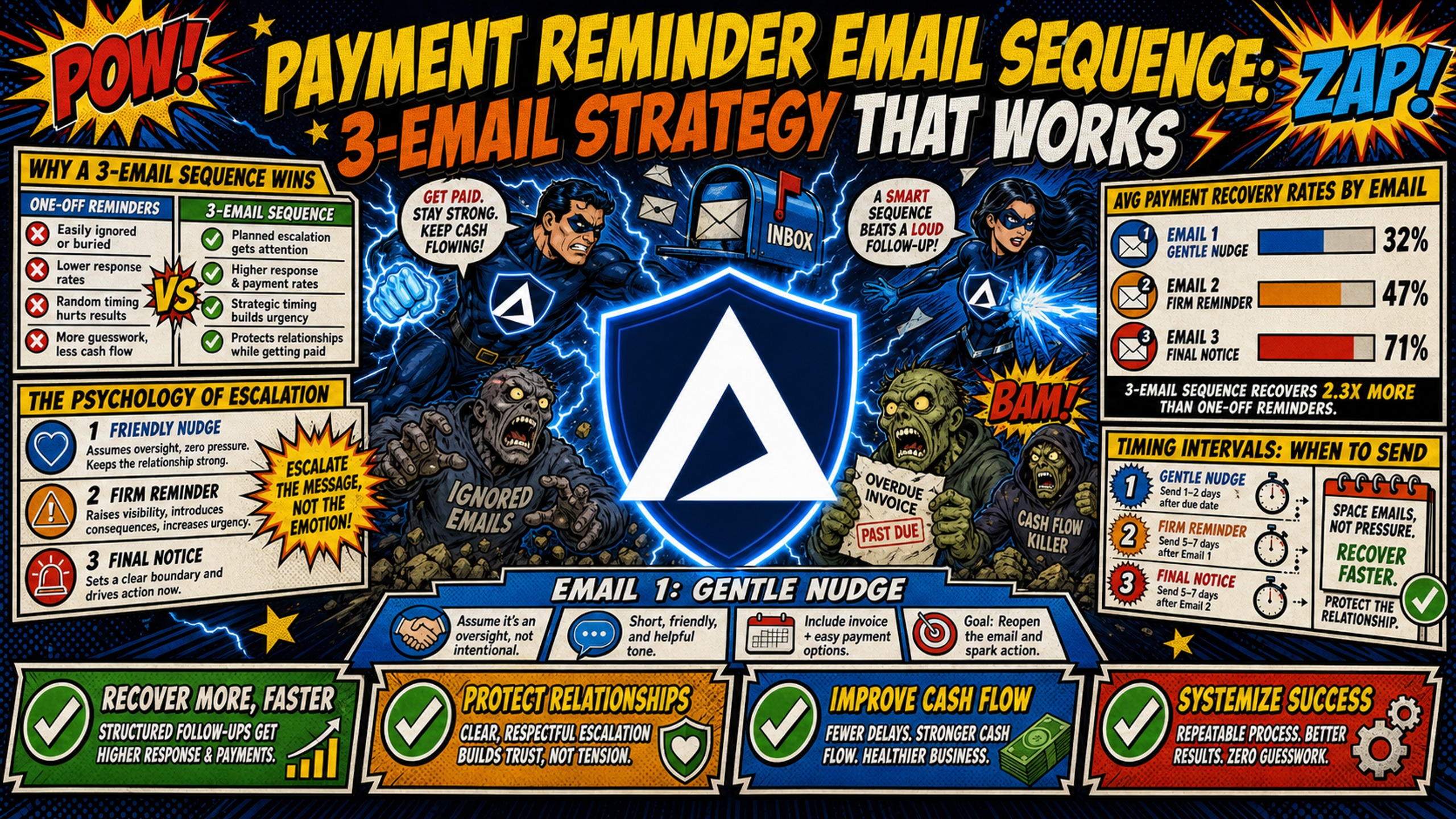
TL;DR: A structured 3-email payment reminder sequence (gentle nudge, firm reminder, final notice) recovers overdue invoices faster than ad-hoc follow-ups and protects client relationships through deliberate tone escalation. Sending this sequence from a dedicated billing domain, rather than your primary business or cold outreach domain, isolates spam risk and keeps your core deliverability intact. Inframail's Unlimited Plan provisions unlimited email inboxes with automated SPF, DKIM, and DMARC setup for $129/month flat, meaning one frustrated client flagging a collection email can't destroy your entire outbound infrastructure.
High spam complaint rates on collection emails are a real deliverability threat. Email reputation is typically evaluated at the domain level, so when billing emails from your primary domain accumulate complaints, that damage can spread to your campaign outreach, client communications, and operational email simultaneously. For a bootstrapped agency running 50-200 cold email domains across 5-15 clients, that's an existential risk hiding inside a routine billing task.
The fix is a 3-email escalation sequence sent from a dedicated billing domain, automated to run without manual intervention, and timed precisely to convert late-paying clients before cash flow strain compounds.
Why a 3-email sequence works better than one-off reminders
A single payment reminder often fails for a predictable reason: it can arrive, get noted, and then get deferred. Without a follow-up structure, the invoice may compete with every other priority in your client's inbox until it quietly drops off both of your mental queues.
A follow-up sequence gives an overdue invoice more chances to be seen and paid than a single reminder does. AR automation can meaningfully reduce Days Sales Outstanding (DSO), with highly automated organizations reporting an average 41% reduction when combining automated payment solutions with structured follow-up cadences. For many B2B agencies, targeting a DSO of 30-45 days helps maintain sufficient working capital.
Reducing DSO through structured collections can free significant working capital for agencies managing multiple retainer clients.
Table 1: Manual vs. automated collections for 5-10 billing inboxes
| Metric | Manual process | Automated process (with Inframail + CRM) | Net impact |
|---|---|---|---|
| Follow-up consistency | Often inconsistent | Triggered by invoice status | Improved consistency |
| Domain risk | Billing from primary domain | Dedicated billing domain isolated | Primary domain reputation better protected |
| Cost for 5-10 billing inboxes (infrastructure) | $35-84/mo (Google Workspace Business Starter, per seat) | $129/mo flat (Inframail, unlimited inboxes) | Flat-rate regardless of inbox count |
| DSO impact | Baseline (no structured cadence) | Potential reduction | Possible cash flow improvement |
The psychology of escalation
Human behavior often responds predictably to a graduated sequence because each email operates on a different assumption. The first email assumes the client forgot, an assumption that costs you nothing if true and may signal professionalism if they didn't. The second assumes the payment hasn't been made despite the reminder, which shifts the tone to direct without being accusatory. The third treats non-payment as a deliberate choice that triggers a specific consequence.
This progression keeps clients from becoming defensive early. Jumping to a firm tone in the first email forces your client to either capitulate or dig in, and digging in is the easier path. Starting with a helpful assumption gives them a face-saving exit that most clients take.
Average payment recovery rates by email
The first email in a structured sequence catches the largest share of late payments because most overdue invoices reflect administrative oversight rather than unwillingness to pay. Your client's accounts payable team lost the invoice, the approval workflow stalled, or the payment slipped through the cracks during a busy period. According to CreditPulse benchmarks, collection rates decline as invoices age, with accounts past 90 days carrying significantly lower recovery odds. Acting early and consistently is what keeps those odds in your favor.
Timing intervals: when to send each email
The table below runs from pre-due to post-due and includes a defined exit condition for each touchpoint. An exit condition is the specific event that removes the client from the sequence, typically payment confirmation or a confirmed payment plan.
Table 2: Pre-due to post-due sequence timeline
| Timing | Email type | Tone | Exit condition |
|---|---|---|---|
| Several days before due date | Pre-reminder | Courteous heads-up | Invoice paid |
| Due date (Day 0) | Gentle nudge | Friendly and helpful | Invoice paid |
| ~7 days past due | Firm reminder | Professional and direct | Invoice paid or payment plan confirmed |
| ~30 days past due | Final notice | Firm with stated consequences | Invoice paid, plan confirmed, or service paused |
| 30+ days | Escalation action | Phone call or formal demand | Invoice paid or account sent to collections |
Email 1: gentle nudge timing
Send a soft pre-reminder 3-5 days before the due date for high-value retainers where client payment approvals require multiple internal steps. The gentle nudge itself goes out on the due date, catching the largest share of honest oversights, because many clients intend to pay on the due date but need a prompt to execute the transfer.
Email 2: firm reminder timing
Escalating to a firmer, multi-channel follow-up by day 7 keeps pressure building without exhausting goodwill, per standard AR best practices from EngageLab. This interval gives clients enough time to address the oversight after the first email without giving so much runway that the invoice drops off their radar. At this point, the email states the outstanding balance, the original due date, and your payment terms clearly.
Email 3: final notice timing
Send the final notice at Day 30 past due. Many effective dunning sequences run 3-5 emails, adjusting cadence to account value and relationship length. This sequence places the final notice at Day 30 to keep pace with the faster billing cycles typical of agency retainers, tightening the window compared to longer enterprise dunning timelines. This gives clients with longer internal approval workflows enough runway to process payment before consequences apply. For accounts past 30 days with no response, shift the communication channel from email to a direct phone call or formal written demand.
Email interval adjustments by invoice size
Larger enterprise retainers ($10,000+/month) often have multi-step internal approval workflows that genuinely require additional time. For these accounts, consider extending the interval between emails and adding a phone call earlier in the sequence. For smaller, high-velocity retainers ($1,500-5,000/month), consider tightening the cadence, because the cash flow impact of a 30-day delay is proportionally larger and faster follow-up protects margin more effectively.
Tone escalation framework across the sequence
The sequence works because each email assumes a different reason for non-payment. The tone shifts from "I'm sure this just slipped through" in Email 1, to "Here's what's outstanding and what I need from you" in Email 2, to "Here's exactly what happens next if this isn't resolved" in Email 3.
The risk of escalating too fast is client defensiveness. The risk of escalating too slowly is normalized late payment behavior. A 7-day interval between the first and second email provides a reasonable balance for most B2B retainer relationships. On the question of automated late fees, introduce them at the firm reminder stage if your contract includes them.
Late fee language typically specifies 1% to 2% monthly interest on overdue balances, as noted in Jobber's guidance on invoice late fees. The data on whether late fees increase churn in agency-retainer models is inconclusive, but they do create urgency and give clients a financial reason to prioritize your invoice over others.
Email 1: friendly and helpful
Keep the assumption charitable. The client forgot. Use language that helps them act quickly without making them feel accused. Include the invoice number, amount, due date, and a direct payment link. No late fee mention, no consequence language.
Email 2: professional and direct
Drop the pleasantries. State the facts: the invoice number, the outstanding amount, the original due date, and your payment terms. Provide the payment link again. Bold the payment amount and deadline date to create visual urgency without emotional pressure.
Email 3: firm with consequences
State the specific consequence clearly and professionally. For lead generation and cold email agencies, that consequence is pausing active campaign delivery. Frame it as a necessary operational step, not a punishment, and keep the language calm and factual.
Email 1: gentle nudge template and breakdown
Email 1: subject line options
- "Invoice [NUMBER] for [CLIENT NAME] - friendly reminder"
- "Quick note: Invoice [NUMBER] due today"
- "[AGENCY NAME] Invoice [NUMBER] - payment due [DATE]"
Email 1: body copy template
Hi [NAME],

Quick note to flag that Invoice [NUMBER] for $[AMOUNT] is due today, [DATE].

You can pay directly here: [PAYMENT LINK]

I've attached the invoice PDF for your records. If you have any questions
about the charges or need a different payment method, just reply to this
email and I'll sort it out.

Thanks,
[YOUR NAME]
[AGENCY NAME]
What to include and exclude
Include:
- Invoice number and exact dollar amount
- Direct payment link (such as a Stripe checkout link, which can reduce friction significantly)
- Attached invoice PDF
- A clear, single call to action
Exclude:
- Late fee threats at this stage
- Accusatory language
- Multiple asks or questions
Embedding a direct payment link inside the email body reduces friction between reading and paying. Direct payment links convert 2-3x higher than traditional invoices, making the payment link the highest-leverage element in the first email.
Email 2: firm reminder template and breakdown
Email 2: subject line options
- "Overdue: Invoice [NUMBER] - [AGENCY NAME]"
- "Invoice [NUMBER] is [X] days past due - action required"
- "[AGENCY NAME]: Outstanding invoice [NUMBER] requires payment"
Email 2: body copy template
Hi [NAME],

Invoice [NUMBER] for $[AMOUNT] was due on [ORIGINAL DUE DATE] and
remains outstanding.

Please process payment at your earliest convenience: [PAYMENT LINK]

Per our agreement, invoices unpaid after [X] days are subject to a
[1.5%] monthly interest charge on the outstanding balance. To avoid
this, please complete payment by [DATE 7 DAYS FROM NOW].

If there's a billing question or you need to discuss payment terms,
reply directly and I'll respond within one business day.

[YOUR NAME]
[AGENCY NAME]
Adding urgency without aggression
Set a clear date, not "soon" or "as soon as possible." A specific date removes ambiguity and creates a decision point. Avoid emotional language like "I'm frustrated" or "I shouldn't have to ask again." State the facts, state the deadline, and make payment as easy as possible.
Email 3: final notice template and breakdown
Email 3: subject line options
- "FINAL NOTICE: Outstanding Invoice [NUMBER] - service suspension [DATE]"
- "Invoice [NUMBER] - final notice before campaign pause"
- "[AGENCY NAME]: Action required by [DATE] to avoid service interruption"
Email 3: body copy template
Hi [NAME],

This is a final notice regarding Invoice [NUMBER] for $[AMOUNT],
now [X] days past due.

If payment is not received by [DATE - 3 BUSINESS DAYS FROM SEND DATE],
all active campaign delivery for [CLIENT NAME] will be paused until
the account balance is cleared.

Pay now: [PAYMENT LINK]

If you'd like to discuss a payment arrangement before that date, reply
to this email or call me directly at [PHONE NUMBER].

[YOUR NAME]
[AGENCY NAME]
Stating consequences clearly
Name the specific service that pauses: cold email campaign delivery, lead generation activities, or Sales Development Representative (SDR) outreach, depending on your retainer scope. "We may need to pause work" is easy to ignore. "All campaign delivery pauses on [SPECIFIC DATE]" is not. Frame the pause as an operational necessity and most clients will treat it as one.
What to do when the sequence doesn't work
When three emails produce no response and no payment, the sequence has done its job. You've given the client three clear opportunities and a stated consequence. Now you act on it.
Agency-retainer scenarios by days overdue:
- 30 days overdue: State clearly that service delivery will be paused if payment is not received. Send a brief written notice indicating the pending consequence.
- 60 days overdue: Consider sending a formal written demand letter citing your contract terms. Pause all active service delivery if not already suspended.
- 90 days overdue: Consider transitioning to a collections agency or initiating small claims proceedings depending on the balance size. Accounts past 90 days with no engagement typically carry sharply lower recovery odds, per Chaser's research on invoice collection timing.
Protecting deliverability with a dedicated billing domain
This is where the infrastructure decision matters most. Sending all three collection emails from your primary business domain or cold email sending domains creates a direct line between an unhappy client and your entire outbound operation. Email reputation is typically evaluated at the domain level, so high spam complaint rates from collection emails can land your CEO's outreach and your billing notices in spam at the same moment.
The solution is a dedicated billing domain (such as billing-[agencyname].com) provisioned exclusively for accounts receivable communications. Inframail automates this setup entirely. The platform provisions unlimited billing and operational domains with automated SPF, DKIM, and DMARC record configuration, eliminating the manual DNS panel work that typically takes hours across multiple domains.
SPF, DKIM, and DMARC are the three Domain Name System (DNS) records that mailbox providers use to determine whether your emails are trustworthy. In 2025, these aren't optional. Google, Yahoo, and Microsoft enforce DMARC (which relies on SPF and DKIM) as a requirement for bulk senders (5,000+ emails per day). Inframail automates all three records on every domain provisioned through the platform, as detailed in Inframail's infrastructure monitoring guide.
The cost comparison for dedicated billing domains is straightforward. Google Workspace pricing typically runs around $7-8 per user per month depending on the plan and billing frequency. A 5-10 inbox dedicated billing setup on Google Workspace costs $35-84/month, and those inboxes share IP reputation with your other Workspace accounts.
Inframail's flat-rate $129/month covers unlimited inboxes across unlimited domains on 1 dedicated US-based IP, meaning billing domains, cold email domains, and operational domains all run on infrastructure with isolated reputation. Inframail also includes automated blacklist monitoring with a 68.3% delisting success rate within 48 hours, which matters directly when collection emails occasionally trigger spam complaints.
For technical integration, connect your accounting software (QuickBooks, Xero, or FreshBooks) to your CRM using Zapier or a similar automation platform. Set a trigger for invoice status changing to "overdue," then enroll the contact in your payment reminder sequence automatically. Simple Mail Transfer Protocol (SMTP) credentials export from Inframail to your sending platform in a single CSV step, as covered in the Smartlead integration guide, and the same workflow applies to HubSpot, Salesforce, and other major CRMs.
When to pick up the phone
Move to a phone call if Email 3 produces no response within 3-5 business days of sending. Keep the script brief and factual:
"Hi [NAME], this is [YOUR NAME] from [AGENCY NAME]. I'm following up on Invoice [NUMBER] for $[AMOUNT], which is now past due. I sent three emails over the past few weeks and want to confirm you received them. Campaign delivery is currently paused. Can we get this resolved today or set up a payment plan?"
Keep the tone neutral and the ask specific. If the client raises a dispute about the work, separate it: "I'm happy to discuss any concerns about the work separately. For now, can we get the invoice resolved so we can keep campaigns running?"
Pausing service vs. collections
Pausing active campaign delivery is almost always the right first step because it creates immediate incentive for the client to pay without ending the relationship. A collections referral ends the relationship and invites a counter-dispute. For smaller retainer balances, the cost of legal action may exceed the recovery value after legal fees. Pause service first, engage collections only after 30+ days of non-response with a balance large enough to justify the cost and the relationship termination.
Sign up to Inframail and get started today to provision dedicated billing domains with automated DNS configuration for $129/month, isolating your collection emails from your primary sending reputation.
FAQs
How long should I wait between payment reminder emails?
The recommended timing is to send the first email on the due date, the second email at Day 7 past due, and the third email at Day 30 past due. This creates a post-due escalation window that is firm enough to recover most invoices without triggering defensive client behavior.
Should I automate payment reminders?
Yes, automating reminders ensures consistent follow-up and eliminates the manual tracking overhead that compounds as your client roster grows past 10 accounts. Connect your accounting software to your CRM via Zapier and trigger each email based on invoice status changes automatically.
What if a client ignores all three emails?
Pause all active campaign services immediately after the final notice deadline passes and initiate a direct phone call using the script above. If the account remains unpaid at 30 days with no communication, transition to formal collections or legal review depending on the outstanding balance size.
Can I skip straight to the final notice?
No. Skipping to a final notice on the first contact can assume bad faith from a client who may have simply missed the invoice, and that assumption can damage a relationship that may otherwise be healthy. Always use the full escalation sequence to give clients the benefit of the doubt before applying consequences.
Should payment reminders come from my primary business domain?
No. Sending collection emails from your primary business domain can create risk if a frustrated client marks the email as spam, because those complaints may accumulate against the domain reputation used by all your outbound campaigns. Use a dedicated billing domain provisioned through Inframail, which automates SPF, DKIM, and DMARC setup and provides a dedicated IP isolated from your cold email infrastructure.
What are the right timing intervals for large enterprise retainers?
For retainers over $10,000/month where clients have multi-step internal approval workflows, consider extending each interval and adding a phone call earlier in the sequence rather than relying solely on the three-email cadence. Larger enterprise accounts may require more time for internal approvals, and a tighter cadence can create friction with contacts who don't control their own approval timelines.
How do I handle a client who disputes the invoice after receiving a reminder?
Separate the dispute resolution from the payment conversation. Acknowledge the dispute, agree to review it within 24-48 hours, and ask the client to confirm whether any portion of the invoice is undisputed and can be paid now. Mixing dispute resolution with collection follow-up allows clients to stall indefinitely by reopening the scope conversation.
Key terms glossary
Days Sales Outstanding (DSO): The average number of days it takes to collect payment after a sale is made. For B2B agencies, a healthy DSO target is typically in the range of 30-45 days.
SPF (Sender Policy Framework): A DNS (Domain Name System) record that helps define which mail servers are authorized to send email on behalf of your domain. Part of the authentication trio (SPF, DKIM, DMARC) used by major email providers.
DKIM (DomainKeys Identified Mail): A digital signature added to outgoing email that proves the message wasn't altered in transit. Configured at the DNS level and automated by Inframail on every provisioned domain.
DMARC: A DNS policy record that aligns SPF and DKIM and tells inbox providers how to handle authentication failures (reject, quarantine, or report). Inframail configures DMARC automatically for every domain on the platform.
Dedicated IP: A sending IP address assigned exclusively to one sender, meaning your deliverability reputation isn't affected by other users' sending behavior. Inframail's Unlimited Plan includes 1 dedicated US-based IP, and the Agency Pack includes 3.
Dunning sequence: An automated series of payment reminder communications sent at defined intervals to recover overdue invoices. The 3-email cadence in this article is a focused dunning sequence for agency-retainer billing models.
Convenience link: A direct payment URL (such as a Stripe checkout link) embedded in a payment reminder email. A direct payment link converts 2-3x higher than a traditional invoice, making it one of the highest-leverage elements in a payment reminder sequence.