
Link building cold email templates: templates that earn backlinks
: A link building cold email template is a reusable outreach script built to get an editor to add or fix a link, not to sell a product. Six categories cover alm
TL;DR: A link building cold email template is a reusable outreach script built to get an editor to add or fix a link, not to sell a product. Six categories cover almost every opportunity: broken-link fix, skyscraper, resource-page add, guest-post pitch, unlinked-mention reclamation, and expert-quote offer. Match the category to what you found on the target page, keep the email between 75 and 125 words, inside Boomerang’s 50 to 125 word sweet spot, and send at least one follow-up, which Backlinko and Pitchbox found boosts replies by 65.8%. Base rates are low, only 8.5% of outreach emails get a response in that same 12-million-email analysis, and Sopro puts advanced personalization at 18% response versus 9% for generic sends. None of it matters if the email never arrives, so configure SPF, DKIM and DMARC and send from a dedicated IP before scaling across clients.
Most link building outreach emails get low reply rates. The reason is rarely the template itself. Most commonly, the email reads like a sales pitch instead of a genuine value offer, or the sender’s domain has broken DNS records that route the message straight to spam.
This guide gives you ready-to-customize templates for every major link building scenario, from broken link replacement to unlinked mention reclamation. Each template includes personalization placeholders, and every section connects the outreach strategy to the technical infrastructure that determines whether your email actually reaches a human inbox.
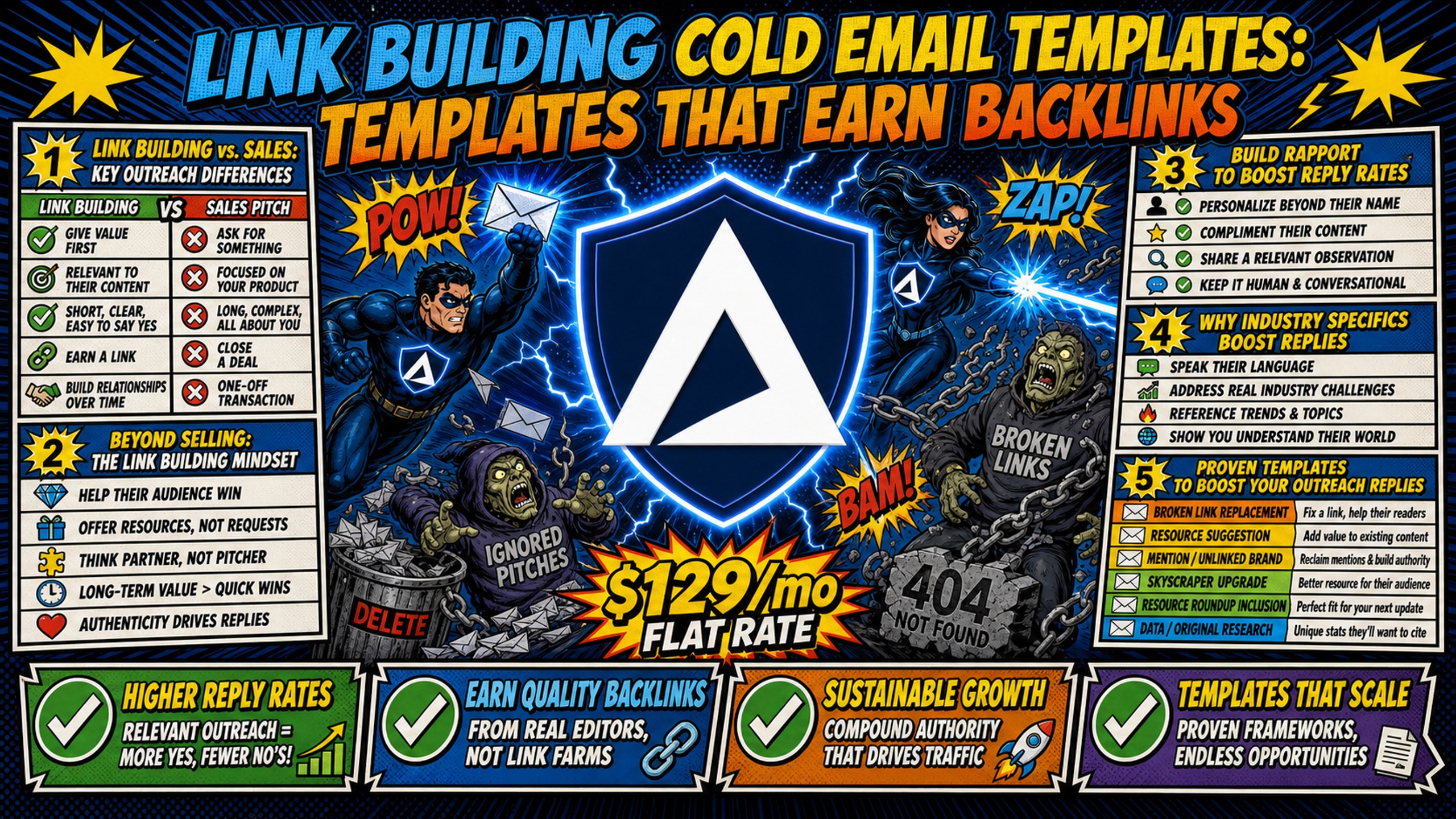
Link building vs. sales: key outreach differences
Link building cold email templates fail when they borrow the structure of sales prospecting emails. A sales email asks someone to buy something. A link building email asks someone to edit their published content, and that distinction changes everything about how you write.
Sales prospecting emails typically open with a pain point, present a solution, and close with a meeting request. Link building emails typically open with research, offer value to the recipient’s audience, and close with a specific, low-effort ask. Most link outreach fails because it asks for value before giving editors a clear reason to care.
Beyond selling: the link building mindset
The best link building emails help the recipient improve a page, update a resource, strengthen a citation, or give their readers better information. They don’t beg for backlinks. Broken-link emails lead with a fix rather than a request, which gives the editor a reason to act before you ask for anything.
This means your opening line should reference something specific about their content, not something generic about their company. The psychology behind first-line reply dynamics applies directly here: editors dismiss generic openers the same way sales prospects do.
Build rapport to boost reply rates
Backlinko and Pitchbox’s 2019 analysis of 12 million outreach emails found that only 8.5% receive a response, with top performers reaching higher rates by optimizing hooks, targeting, and follow-up sequences. Link builders who treat outreach as relationship building rather than transactional requests tend to achieve better results.
Rapport starts with the greeting. Generic openers signal mass outreach immediately. Reviewing common opener mistakes that kill replies before launching a campaign prevents first-impression failures that no follow-up sequence can recover.
Why industry specifics boost replies
Editors and content managers receive many outreach emails. The ones that earn replies reference specific articles, specific data points, and specific gaps in existing content. Personalized openers consistently outperform generic ones in reply rate testing, and the gap widens when the personalization references something the recipient actually wrote. Independent data from Sopro’s 2026 cold outreach statistics supports this: advanced personalization lifts response rates to 18%, compared to 9% for generic emails.
This is where industry-specific knowledge becomes a competitive advantage. Mentioning a statistic from their article, noting a broken link in a specific paragraph, or referencing a resource they published last quarter proves you did the work before hitting send.
Proven templates to boost your outreach replies
The highest-performing link building templates share a common structure: a specific research-based opener, a clear value proposition for the recipient’s audience, and a low-friction ask. Below are the frameworks that earn backlinks across outreach types.
Research sites to refine your pitch
Before writing a single word, spend a few minutes on the target site. Read the article you want a link from. Check the author’s name and role. Look for broken links, outdated statistics, or missing resources that your content could fill.
This research step determines which template category fits the opportunity.
A broken link on their page calls for a replacement pitch. An unlinked mention of your brand calls for a reclamation email. A resource page missing your content type calls for a suggestion pitch. Matching the template to the opportunity is the difference between a generic ask and a reply.
The six link outreach categories, compared
The six template categories that earn backlinks are broken-link fix, skyscraper or “better resource” pitch, resource-page add, guest-post pitch, unlinked-mention reclamation, and expert-quote or roundup offer. Each requires a different structure, and each suits a different type of opportunity.
| Outreach Type | Best Use Case | Personalization Hook | Expected Reply Rate |
|---|---|---|---|
| Broken link fix | Target page has dead outbound links | Specific broken URL and anchor text | Typically higher than cold outreach |
| Resource page add | Curated list missing your content type | Reference specific resources on their page | Varies by personalization depth |
| Guest post pitch | Site accepts contributed content | Reference their recent articles and style | Above average for outreach, per Backlinko and Pitchbox |
| Unlinked mention | Brand mentioned without a hyperlink | Thank them, then request the link | Typically higher than cold outreach, because the mention already exists |
| Expert roundup | Site publishes expert contributions | Compliment their expertise on a topic | Varies by targeting quality |
| Skyscraper / better resource | An existing linked resource is outdated or less comprehensive | Identify the existing resource and explain your content’s specific advantage | Varies by targeting and content quality |
Reply rates vary by list quality, personalization depth, and sending infrastructure.
Draft concise link building emails
Keep every link building email between 75 and 125 words. Boomerang’s analysis of emails sent through its service puts the sweet spot at 50 to 125 words, all of which produced response rates above 50%. Response rates fell to around 44% at 500 words and below 35% past 2,500 words.
Every sentence in your template should earn its place. Cut anything that doesn’t either build credibility, demonstrate research, or move the recipient toward your ask. The principles in this guide to high-reply greetings and openers apply equally to link building outreach.
Use data points for better personalization
Data-driven personalization outperforms compliment-based personalization because it proves you engaged with the content rather than skimming the headline. Reference a specific statistic from their article, note the publication date of a resource they cite, or mention a recent update to their content.
For example, instead of writing “I loved your article on SEO trends,” write “Your point about page speed affecting bounce rates in your March article caught my attention.” The specificity signals genuine engagement, and genuine engagement drives replies.
Ready-to-use backlink outreach templates
These templates are frameworks, not scripts to copy verbatim. Replace every [bracketed placeholder] with research-specific details before sending.
Drafting high-response research emails
Subject: Data for your [Topic] article
Hi [First Name],
Your article on [Article Topic] covered [Specific Point] well. I noticed you referenced [Existing Source] for your data on [Subtopic].
We just published original research on [Your Research Topic] that includes [Specific Data Point]. It complements your article and gives your readers [Specific Benefit].
Here’s the study: [URL]
If you find it useful, I’d be happy to provide the raw dataset for citation.
Best, [Your Name]
Industry survey results template
Subject: New [Industry] survey data for [Their Article Title]
Hi [First Name],
I read your piece on [Article Topic] and found your analysis of [Specific Section] particularly useful.
We surveyed [Number] [Industry Professionals] about [Survey Topic] and found that [Key Finding]. This data directly supports the argument you made in your [Section Name] section.
Full results here: [URL]
Happy to share the raw data or create a custom cut for your audience if that would be helpful.
Best, [Your Name]
Infographic pitch template
Subject: Infographic for your [Topic] guide
Hi [First Name],
Your guide on [Topic] is one of the most thorough resources I’ve found on [Subtopic]. The section on [Specific Section] was especially well-researched.
We created an infographic that visualizes [Data/Process] from our recent study. It might make a useful addition to your [Section Name] section.
You can see it here: [URL]
If you’d like an embed code or a custom version sized for your site, just let me know.
Best, [Your Name]
Broken link and replacement outreach templates
Broken link building works because it solves a problem for the editor before asking for anything. Make the fix as easy as possible to find and make.
Broken link notification template
Subject: Broken link on your [Page Title] page
Hi [First Name],
I was reading your article on [Article Topic] and noticed that the link to [Broken Link Anchor Text] in your [Section Name] section returns a 404 error.
The broken URL is: [Broken URL]
We recently published a resource that covers the same topic: [Your URL]. It includes [Specific Benefit or Data Point] that your readers might find useful.
Either way, thought you’d want to know about the broken link.
Best, [Your Name]
Scripts that secure replacement links
Subject: Replacement for [Broken Resource Name] on [Their Site Name]
Hi [First Name],
I noticed that [Resource Name] linked from your [Page Title] page is no longer active. The link appears in your [Section Name] section.
We cover the same topic at [Your URL], and our guide includes [Specific Advantage: updated data, more examples, interactive elements].
If you’re looking for a replacement, I’d suggest placing it where you referenced [Original Anchor Text]. Happy to provide the exact anchor text that would fit naturally.
Best, [Your Name]
Outreach scripts for unlinked brand mentions
Unlinked mention reclamation typically achieves high conversion rates because the site already referenced your brand. You’re not asking for new coverage. You’re asking them to add a hyperlink to existing coverage.
Basic reclamation request
Subject: Thanks for mentioning [Your Brand] in [Article Title]
Hi [First Name],
I noticed you mentioned [Your Brand/Product] in your article on [Article Topic], here: [URL]
Thanks for including us. Would you consider adding a link to [Your URL] so your readers can find the resource directly?
Either way, appreciate the mention.
Best, [Your Name]
Competitor link parity request
Subject: Quick addition to your [Article Title]
Hi [First Name],
Your article on [Topic] mentions [Competitor/Related Brand] alongside [Your Brand] in the [Section Name] section. I noticed [Competitor] has a link but [Your Brand] doesn’t.
Here’s the URL if you’d like to add one: [Your URL]
Thanks for including us in the piece.
Best, [Your Name]
Correcting an outdated link
Subject: Your [Article Title] reference to [Your Brand]
Hi [First Name],
I came across your article on [Topic] where you referenced [Your Brand]’s [Research/Tool/Data]. The mention is in your [Section Name] section.
The link appears to point to [Incorrect/Outdated URL]. The current resource is at: [Correct URL]
Thought you’d want to update it so your readers land on the right page.
Best, [Your Name]
Skyscraper, resource page, and expert roundup templates
These three templates cover the remaining categories from the comparison table: the skyscraper pitch for outperforming an existing linked resource, the resource page add for curated lists, and the expert-quote offer for roundup-style content.
Skyscraper or better resource pitch template
Subject: Updated resource for your [Article Title]
Hi [First Name],
Your article on [Topic] links to [Existing Resource] in the [Section Name] section. It’s a solid resource, but it hasn’t been updated since [Year] and doesn’t cover [Specific Gap].
We just published a guide that covers [Key Point 1], [Key Point 2], and [Key Point 3], with [Specific Advantage: current data, more examples, original research].
Here it is: [URL]
If you think it’s a stronger fit for your readers, it could replace or complement the existing link.
Best, [Your Name]
Resource page add template
Subject: Resource suggestion for your [Page Title] page
Hi [First Name],
I found your [Page Title] resource page while researching [Topic]. The list is well curated, especially [Specific Resource Already Listed].
We published a [Guide/Tool/Checklist] on [Topic] that fits your [Section Name] section. It covers [Specific Benefit] and is free to access.
Here’s the link: [URL]
If it meets your standards, I’d be glad to see it listed alongside the other resources.
Best, [Your Name]
Expert quote or roundup offer template
Subject: Expert quote for your [Topic] content
Hi [First Name],
I read your recent roundup on [Topic] and noticed you feature practitioner perspectives on [Subtopic].
I’m [Your Name], [Role or Credential] at [Company]. I’ve [Specific Experience or Result], and I’d be glad to contribute a short quote on [Specific Question or Topic] for a future piece.
Here’s an example of a recent contribution: [URL]
Happy to turn something around within [Timeframe] if you’re working on a related article.
Best, [Your Name]
Guest post and co-marketing templates
These templates cover guest posting and co-marketing. Each follows the same principle: lead with value, keep it short, and make the ask specific.
Customizable guest post outreach templates
Subject: Guest post idea for [Blog Name]
Hi [First Name],
I’m a regular reader of [Blog Name]. Your recent article on [Specific Article Topic] stood out because [Specific Reason].
I’d love to contribute a guest post. Here are three topics I think would fit your audience:
- [Topic 1 with Brief Description]
- [Topic 2 with Brief Description]
- [Topic 3 with Brief Description]
I’ve written for [Publication 1] and [Publication 2] on similar topics. Here are samples: [URL 1], [URL 2]
Happy to follow your contributor guidelines if any of these topics resonate.
Best, [Your Name]
When pitching a guest post, follow the contributor guidelines on the target site. This pitch appeals to editors because it offers guest-written content targeting keywords researched specifically for their blog, which saves them the work of topic research.
High conversion guest posting email copy
Subject: Guest post pitch: [Specific Title] for [Blog Name]
Hi [First Name],
I noticed [Blog Name] hasn’t covered [Specific Topic] yet, but your audience clearly cares about [Related Topic] based on the engagement on your article about [Existing Article].
I’d like to write “[Proposed Title]” for your blog. The piece would cover [Key Point 1], [Key Point 2], and [Key Point 3], targeting the keyword “[Target Keyword]” which currently has [Search Volume] monthly searches.
My recent guest posts on [Publication 1] and [Publication 2] covered similar ground: [URL 1], [URL 2]
Best, [Your Name]
Co-marketing outreach email templates
Subject: Co-marketing idea: [Your Brand] x [Their Brand]
Hi [First Name],
Your [Content Piece] on [Topic] and our [Your Content Piece] on [Related Topic] cover complementary ground. I think there’s a co-marketing opportunity that benefits both audiences.
Here’s what I’m thinking: we create a joint [Webinar/Guide/Research Report] on [Combined Topic], promote it to both email lists, and cross-link from our respective resource pages.
Would a 15-minute call this week make sense to explore this?
Best, [Your Name]
Structuring effective backlink follow-ups
Most link building replies come from follow-ups, not initial emails, and Sopro’s 2026 cold outreach statistics back this up: most prospects reply to the second or third cold email, not the first. For link building outreach, a 2-follow-up cadence over 2 weeks works well: a 3 to 5 day nudge and a 14-day close-out.
RAIN Group’s Top Performance in Sales Prospecting research found it takes an average of 8 touchpoints to convert a new prospect, while top performers average 5. Better targeting is what closes that gap, not more sends. Backlinko and Pitchbox found that a single follow-up message boosts replies by 65.8%. Understanding email sequence strategy frameworks helps structure follow-ups that build on each other rather than repeating the same ask.
3-5 day outreach follow-up template
Subject: Re: [Original Subject Line]
Hi [First Name],
I wanted to follow up on my email from [Day of Week] about [Topic]. I know inboxes get busy.
The quick version: [One-Sentence Summary of Your Ask]. Here’s the link again: [URL]
If it’s not a fit, no worries at all.
Best, [Your Name]
14-day follow-up for link prospects
Subject: Last note: [Original Subject Line]
Hi [First Name],
This is my last follow-up on [Topic]. I don’t want to clutter your inbox.
If you’d ever like to [Specific Ask: add the resource, fix the link, consider a guest post], the details are in my previous emails. And if there’s a better person to contact about this, I’d appreciate a point in the right direction.
Thanks for your time either way.
Best, [Your Name]
Why templates alone won’t earn backlinks
Every template in this guide fails if the email lands in spam. Deliverability is the silent killer of link building outreach. Most template guides ignore infrastructure entirely, but DNS health and IP reputation determine whether your carefully personalized pitch reaches a human inbox or dies in a spam folder.
The DNS checklist before you send a single email
Three DNS records plus two pre-send checks help determine whether email providers trust your domain: SPF, DKIM, DMARC, domain age, and IP reputation.
Pre-send checklist:
- SPF record: Verify your sending server’s IP is included in your domain’s SPF record
- DKIM record: Confirm your DKIM public key is published and your sending platform signs outgoing messages
- DMARC record: Set a policy that protects your domain
- Domain warmup: Warm up new domains before launching outreach. Inframail has no built-in warmup tool, so plan for an external service like Warmbox or Lemwarm at $15 to $50 per inbox per month. The exception is Inframail’s DFY package, which includes free domain warmup.
- IP reputation: Check whether your sending IP appears on blacklists before launching
Dedicated IP vs. shared IP for link building outreach
Shared IP pools work like carpool lanes where you’re affected by other drivers. If one sender in a shared pool hits spam traps or generates high bounce rates, the entire IP reputation suffers, and you have zero visibility into who shares your pool. Spamhaus can list whole ranges where it sees snowshoe-style sending patterns, and removal requests have to come from the ISP that owns the listed addresses, which means you are waiting on someone else to act.
Dedicated IPs work like private lanes where your behavior alone determines reputation. Inframail’s dedicated IP vs. shared IP breakdown explains how agencies often discover shared IP problems only after deliverability drops have already affected client campaigns. Kidous Mahteme’s dedicated IP vs. shared pool comparison illustrates exactly how this plays out in practice.
The cost of scaling link building outreach
Learning how to write link building outreach emails is only half the equation. The other half is infrastructure that can send those emails at scale without per-inbox costs eating your budget. One limitation worth stating plainly before the numbers: Inframail provisions Microsoft inboxes only, so teams that require Google Workspace infrastructure are not a fit. The comparison below is a switch from Google Workspace to Microsoft infrastructure, not a cheaper way to keep running Google Workspace.
For 50 inboxes, Google Workspace Business Starter costs $420/month at $8.40 per user per month on the Flexible Plan (month-to-month, no commitment). Inframail’s platform fee is $147/month flat for unlimited inboxes, as detailed in Inframail’s pricing breakdown. That is $273/month in platform savings, or $3,276 annually.
| Inbox Count | Google Workspace (Flexible, per-seat) | Inframail (Unlimited, flat-rate) | Monthly Platform Savings |
|---|---|---|---|
| 50 inboxes | ~$420/month | $147/month | $273 |
| 100 inboxes | ~$840/month | $147/month | $693 |
| 200 inboxes | ~$1,680/month | $147/month | $1,533 |
Platform fees only. Domain costs ($5 to $16 per domain per year) and warmup tools (typically $15 to $50 per inbox per month) apply on both sides and are not included in this comparison.
Setting up 50 cold email domains manually takes 12+ hours of DNS panel work. Inframail’s automated DNS configuration handles SPF, DKIM, and DMARC records without manual panel access, auto-provisioning inboxes and writing all DNS records quickly. You can scale to hundreds of inboxes without paying extra beyond the flat infrastructure price, because inbox count is unlimited on both plans.
The binding constraint at scale is monthly send volume, not inbox count. The Unlimited Plan ($147/month) sends up to 80,000 cold emails per month, and the Agency Pack ($387/month) sends up to 300,000 cold emails per month for higher-volume campaigns.
What real users report
The deliverability claims matter, but so does the operational experience:
“I send 4,000 emails a day, sometimes 7 days a week. All my domains are .info which aren’t the best for deliverability and even then I’m still hitting ~99% deliverability across the board.” - Verified user review of Inframail
Inframail maintains a 4.5/5 TrustScore on Trustpilot, with users reporting high deliverability rates and effective blacklist management that active link building campaigns require. On the operational side, support runs 16 hours a day from real people, and Inframail’s website testimonials report setup speeds as fast as 10 inboxes in 2 minutes.
For a comprehensive walkthrough of cold email infrastructure setup, this 2025 cold email infrastructure walkthrough covers the full process from domain purchase through sending platform import. And for teams evaluating their options, this comparison of four inbox purchasing approaches breaks down the trade-offs between vanilla Google and Microsoft accounts, resellers, and dedicated infrastructure providers.
Scale your link building outreach with the right infrastructure
Inframail is a flat-rate Microsoft email infrastructure provider built for agencies and outreach teams running cold email at scale. It automates SPF, DKIM, and DMARC configuration across unlimited inboxes, provides a dedicated US-based IP on the Unlimited Plan (or three on the Agency Pack) so your sending reputation stays isolated, and covers all inboxes for $147/month flat. Inframail reports a 98%+ deliverability rate and a 68.3% blacklist delisting success rate within 48 hours, so campaigns stay running when they need to.
In this case study video, learn how Inframail helped a client launch cold email outreach at a low cost using around 75 email accounts with strong deliverability, book more calls than ever before, and more than double their monthly recurring revenue in 60 days.
Sign up to Inframail and get started today.
FAQs
How long should a link building cold email be?
Keep link building emails between 75 and 125 words. Boomerang’s analysis puts the sweet spot at 50 to 125 words, all of which produced response rates above 50%. Response rates fell to around 44% at 500 words and below 35% past 2,500 words.
What’s the best time to send link building outreach emails?
Backlinko and Pitchbox found Wednesday was the best-performing day, with weekday sends converting 23.3% better than weekend sends. Time of day matters less than day of week in their data.
How many follow-ups should I send for link building?
Send two follow-ups over 2 weeks: a 3 to 5 day nudge and a 14-day close-out. Most link building replies come from follow-ups, not the initial email, so stopping after one send leaves backlinks on the table.
Should I use my personal email or company domain for outreach?
Use a dedicated secondary domain, not your primary company domain. Cold outreach can risk spam complaints and blacklisting, and a secondary domain helps isolate that risk so your main business email reputation stays protected.
What’s a good response rate for link building emails?
Backlinko and Pitchbox’s analysis of 12 million outreach emails found that only 8.5% receive a response. Sopro’s 2026 research puts the average cold email response rate at 5.1%, with most campaigns landing between 1% and 5%.
Key terms glossary
Backlink outreach: The practice of contacting website owners, editors, and content managers to request a link to your content. Effective backlink outreach templates lead with value rather than asking for favors.
Broken link building: A link building strategy where you find dead outbound links on target websites and suggest your content as a replacement. This approach leads with a fix rather than a request, which gives the editor a reason to act before you ask for anything.
Unlinked mention: A reference to your brand, product, or content on another website that doesn’t include a hyperlink. Because the site has already referenced the brand, adding a link is an edit rather than a new editorial decision.
Resource page: A curated page on a website that lists helpful links, tools, or references for a specific topic. Resource page outreach involves suggesting your content as an addition to the existing list.