
How many reminder emails should you send before stopping?
The right reminder email count depends on context. Industry benchmarks suggest cold outreach sequences typically use four to seven touches, meeting confirmation
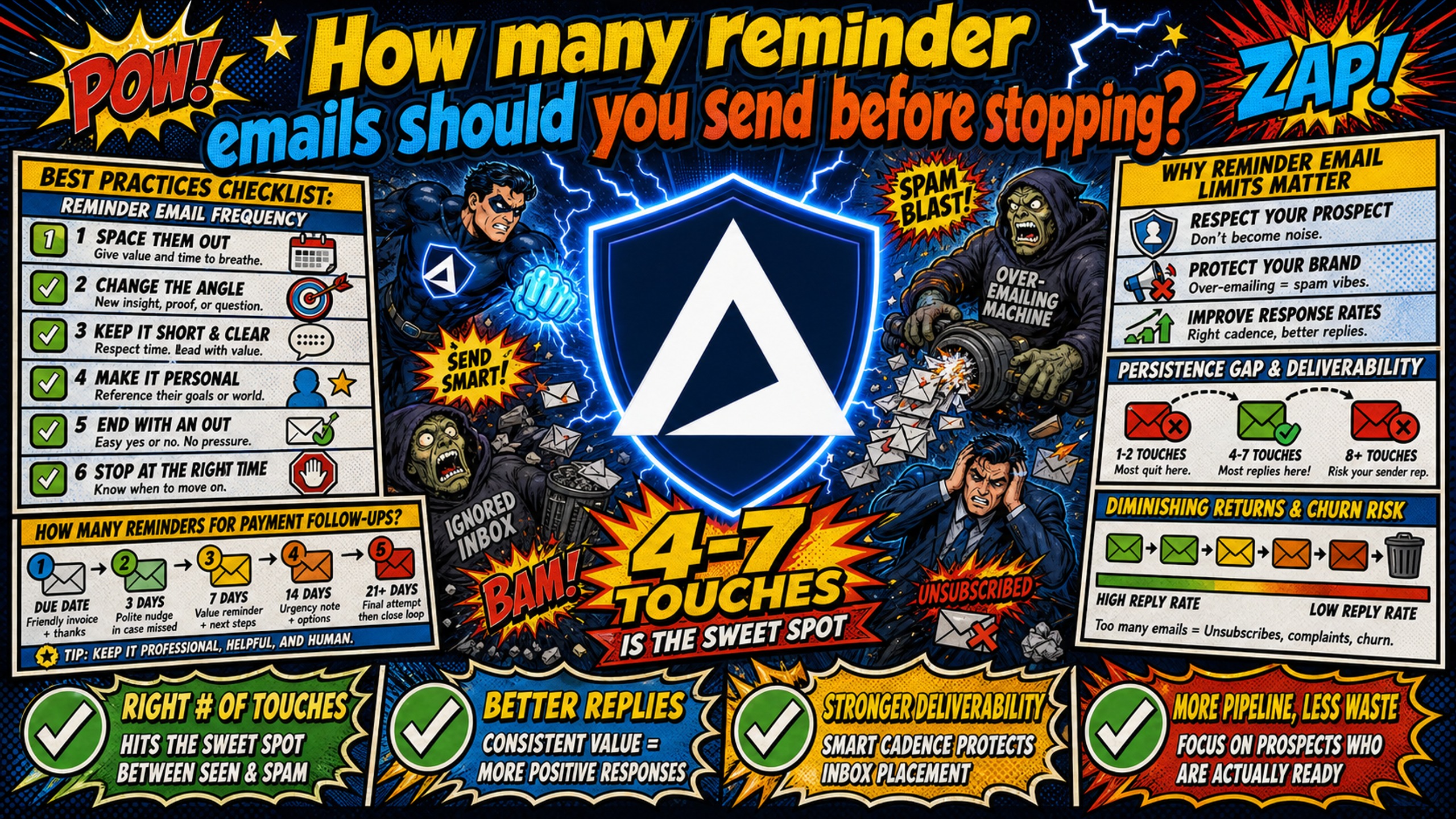
TL;DR: The right reminder email count depends on context. Industry benchmarks suggest cold outreach sequences typically use four to seven touches, meeting confirmations two to three, and payment reminders five to six touches spread across 30 to 60 days. Sending beyond recommended thresholds can increase spam complaints and risk domain blacklisting, which can destroy active client campaigns. Running sequences at agency scale requires infrastructure that keeps costs flat as volume grows. Inframail's flat-rate Microsoft infrastructure at $129/month provides dedicated IPs and automated DNS setup so agencies can run optimal sequences without paying per-seat fees on every inbox.
Most agency founders focus on email copy. The real bottleneck is knowing exactly when persistence crosses into spam territory and starts burning the domains their entire client base depends on.
Research widely cited across B2B sales training suggests that a significant portion of non-routine sales require multiple follow-up touches to close, yet many sales representatives stop after a single email. That gap between what persistence actually requires and what most teams actually do represents measurable revenue loss. At the same time, pushing beyond the safe threshold for each sequence type risks far more than a missed reply. It risks the domain health that keeps every client campaign deliverable.
This guide breaks down the exact recommended reminder counts for cold outreach, payment follow-ups, and meeting confirmations, along with the technical thresholds that define when to stop.
Best practices checklist: reminder email frequency
Before diving into sequence-specific counts, these core practices apply across every reminder type. Ignoring them at any volume creates deliverability risk regardless of how well-calibrated the sequence length is.
- Goal definition: Define the specific outcome for each sequence before writing the first touchpoint.
- Opt-out mechanisms: Include a clear, simple way for recipients to unsubscribe from every sequence.
- Timing windows: Test different send times based on your audience's behavior patterns to find optimal windows.
- Interval spacing: Wait at least two to three days before sending the first reminder, and space subsequent cold touches four to five days apart initially, increasing to seven to fourteen days for later touches.
- Reputation monitoring: Track domain health and blacklist status regularly to catch deliverability drops before clients notice.
Why reminder email limits matter
Two dynamics drive the case for strict sequence limits: what happens to reply volume when senders stop too early, and what happens to domain health when they don't stop early enough.
The persistence gap and deliverability impact
Industry benchmarks suggest that a substantial portion of all replies a sequence generates come from follow-up steps rather than the first email. A one-touch campaign abandons a significant share of its potential response volume before it starts. For agencies managing five to fifteen client campaigns simultaneously, that abandonment compounds across every domain in the stack, turning a sequencing decision into a margin decision.
Every email service provider (ESP) assigns a trust score to sending domains based on engagement signals. When emails land in inboxes that don't open, click, or reply across multiple sends, ESPs route messages to spam folders or block them outright. According to Google and Yahoo's February 2024 sender rules, bulk senders must keep spam complaints at or below 0.1% (1 per 1,000 recipients), with 0.3% marked as an absolute ceiling that triggers heavier throttling if crossed. Sequences that keep mailing unresponsive addresses can cross problematic thresholds because the only recipients left are the ones who have already ignored every previous message.
The infrastructure choice determines how much damage a single flagged domain causes. On a shared IP pool, one over-eager sequence from any sender can flag the range and drag down deliverability for every account on it. Inframail's dedicated IP model (one IP on the Unlimited Plan, three on the Agency Pack) means the agency's sending behavior alone determines its reputation, and one client domain hitting trouble doesn't contaminate the others. High-volume senders managing large domain stacks should monitor domain rotation strategy and spam filter thresholds as a separate operational layer from sequence length limits.
Diminishing returns and client churn risk
Reply rates tend to decay predictably across a sequence. The first email typically captures the largest share of all replies. Touches two through four usually capture most of the remainder, and touches five through seven capture a smaller share. Beyond the seventh touch, returns tend to shrink substantially while spam complaint exposure may continue growing with each send.
A deliverability collapse is not a technical inconvenience. For a lead generation agency, it is a client retention crisis. When an over-sent cold sequence burns a client domain and meetings stop arriving, the client's instinct is not to audit the sequence length, it is to cancel the retainer. Managing sequence length is one of the most direct inputs to client lifetime value, not just reply rates. The infrastructure monitoring guide on Inframail's blog covers the specific health checks and alert thresholds that catch deliverability problems before they become client churn triggers.
How many reminders for payment follow-ups
Payment reminders typically carry transactional rather than promotional characteristics, which gives them a natural legitimacy that cold outreach doesn't have. That legitimacy can extend the acceptable sequence length, but it doesn't make infinite follow-up appropriate.
Recommended sequence and timing
A structured payment reminder sequence commonly runs five to six touches spread across 30 to 60 days. Best practice frameworks typically include a courtesy heads-up seven days before the due date, a clear nudge one to three days before the due date, then follow-ups at one day overdue, seven days overdue, and fourteen days overdue, with a final notice at thirty to sixty days if the invoice remains unpaid.
This staged sequence is a standard framework for professional invoice collection. Spacing typically starts at seven days for early reminders, then tightens to every three to seven days as invoices age past the due date, giving recipients time to process the payment initially while increasing urgency for overdue balances. Chaser HQ's payment reminder research documents a similar staged escalation approach, extending to eight touches across 90 days for invoices that stay unpaid the longest.
Tone should shift progressively across the sequence. The first email is a courtesy reminder. The second is a neutral statement of the outstanding balance. The third introduces urgency with a specific resolution deadline. Touches four through six escalate to formal notice language with stated consequences for non-payment.
When to escalate or stop
After the fifth or sixth reminder with no response, consider stopping email outreach. The signal from five unanswered payment emails is typically clear: email is not the right channel to resolve this. Escalating to a phone call or a formal collections process keeps the matter moving without burning the business relationship through continued email pressure.
How many reminders for meeting confirmations
Meeting reminders serve a different purpose than conversion sequences. Their goal is reducing the no-show rate, which directly affects the cost-per-meeting metric agencies use to demonstrate ROI to clients.
Pre-meeting reminder cadence
Common scheduling-platform guidance suggests that a single well-timed reminder can significantly reduce no-show rates. A two-message sequence typically drives further reductions, and adding a third often doesn't meaningfully improve attendance beyond the two-touch baseline. A common pre-meeting cadence is a confirmation email sent immediately after booking, a reminder twenty-four to forty-eight hours before the scheduled call, and an optional short reminder two to four hours before for high-stakes meetings.
No-show follow-up and when to stop
When a prospect misses the meeting, a common approach is to send one to two rescheduling reminders spaced within twenty-four hours of the missed meeting. The first offers a new booking link with a brief, non-judgmental note. The second is a final attempt. This covers the realistic window where a genuinely interested prospect with a scheduling conflict will respond. If there is no response after these rescheduling emails, move the prospect back to a low-frequency nurture list rather than continuing with active outreach.
How many reminders for cold outreach
This is the highest-volume sequence type and the one most likely to create domain health problems if the length is miscalibrated.
Recommended touchpoints for cold sequences
Four to seven touches is commonly recommended for cold outreach sequences, consistent with current industry benchmarks for 2025. This range typically captures the bulk of available replies (touches one through four generate the majority of meetings) while touching the remaining pipeline that only responds at touch five or six. Beyond seven touches, diminishing returns tend to become severe enough that continued sending may inflate spam complaint exposure without generating proportional response volume.
A common timing structure for protecting domain health is a two to three-day wait for the first follow-up and four to five days between subsequent touches initially, increasing to seven to fourteen days for later touches. Spacing tighter than two to three days can signal desperation to ESPs and to recipients, potentially reducing reply rates and increasing unsubscribes. For agencies sending at high volume, Lead Gen Jay's cold email math illustrates how sequence length and daily inbox limits interact to determine required infrastructure scale.
Response rate drop-off by follow-up
According to Woodpecker's cold email benchmarks, the first email reportedly captures 58% of all replies a sequence will ever generate. The first follow-up peaks at around 8.4%, and the second follow-up adds roughly 3% more. Returns diminish sharply beyond the fourth follow-up, where spam and unsubscribe risk roughly triples.
Campaigns with three to five follow-up steps often hit reply rates substantially higher than campaigns with zero follow-ups. A six-touch sequence typically recovers most of the value a twelve-touch sequence would generate, at a fraction of the domain risk. For additional response-rate benchmarks and per-touch tactics, the B2B cold email response rate guide on Inframail's blog covers data from Belkins and Reply alongside Inframail's own findings. For cadence structure and timing strategy, the Instantly follow-up walkthrough covers subject line variation and step spacing in practical detail.
When to move prospects to nurture
After the seventh touch, a common practice is to remove the prospect from the active cold sequence and move them to a low-frequency nurture list. This preserves the domain health of the primary cold sending infrastructure while keeping the prospect in the pipeline for a future outreach cycle. Agencies running this split between active sequences and nurture lists benefit from calculating sending capacity correctly before scaling to ensure inbox count matches daily volume targets across both lists.
Contextual cadence matrix
| Sequence type | Recommended touches | Spacing interval | Primary goal |
|---|---|---|---|
| Cold outreach | 4 to 7 | 2 to 3 days initially, increasing to 7 to 14 days | Book a meeting |
| Meeting reminders | 2 to 3 | 24 to 48 hours / 2 to 4 hours | Reduce no-shows |
| Payment follow-ups | 5 to 6 | 7 days initially, tightening to 3 to 7 days | Collect outstanding invoice |
Cadence quick reference
| Campaign goal | Target audience | Recommended sequence length | Stop trigger |
|---|---|---|---|
| B2B lead generation | Cold prospects | 4 to 7 emails | Opt-out or 7th touch |
| Inbound demo booking | Warm leads | 4 to 5 emails | Meeting booked |
| Invoice collection | Active clients | 5 to 6 emails | Payment received |
| Event attendance | Registered guests | Multiple reminders | Event start time |
The break-up email as a sequence closer
The break-up email is the final touch in a cold sequence, and it often generates a response spike relative to mid-sequence touches. Why it works: When a prospect receives an email that explicitly states it is the last one they will receive, it forces a decision. Ignoring every previous email required no active choice. Ignoring a final email requires a deliberate choice to let the conversation close, and loss aversion drives a portion of prospects to reply.
What to include: A break-up email typically contains a clear statement that this is the last outreach, a brief one-sentence restatement of the specific value being offered, and a simple opt-in mechanism if the prospect wants to reconnect in the future. The tone should be professional and respectful, not guilt-inducing.
Expected results: The pattern across high-volume cold email sequences is consistent: the break-up email generates a spike relative to touches five through seven, but the majority of those replies are polite opt-outs rather than booking requests. A polite opt-out is a clean list, which protects domain health. A booked meeting from the break-up email is direct ROI from a touch that would otherwise have been skipped. For call-to-action (CTA) strategy across all sequence touches including the final email, Inframail's hard vs. soft CTA breakdown covers the mechanics in practical terms.
Signs you're sending too many reminders
Monitoring these signals before a client notices is the difference between a quick fix and a deliverability emergency.
Unsubscribe rate climbs above 0.5%: A rate between 0.2% and 0.5% is typical for most B2B sending. According to a MailerLite analysis cited by Prospeo's unsubscribe research, the overall email unsubscribe rate across general marketing sends reached 0.22%. Anything consistently above 0.5% may signal a mismatch between what recipients expected and what they're receiving, which typically means the sequence is running too long or hitting the same contacts too frequently.
Spam complaints exceed 0.1%: According to Google and Yahoo's February 2024 sender rules, bulk senders must keep spam complaints at or below 0.1% (1 per 1,000 recipients), with 0.3% marked as an absolute ceiling that triggers heavier throttling if crossed. Exceeding the 0.1% mark can trigger throttling and spam-folder routing across Google and Microsoft infrastructure. Senders must also authenticate with SPF (Sender Policy Framework), DKIM (DomainKeys Identified Mail), and DMARC (Domain-based Message Authentication, Reporting, and Conformance), and honor unsubscribe requests promptly according to these sender requirements.
Inbox placement rate drops: A falling inbox placement rate (the percentage of sent emails landing in the primary inbox rather than spam) is the leading indicator that a sequence is damaging a domain. By the time a client reports fewer replies, the damage is already compounding. Inframail's deliverability monitoring dashboard tracks domain and IP health with blacklist monitoring and automatically submits delisting requests when domains are flagged. The platform's 68.3% delisting success rate within 48 hours provides a recovery path when over-sending causes a flag, rather than leaving the agency to manage the process manually.
How to test your ideal reminder count
The ranges in this guide are starting points. Every niche, offer, and audience profile behaves differently, and systematic testing is what converts general benchmarks into agency-specific data.
A/B testing sequence length: Run a split test comparing a four-step sequence against a seven-step sequence using the same offer and audience. Industry guidance commonly suggests a minimum of around 200 emails per variant and approximately five to seven business day run time for meaningful results. Extending tests beyond this window often delays actionable decisions without adding proportional clarity.
Tracking reply rates by touchpoint: The metric to track is positive reply rate per touch, not just overall reply rate. A seven-step sequence where all meaningful replies arrive at touches one through four is telling you that a four-touch sequence captures the same value. Cutting the sequence there protects domain health without sacrificing conversion volume.
Monitoring deliverability impact during tests: Every sequence length test should run against deliverability monitoring alongside reply rate tracking. A longer sequence may generate a marginally higher total reply count while simultaneously degrading the domain's inbox placement rate. Inframail's flat-rate pricing at $129/month allows agencies to spin up additional test domains without incurring extra per-seat costs, which matters when comparing infrastructure options at the cost comparison across seven platforms.
"This is genuinely the best cold email hosting software you can find for many reasons... With the $129/month Unlimited Plan, I'm able to send up to 80,000 emails per month at the recommended 40 emails per inbox per day... All my domains are .info and I'm still hitting strong deliverability across the board." - Verified user review of Inframail
The core answer to how many reminders to send comes down to three numbers: four to seven for cold outreach, five to six for payment follow-ups, and two to three for meeting confirmations. The universal stop trigger across all three sequence types is domain health. When spam complaint rates approach 0.1% or inbox placement rate starts falling, the sequence has already run too long regardless of where it sits in the recommended range.
For agencies deciding between Maildoso's shared IP infrastructure and Inframail's dedicated IP model when choosing a platform for sequence testing, the Maildoso alternatives guide covers the deliverability implications of shared versus dedicated IPs at each volume tier. Sign up to Inframail and get started today.
FAQs
What is the maximum number of cold outreach reminder emails to send?
For cold outreach, industry benchmarks commonly recommend a maximum of seven touches before moving the prospect to a nurture list. Sending beyond seven touches may significantly increase spam complaint exposure without generating meaningful additional replies.
How long should you wait between reminder emails?
Wait two to three days before sending the first cold follow-up, then space subsequent touches four to five days apart initially, increasing to seven to fourteen days for later touches. For payment reminders, send the first reminder seven days before the due date, followed by a nudge one to three days before, then post-due-date reminders starting at one day overdue, seven days overdue, and fourteen days overdue.
Should auto-replies count as engagement in a cold sequence?
No, out-of-office auto-replies typically do not indicate genuine engagement and should not count as active responses. Pause the sequence and resume once the prospect is back and can actively read messages.
When should non-responders be moved off active cold lists?
After the seventh touch with no response, a common practice is to move non-responders to a low-frequency nurture list rather than continuing active cold outreach. Continuing to mail non-responsive addresses past that point may raise spam complaint rates and degrade inbox placement rate for all other recipients on the same domain.
How does a dedicated IP affect sequence limits?
A dedicated IP means that only the agency's sending behavior determines its IP reputation, so one over-sent sequence does not contaminate other client domains sharing the same IP. On shared IP pools, one sender's excessive sequences can potentially flag the entire IP range and affect deliverability for other senders on it.
At what inbox count does Inframail become cheaper than Google Workspace?
The breakeven point sits at approximately 18 to 19 inboxes. At Google Workspace's typical pricing of around $7 per inbox per month, 19 inboxes costs roughly $133/month, which exceeds Inframail's flat $129/month rate regardless of inbox count.
Key terms glossary
Dedicated IP: An IP address used exclusively by a single sender, ensuring their IP reputation is determined solely by their own sending behavior rather than being affected by other users on shared infrastructure.
Inbox placement rate: The percentage of sent emails that successfully land in the recipient's primary inbox rather than being routed to spam or promotional folders.
Spam complaint rate: The percentage of recipients who mark a message as spam. According to Google and Yahoo's February 2024 sender requirements, bulk senders must keep spam complaints at or below 0.1% (1 per 1,000 recipients), with 0.3% marked as an absolute ceiling that triggers heavier throttling or blocking if crossed.
Domain blacklisting: A state where a sending domain is flagged by security databases or email service providers, typically causing messages to be routed to spam or blocked entirely, as covered in Inframail's Microsoft blacklist recovery guide.
SPF, DKIM, and DMARC: DNS authentication records that verify a sending domain's legitimacy to receiving mail servers. Inframail configures all three automatically without requiring manual DNS panel access.
Reply-rate decay curve: The commonly observed pattern of declining response rates across sequential email touches in a campaign, where each additional touch typically generates a smaller share of total replies than the one before it.