
Enterprise email sending API: security, compliance, and volume requirements
Enterprise email API selection is a governance decision disguised as a technical one. Screen vendors on SOC 2 Type II, signed DPAs, granular access controls, an
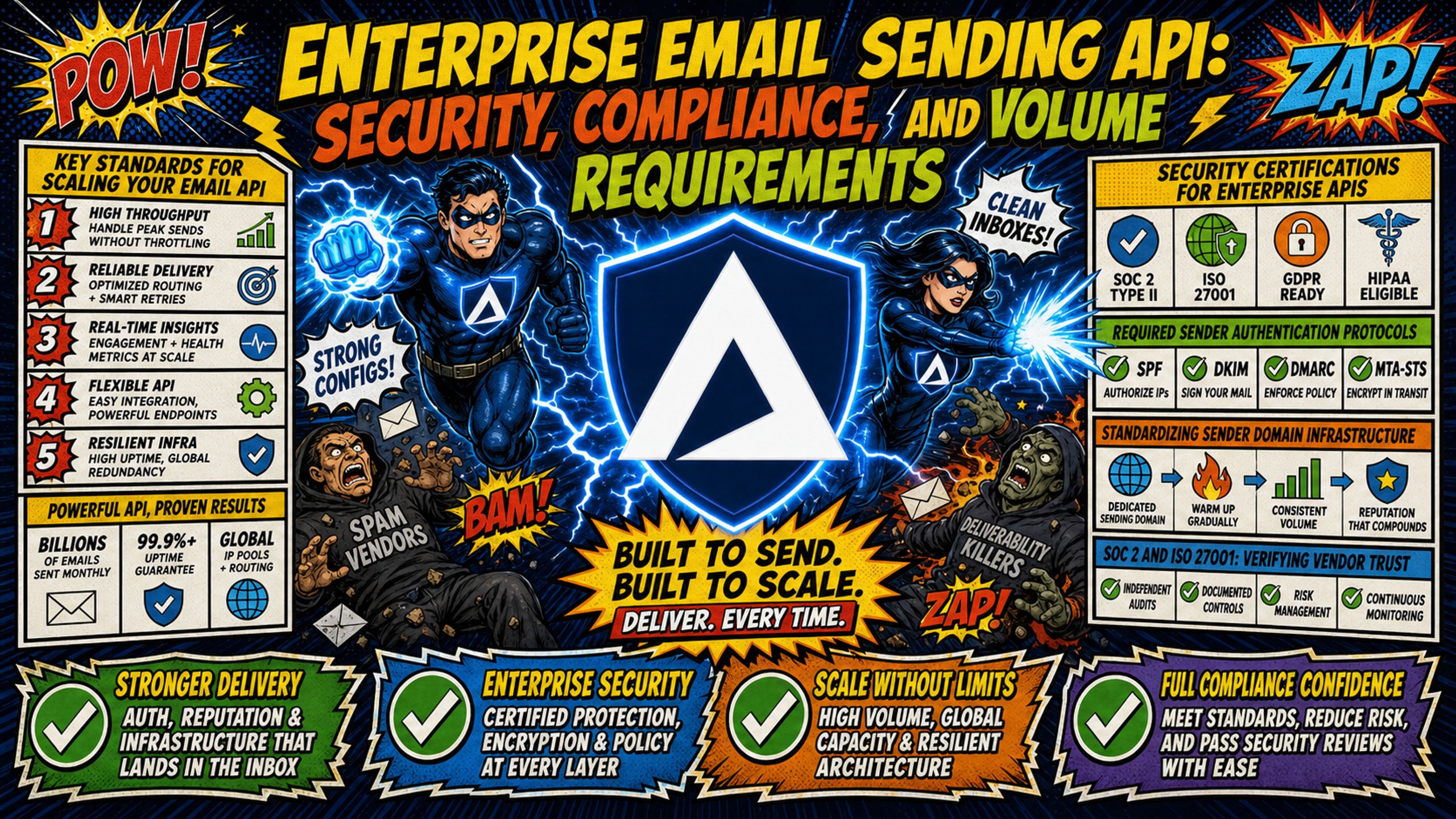
TL;DR: Enterprise email API selection is a governance decision disguised as a technical one. Screen vendors on SOC 2 Type II, signed DPAs, granular access controls, and contractual uptime before price. Certifications are table stakes, not differentiators. The real test is whether the vendor detects a blacklisting before you do and resolves it without a support ticket. Use a weighted scorecard to rank providers by business impact, and disqualify any vendor that cannot provide audit logs or a signed Data Processing Agreement on request. Inframail suits agencies under 300K monthly sends that can work within standardized controls. Teams with a hard SOC 2 procurement requirement should treat its absence as a disqualifier.
A single blacklisted domain can kill reply rates within hours. The vendors that survive enterprise security reviews are the ones that catch that blacklist before you do. Most evaluations start with pricing and end with a compliance failure. The ones that end well start with a governance scorecard that disqualifies providers before a sales call.
This guide provides a weighted vendor scorecard that ranks providers by business impact before pricing enters the conversation. You will learn how to verify security certifications, confirm compliance posture, configure access controls, and detect delivery failures before they cost you a client.
Key standards for scaling your email API
Enterprise procurement teams screen for security posture before they evaluate sending volume. These three standards determine whether you pass the initial screen or get routed to procurement hell for six weeks.
Security certifications for enterprise APIs
SOC 2 Type I is generally understood to assess whether a vendor designed controls correctly at a point in time, while SOC 2 Type II assesses whether those controls operated consistently over an extended period. For enterprise procurement, Type II is the minimum bar. ISO 27001 is a widely recognized international standard for information security management systems, while SOC 2 is a service-audit framework used primarily in North America. For vendors targeting Fortune 500 procurement, both certifications are table stakes. For mid-market teams, these certifications reduce risk but are weighed against other factors like cost, automation, and support quality.
Required sender authentication protocols
SPF (Sender Policy Framework) authorizes which servers can send email for your domain. DKIM (DomainKeys Identified Mail) adds a digital signature proving your email has not been tampered with. DMARC (Domain-based Message Authentication, Reporting & Conformance) tells receiving servers what to do when authentication fails.
Manual configuration across 50 domains takes 12 hours or more. Inframail handles SPF, DKIM, and DMARC setup automatically when you provision domains, eliminating the manual DNS work entirely.
Standardizing sender domain infrastructure
Inconsistent DNS records trigger spam filters. When you manage 50 domains, a single typo in a TXT record can kill deliverability for that entire domain.
Automated provisioning cuts this work from hours to minutes and removes the risk of typos in the records. Dedicated IPs provide another layer of standardization: instead of sharing IP reputation with unknown third parties, you control the sending behavior that determines your sender score. This consistency allows enterprise teams to scale from 5 domains to 50 without hiring a DNS engineer.
SOC 2 and ISO 27001: verifying vendor trust
Certifications are evidence that a third party audited the vendor's controls and found them operating effectively. A provider with poor security controls is more likely to suffer breaches that compromise your sending domains.
How certifications protect sender reputation
A SOC 2 Type II audit examines security, availability, and confidentiality controls over time. If a vendor cannot protect their own infrastructure, they cannot protect your sender reputation. A breach that exposes your API keys or customer lists destroys the domain reputation your team spent months warming up.
Request the actual audit report, not just a badge on a website. Confirm the scope covers the email API service specifically, not just the parent company's general IT infrastructure. Legitimate audits come from accredited firms, not internal security teams.
Confirming compliance for email APIs
Request three documents: the SOC 2 Type II report (under NDA), the ISO 27001 certificate, and a list of sub-processors. The report must show zero exceptions or deviations in controls relevant to email transmission. If the vendor hesitates, disqualify them immediately.
Inframail does not currently hold SOC 2 certification. Teams with a hard procurement requirement for SOC 2 should factor this into their scorecard. For teams that can accept this trade-off, Inframail's $147/month flat rate for unlimited inboxes delivers significant cost savings compared to per-seat providers. Warmup tools are required and not included.
Must-ask security questions for APIs
Ask these four questions in every sales call. Document the answers in your vendor scorecard. If the answers are vague, move on.
- Can you provide your most recent SOC 2 Type II report? ("We're working on it" means no.)
- What is your incident response SLA for security breaches? (Look for 24 hours or less.)
- How do you isolate tenant data in multi-tenant environments? (The answer should involve logical separation, not "trust us.")
- What access controls do you support for API keys and user roles? (RBAC and SSO should be standard, not enterprise add-ons.)
Email API compliance requirements: GDPR and DPA
If you send email to EU citizens, GDPR applies. If your vendor processes personal data on your behalf, you need a Data Processing Agreement (DPA). Ignoring either requirement can result in regulatory fines.
Key DPA requirements for email vendors
A DPA under GDPR Article 28 must describe the processing (subject matter, duration, nature, purpose, types of personal data, categories of data subjects, and controller obligations) and commit the processor to a set of contractual terms. These are generally understood to include processing only on documented instructions, ensuring confidentiality, implementing security measures, managing sub-processors, assisting with data subject rights, helping with compliance, deleting or returning data at termination, and allowing audits. If a vendor's DPA is missing any of these clauses, it may not be GDPR compliant. The regulation became applicable on May 25, 2018 (Regulation (EU) 2016/679), and Article 28 terms should be treated as a day-one procurement requirement.
Verifying GDPR compliance for email APIs
Request the DPA before you sign the order form. Review the sub-processor list to see where your data actually goes. If your vendor uses US-based sub-processors but claims GDPR compliance, verify they have Standard Contractual Clauses (SCCs) in place for the transfer.
Inframail operates US-based infrastructure only. If your clients require data to remain in the EEA, you will need to either restrict Inframail usage to non-EU campaigns or choose a vendor with EU data centers.
Regional data residency requirements
Some enterprise buyers require data to stay in specific regions. Buyers in regulated sectors, including EU financial services and APAC firms handling personal data, may mandate regional data residency. Inframail operates US-based infrastructure only. Teams with strict EU or APAC residency requirements should weight this heavily in their vendor scorecard.
Transferring data outside the EEA
Standard Contractual Clauses (SCCs) are the legal mechanism for transferring personal data from the EU/EEA to the United States. Verify your vendor's DPA includes the current SCCs, not outdated earlier versions.
Configuring secure API access controls
Access controls determine who can provision domains, who can export credentials, and who can see audit logs. Weak access controls turn a compromised password into a full infrastructure breach.
SSO for secure team access
Single Sign-On (SSO) allows users to access your email infrastructure using your existing identity provider (Okta, Azure AD, Google Workspace). This reduces credential sprawl and makes offboarding instant: when a team member leaves, you disable their account in your identity provider and they lose access to all connected systems immediately. Without SSO, you are managing separate passwords for your email infrastructure, CRM, sending platform, and data provider, each a potential breach vector. For enterprise teams, SSO is basic security hygiene.
Implementing least privilege API access
Role-Based Access Control (RBAC) grants permissions based on job function, not seniority. A campaign manager needs to provision domains and monitor deliverability, but they do not need access to billing settings or the ability to delete entire client accounts. Least privilege means granting the minimum access necessary for the role.
Automating API key lifecycle management
API keys are credentials that allow programmatic access to your email infrastructure. If a developer hardcodes a key into a script and that script ends up in a public GitHub repository, your infrastructure is compromised. Automated key rotation limits the window of exposure. Short-lived tokens reduce damage from leaked credentials. Your email API should support automated rotation without breaking existing integrations. If rotating a key requires a support ticket and 48 hours of downtime, the vendor does not understand enterprise security.
Detecting blacklists and delivery issues
Audit logs and real-time alerts are the difference between catching a blacklist early and discovering it when your client calls asking why reply rates dropped to zero.
Mandatory audit logs for email APIs
Audit logs record every action taken in your account: who provisioned which domain, when they exported credentials, what IP addresses accessed the API, and when settings changed. For security incidents, these logs provide the forensic trail needed to determine what happened and what data was exposed. For compliance audits, they prove you followed procedures. SOC 2 auditors will ask for evidence of access controls and monitoring. If your email API cannot export audit logs showing who accessed which domain and when, you will fail the audit.
How to archive and export audit data
Export your audit logs to a SIEM (Security Information and Event Management) system or cloud storage bucket. Set retention policies based on your compliance requirements. GDPR requires logs only as long as necessary for the processing purpose, but many SOC 2 auditors typically expect 12 months of log retention. Test the export process before you need it, and verify you can export logs in a standard format via API, not just through a web interface that requires manual clicking.
Instant delivery failure notices
Real-time alerts for blacklistings allow you to pause campaigns before they damage your sender reputation further. Inframail's platform monitors domain and IP health continuously and auto-submits delisting requests at a 68.3% success rate, per Inframail's buyer's guide. The platform alerts you when domains are flagged. For high-volume senders, this monitoring is the difference between a minor deliverability dip and a client-facing disaster.
For agencies that have already lived through a provider failure, blacklist visibility becomes the top evaluation criterion.
High volume email API infrastructure requirements
Sending 80,000 emails per month requires different infrastructure than sending 800. Verify that the vendor can handle the volume without throttling, that uptime is contractually guaranteed, and that reputation isolation is architectural.
Defining uptime guarantees for APIs
An uptime SLA (Service Level Agreement) is a contractual commitment to availability. Look for 99.9% or higher. The SLA should define how uptime is calculated, what counts as downtime, and what credits you receive for breaches. "We have great uptime" is not a commitment, but "We guarantee 99.9% uptime with service credits for any month below that threshold" is. Verify the SLA covers the API specifically, not just the web dashboard.
Managing sending volume and rate limits
High-volume cold email requires clear rate limits. Inframail's Unlimited Plan supports up to 80,000 cold emails per month (per workday), while the Agency Pack supports up to 300,000. Per-workday limits mean the platform measures capacity based on active sending days, not calendar days. Calculate your required capacity before you evaluate vendors. If you need 100,000 emails per month but the vendor's top tier caps at 80,000, you are disqualified regardless of security certifications.
When to use dedicated sending IPs
Shared IP pools work like carpool lanes where you are affected by other drivers. One bad actor spamming gets the whole range flagged. Dedicated IPs work like private lanes where your behavior alone determines reputation. Inframail provides 1 dedicated US-based IP on the Unlimited Plan and 3 on the Agency Pack. This isolation means your sender reputation is not contaminated by other users on the same IP range.
Maintaining uptime during API failures
Failover and redundancy determine whether a single server failure takes down your entire campaign. Inframail is built on Microsoft's cloud platform, which provides infrastructure redundancy, and announced an enterprise partnership with Microsoft in January 2024, according to Inframail's buyer's guide. Verify the vendor's incident response process: when an API endpoint fails, how quickly do they detect it? Do they have a status page with real-time updates? Can you reach support during an active incident?
The enterprise email API vendor scorecard
Price is what you pay. Value is what you get. This scorecard weights criteria according to their impact on your business.
| Criterion | Suggested weight* | What to Verify | Score (1-10) |
|---|---|---|---|
| Sender Protocols & Security | ~20% | Automated SPF/DKIM/DMARC, dedicated IPs available | |
| API Uptime & Guarantees | ~20% | Published SLA, credit structure, historical uptime reports | |
| Domain & User Permissions | ~15% | SSO support, RBAC granularity, API key management | |
| Support SLAs & Documentation | ~15% | Blacklist response time, documentation completeness, support hours | |
| Compliance Certifications | ~15% | SOC 2 Type II, ISO 27001, DPA availability | |
| Data Residency Options | ~10% | Regional availability, SCCs for transfers | |
| Audit Logging | ~5% | Log completeness, export capability, retention policies |
*Weights are a suggested starting point based on typical business impact, not an industry standard. Adjust them to match your organization's risk profile.
Verifying sender protocols and security
Does the provider automate SPF/DKIM/DMARC configuration, or do you need DNS panel access? Does it support dedicated IPs? Inframail automates the DNS configuration entirely and provides dedicated US-based IPs on all plans, eliminating the 12+ hours of manual record creation for 50 domains.
Assessing API uptime and service guarantees
Request the uptime report for the last 12 months and verify the credit structure for breaches. If the vendor cannot provide historical uptime data, assume they do not meet their claimed SLA.
Managing domain and user permissions
Verify that the platform supports SSO integration with your identity provider. Check that RBAC allows you to restrict billing access to finance teams while allowing campaign managers to provision domains.
Support SLAs and documentation quality
What is the response time for blacklist emergencies? Inframail provides support 16 hours per day, 7 days per week, with priority support on the Unlimited Plan and Agency Pack. Ask whether documentation is current and includes API references, not just marketing copy.
Weight the criteria based on what breaks your business. For active campaigns, deliverability and uptime matter most. For compliance teams, access controls and audit logs matter most. Adjust the percentages to match your risk profile, score each vendor from 1-10 on each criterion, multiply by the weight, and sum for a total score. For example, a vendor that scores 8 on Sender Protocols (20% weight) contributes 1.6 points to the total. A perfect 10 across all criteria yields a 10.0 final score. Use the total scores to rank vendors, and drop the lowest scorers before pricing conversations.
Critical checks before you buy an email API
Before you sign the contract, verify four non-negotiables:
- Security: SOC 2 Type II report available under NDA, SSO supported, audit logs exportable via API
- Compliance: Signed DPA with all 8 GDPR Article 28 clauses, sub-processor list current, SCCs for EEA transfers
- Scale: Published uptime SLA of 99.9%+ with financial credits, rate limits documented and match your volume
- Transparency: Pricing published without requiring a sales call, no hidden costs for core features
Disqualify any vendor that cannot provide these on request.
Evaluating enterprise email API provider tiers
Match the vendor's infrastructure capacity to your actual monthly send volume.
Evaluation criteria if you outgrow Inframail
This section is for buyers who will exceed the Agency Pack's 300,000-send cap. At 500,000 monthly sends, you need SOC 2 Type II, a signed DPA, SSO, and comprehensive audit logs. Inframail's Agency Pack supports up to 300,000 cold emails per month (per workday), which covers most agency use cases but not 500K+ sends. For volumes above 300K, evaluate enterprise-tier transactional providers or custom infrastructure.
Managing high volume email API security
At high volume, security shifts from access control to reputation protection. Dedicated IPs become mandatory. Automated DNS configuration becomes essential because manual setup cannot scale to hundreds of domains. Proactive blacklist monitoring becomes the difference between a minor incident and a client churn event. Maildoso offers per-mailbox pricing that decreases at higher volumes, reportedly falling to about $0.99 per mailbox at the 300-mailbox tier, according to Maildoso's pricing structure. Inframail provides flat-rate pricing at $147/month regardless of inbox count, which protects margins as you scale from 50 to 200 domains. Domain costs ($5 to $16 per domain per year) and warmup tools (typically $15 to $50 per inbox per month) apply in addition to the platform fee.
Custom compliance for enterprise APIs
Some enterprise buyers require custom compliance terms such as on-prem data processing or custom DPA clauses. Inframail provides standardized security controls and flat-rate pricing, which works for most agencies running 50-200 Microsoft email domains but may not satisfy Fortune 500 procurement requirements. For teams that can work within standardized controls, Inframail automates DNS setup and provides flat-rate predictability that per-seat competitors cannot match.
Get started with Inframail
Inframail is a flat-rate Microsoft email infrastructure provider for agencies running 50-200 cold email domains. The platform automates SPF, DKIM, and DMARC setup, includes dedicated US-based IPs (1 on the Unlimited Plan, 3 on the Agency Pack), and reports a 68.3% blacklist delisting success rate within 48 hours. Platform pricing is $147/month for the Unlimited Plan and $387/month for the Agency Pack (domain costs and warmup tools apply in addition).
Watch this case study video and see how Inframail helped a client make high-volume cold email outreach economically viable with reliable deliverability, achieve 20-35% positive reply rates, and generate four to five sales worth roughly $5,000 in lifetime value each, delivering an estimated 10x return on investment.
Sign up to Inframail and get started today.
FAQs
What's the difference between SOC 2 Type I and Type II?
Type I evaluates whether a vendor designed controls correctly at a point in time. Type II evaluates whether a vendor operated those controls effectively over 3-12 months under the AICPA's SOC 2 framework. For an auditor's explanation, see PBMares' SOC 2 FAQ.
Do I need a separate DPA for each region?
No. One DPA can cover multiple regions if it includes the required clauses, such as Standard Contractual Clauses for EEA data transfers to third countries.
How do I verify a provider's uptime claims?
Request the uptime report for the last 12 months and check the credit structure for breaches. A provider without a published SLA is a red flag.
Can I use a high volume email API without dedicated IPs?
Yes, but shared IP pools expose your sender reputation to other users' behavior. Dedicated IPs isolate your reputation so your sending practices alone determine your inbox placement.
What audit log retention period is required for compliance?
Retention requirements vary by framework, and the right answer depends on which applies to your organization. Many SOC 2 auditors expect 12 months of log retention, while GDPR requires keeping logs only as long as necessary for the processing purpose, according to GDPR Article 5(1)(e) storage limitation.
Key terms glossary
SOC 2 Type II: An audit that tests security, availability, and confidentiality controls over 3-12 months.
ISO 27001: An international standard for information security management systems.
DPA (Data Processing Agreement): A contract defining how a vendor processes personal data on behalf of a customer, required under GDPR Article 28.
SPF/DKIM/DMARC: Three email authentication protocols that verify sender identity and prevent spoofing.
Dedicated IP: An IP address used exclusively by one sender, isolating sender reputation from other users.
SSO (Single Sign-On): Authentication that allows users to access multiple systems with one set of credentials.
RBAC (Role-Based Access Control): Access control that grants permissions based on a user's role within the organization.
Uptime SLA: A contractual commitment to a minimum percentage of service availability, typically 99.9% or higher.