
Email subject for introduction: 44 templates for cold outreach
Cold introduction subject lines perform best at 4-7 words, keeping mobile truncation and spam risk low. The "Three Whys" framework (Why change? Why now? Why you
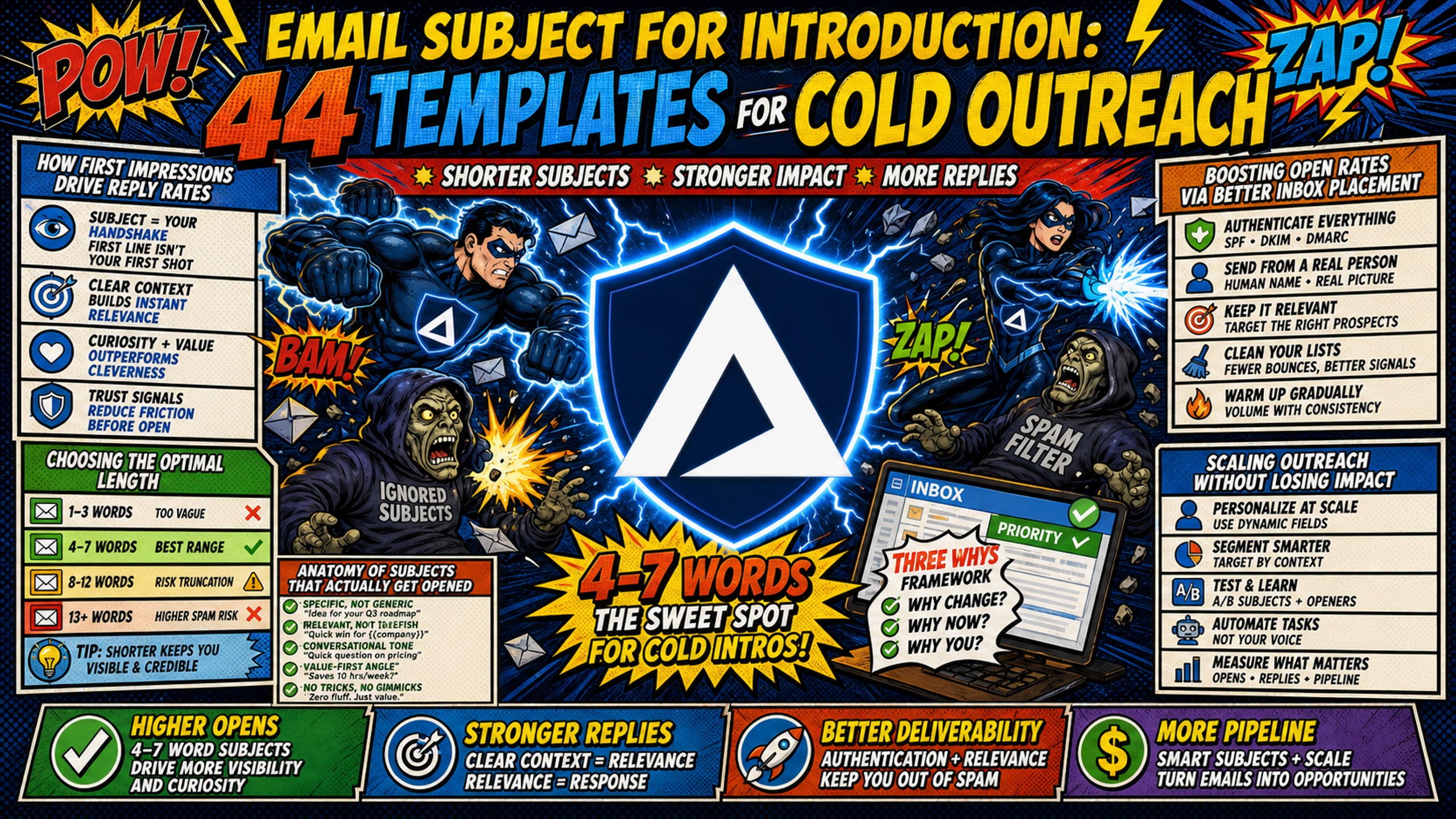
TL;DR: Cold introduction subject lines perform best at 4-7 words, keeping mobile truncation and spam risk low. The "Three Whys" framework (Why change? Why now? Why you?) gives each line a specific job, establishing relevance before the email is even opened. No subject line, however well-crafted, can compensate for missing SPF, DKIM, or DMARC authentication. Automated DNS setup and dedicated IPs are the technical baseline for reliable inbox placement, and subject line quality only determines opens once delivery is secured. The 44 templates below are categorized by hook type, industry, and seniority level so you can match the right line to the right lead.
Email acquisition only works when your message actually lands in the primary inbox. Most campaign managers spend hours testing subject line copy while the real constraint, domain reputation and DNS configuration, quietly routes their campaigns straight to spam.
This guide delivers 44 copy-pasteable introduction email subject line templates alongside the technical setup required to make them perform. You'll find frameworks for every buyer type, industry, and seniority level, plus the infrastructure logic that keeps them out of the spam folder.
How first impressions drive cold email reply rates
The subject line and sender name are the only two pieces of information a prospect sees before deciding whether to open or delete. Industry research suggests B2B cold email reply rates typically range from 1% to 7%. The difference between tiers is rarely the product. It's the first line and the infrastructure running under it.
Boosting open rates via better inbox placement
Open rates are a function of deliverability first and copy second. Industry data suggests average open rates have declined in recent years, partly due to tighter ESP (email service provider) filtering and mail privacy protection. High-performing campaigns typically run on well-authenticated domains with tested subject lines on dedicated infrastructure.
A subject line crafted to earn a 60% open rate on a warm list will trigger spam filters on a cold campaign if the sending domain carries no SPF, DKIM, or DMARC authentication. As this deliverability breakdown explains, the rules for cold email infrastructure have tightened significantly and sender authentication is now non-negotiable.
Inframail configures SPF, DKIM, and DMARC records automatically on every domain provisioned through the platform, eliminating the manual DNS panel work that blocks campaign managers from launching fast. Combined with dedicated US-based IPs (1 on the Unlimited Plan at $129/month, 3 on the Agency Plan at $327/month), every domain starts with a clean, isolated sending reputation. Monitoring domain health and checking authentication records regularly helps catch deliverability issues before they affect campaign performance.
Choosing the optimal length for cold intro emails
Industry best practices suggest keeping subject lines concise, typically 4-7 words, with the core message front-loaded. Mobile email clients display fewer characters in the preview, so placing your hook early increases visibility. Research from Belkins shows that 2-4 word subject lines achieve 46% open rates, and multiple studies confirm that 30-50 characters (approximately 1-4 words) consistently perform well for cold B2B outreach across device types.
Scaling outreach without losing impact
Scaling from 10 domains to 50 requires more than copy discipline. Every new domain batch needs SPF, DKIM, and DMARC records configured before the first send, and manual DNS setup across multiple registrars consumes significant time per batch. Inframail offers two plans: the Unlimited Plan at $129/month and the Agency Pack at $327/month, to fit different campaign footprints.
Anatomy of emails that actually get opened
A cold introduction email typically includes these structural elements: subject line, preview text, hook, offer, and CTA. The subject line sets the expectation. The preview text either confirms or undercuts it. A mismatch between those two elements can contribute to open rate problems. Aaron Reeves covers this anatomy for B2B contexts where brevity and specificity outperform storytelling.
Sparking interest without clickbait
Deceptive subject lines, including fake "Re:" prefixes or manufactured urgency, may generate short-term opens but can damage long-term domain reputation. Spam complaints can negatively impact your complaint rate. Keeping your complaint rate low is important for primary inbox placement.
Pitching value in one line
The Three Whys framework structures cold outreach around three questions every prospect must answer to justify engagement: Why change? Why now? Why you? These are the three most important questions a prospect must answer to justify a purchase of any sort. Mapping your subject line to one of these three questions turns it from a generic headline into a specific, relevant prompt.
Benefit-led lines emphasize outcomes. Time-specific lines create urgency. Credibility or social proof lines build trust. The 44 templates below are built on this structure.
Bypassing spam filters in cold email
Shared IP pools work like carpool lanes. One bad actor sending spam gets the whole range flagged, and your campaigns suffer for behavior you didn't produce. Dedicated IPs operate as private lanes where your sending behavior alone determines ESP trust. Industry analysis confirms that shared infrastructure exposes senders to reputation risks they cannot control.
Technical sidebar: Why copy can't save bad infrastructure
Check these four points before blaming your subject line for low open rates:
- Domains missing SPF, DKIM, or DMARC records route to spam regardless of subject line quality.
- Concise subject lines (4-7 words) with no spam trigger keywords are recommended for authenticated domains.
- A healthy inbox placement rate (the percentage of successfully delivered emails that land in the primary inbox rather than spam, promotions, or junk) is critical for campaign success. Low placement rates signal infrastructure problems.
- Inframail's automated authentication setup and dedicated IP isolation are designed to hold inbox placement at 98%+.
Validating cold email subject lines
Before launching a sequence, run your subject line through a spam checker to flag high-risk words and formatting errors. Check for excessive punctuation, all-caps words, and common trigger phrases. Our deliverability walkthrough shows the exact pre-send checklist used by Inframail customers managing high-volume campaigns.
Proven hooks for every outreach scenario
Once your subject line passes spam validation, the next variable is relevance. The right hook depends on how much context you have on the lead. Warm referral leads respond to social proof and shared connection. Cold prospecting leads respond to curiosity and direct outcomes. Use the selection matrix below to match hook style to lead type before choosing a template.
Relationship-based selection matrix
| Lead type | Subject line style | Core focus | Example |
|---|---|---|---|
| Cold prospecting | Curiosity-based | Spark interest, withhold full context | "Question about [Company]'s pipeline" |
| Warm leads | Descriptive / project-specific | Reference shared context or mutual connection | "[Name] suggested I reach out" |
Writing benefit-led cold introduction lines
These five templates answer "Why change?" by leading with a quantifiable outcome. Replace placeholders with real numbers from your ideal customer profile (ICP) research.
- "Cut [Process] time by [X]%"
- "Save [X] hours on [Task] weekly"
- "[X] more [Meetings/Leads] per month"
- "How [Competitor] reduced [Cost] by [X]"
- "Add [X] pipeline in 30 days"
Using questions in cold outreach
Question-based subject lines create an open information loop the brain wants to close. They perform best when the question is specific enough to feel relevant without revealing the full pitch. Chris Bussing covers question-based structure in his B2B tech sales framework.
- "Quick question about [Company] outbound"
- "Are you hitting Q[X] pipeline targets?"
- "How are you handling [Pain Point] today?"
- "Is [Tool/Process] still working for [Company]?"
- "What's [Company]'s approach to [Goal]?"
Using mutual connections in cold email subject lines
Mutual connections can provide additional context for cold outreach. Use these when you share a LinkedIn group, a past employer, a client, or a mutual contact.
- "[Mutual Contact] suggested I reach out"
- "Saw you at [Event/Group], had a thought"
- "Fellow [Community/Membership] member here"
- "We both work with [Shared Client/Tool]"
- "[Mutual Contact] said you'd find this useful"
Drafting problem-aware intro emails
Problem-aware subject lines work when you have enough ICP intelligence to name a specific pain. Pair these with the "Why now?" urgency layer for higher reply rates.
- "Still losing hours to manual [Process]?"
- "[Industry] teams are getting hit by [Problem]"
- "Your [Metric] doesn't have to stay flat"
- "Before Q[X] closes: [Specific Issue]"
- "Most [Role]s fix [Problem] too late"
Three "Why now?" urgency builders:
- "Q[X] ends in [X] weeks - worth a chat?"
- "[Trigger Event] changes everything for [Role]"
- "[Competitor] just did [X] - your move?"
Matching subject lines to lead intent
Segment your list by intent signal before choosing a template. High-intent leads (visited pricing page, opened a previous email, triggered a LinkedIn signal) warrant descriptive, project-specific lines. Cold list contacts with no prior engagement respond better to curiosity-based hooks. Kidous Mahteme's LinkedIn signal tutorial shows how to catch high-intent leads the moment they post, making subject line selection much easier.
Industry-specific cold email subject templates
Industry vocabulary can improve relevance. A generic subject line sent to a SaaS CFO reads differently than one that references ARR or churn. Matching the language to the industry may improve open rates without increasing length.
| Industry | Template 1 | Template 2 | Template 3 |
|---|---|---|---|
| SaaS | "Cut [Tool] spend without losing [Feature]" | "How [Comp] improved NRR by [X]%" | "Your CAC:LTV ratio and [Solution]" |
| Agency | "[X] new clients without adding headcount" | "Infrastructure cost eating into margins?" | "How [Agency] added [X] retainers in [Time]" |
| Hiring | "Your [Role] pipeline for Q[X]" | "[X] vetted [Job Title]s available now" | "Reducing time-to-hire for [Department]" |
| Retail | "Your [Category] margins in [Season]" | "[X]% fewer returns with [Approach]" | "How [Brand] grew AOV by [X]%" |
Subject line templates by recipient seniority level
Seniority level can inform subject line approach. Different roles may respond to different messaging styles. Testing subject lines by recipient seniority helps optimize relevance and reply rates.
| Recipient | Template 1 | Template 2 | Template 3 |
|---|---|---|---|
| VP | "Pipeline math for [Department] in Q[X]" | "[X] leads/week from [Channel] - realistic?" | "How [Comp] VP solved [Problem]" |
| C-suite | "[Outcome] without [Tradeoff]" | "Worth 15 mins, [Company]?" | "[Specific metric] for [Company] in Q[X]" |
| Founder / Solo | "Idea for [Company] - 2 mins" | "[X] more clients, same team size" | "Fast win for [Founder's Known Challenge]" |
For a full cold email workflow built for solo and small-team senders, the Salesman.com cold email walkthrough is a practical reference.
How to refine your first email subject line
Running 44 templates without a testing framework produces noise, not data. Treat subject line optimization as a repeatable process with defined variables, sample sizes, and decision rules.
Setting up A/B tests for cold email
Follow this three-step framework to produce statistically meaningful results:
- Isolate one variable: Change either the hook style (curiosity vs. benefit-led) or the length (4 words vs. 7 words), never both at once.
- Set minimum sample size: Industry best practices suggest testing on at least 500-1,000 leads per variant for more reliable results. Smaller samples may show variance from list quality rather than subject line performance.
- Measure reply rate, not open rate: Open rates may be affected by mail privacy protection (MPP). Reply rate is a more reliable signal. Inframail's CSV export of IMAP/SMTP credentials feeds directly into Instantly or Smartlead, making it straightforward to spin up unlimited test inboxes at the Unlimited Plan's flat $129/month rate.
Measuring lead quality over open rates
A 70% open rate that produces unsubscribes and spam complaints is worse than a 35% open rate that generates qualified replies. Track positive reply rate (interested, not just "remove me"), meeting-booked rate, and domain health alongside open rate.
Scheduling cold email subject line refreshes
Consider rotating subject line templates after high email volumes on a given domain. Spam filters may pattern-match repeated templates from the same domain, and repeated identical subject lines may accelerate domain fatigue. Inframail does not include a native warmup tool, so external tools like Warmbox or Lemwarm at $15-50/month per inbox are required.
Subject line red flags that trigger spam filters
Spam filters score the whole message. The subject line is one signal among many, but it carries significant weight and high-risk patterns there compound quickly with poor formatting and low engagement history. Use the checklist below before every send.
Avoiding spam trigger words
High-risk keywords commonly flagged by spam filters:
- Avoid these words: Free, guaranteed, earn money, act now, click here, buy now, limited time offer, bonus, urgent, winner, make money fast
- Avoid these patterns: Dollar signs in subject lines, multiple exclamation marks, stacked question marks
Fixing harsh subject line formatting
ALL CAPS words in subject lines (FREE, GUARANTEED, URGENT) are commonly associated with spam. The pattern may raise spam scores, particularly when combined with other risk factors like spam trigger words, excessive punctuation, and poor historical engagement. Write in sentence case and reserve capitalization for proper nouns.
Preventing deceptive email subject lines
Fake "Re:" or "Fwd:" prefixes in cold outreach may create initial opens but can destroy reply rates and trust. Beyond the deliverability risk, deceptive subject lines may carry legal exposure under email marketing regulations. The one-time open boost is not worth the reputation cost, and honest framing outperforms clickbait over any meaningful campaign horizon.
Avoiding dangerous personalization errors
A broken merge tag, for example "Hi {First_Name}" or "Hi [CONTACT_FIRST_NAME]", can signal low-quality sending practices to recipients. Always test personalization variables on a seed list before scaling a sequence. Every broken tag that reaches a real prospect may increase your complaint rate and damage domain reputation.
Essential tips for first email subject lines
The tips below cover the practical decisions that affect subject line performance, from length and formatting to refresh timing and open rate benchmarks.
Subject line length for cold emails
| Subject line length | Desktop visibility | Mobile visibility | Spam risk |
|---|---|---|---|
| 1-3 words | Full | Full | Typically low |
| 4-7 words (recommended) | Full | Full | Lowest |
| 8-12 words | Full | Partial truncation | Variable |
| 12+ words | Full | Significant truncation | Variable |
The 4-7 word range is a recommended baseline for cold B2B outreach across devices. Keeping subject lines concise helps avoid truncation on mobile devices.
Impact of emojis on reply rates
Emojis in B2B cold email subject lines typically trigger spam filters or route emails to the promotions tab. Research from Nielsen Norman Group shows that emojis in subject lines increase negative sentiment toward an email and do not increase the likelihood of an email being opened. Academic research and real-world case studies demonstrate emojis undermine credibility in professional contexts. Avoid them in first-touch cold introduction emails.
Cold email subject line refresh timing
Quick refresh checklist for active campaigns:
- Subject line is 4-7 words with no spam trigger keywords
- No ALL CAPS combined with other high-risk formatting signals
- No fake "Re:" or "Fwd:" prefix
- Personalization variables are populated correctly on all contacts
- No broken merge tags confirmed via seed test
- Subject line hasn't been used excessively on this domain
- Preview text reinforces, not contradicts, the subject line
Subject line keywords and spam risks
Keywords that correlate with spam folder placement share a pattern: they are high-volume, low-specificity, and associated with mass commercial messages. Generic benefit claims like "Free consultation," "guaranteed results," and "exclusive offer" may fit this pattern. Replace generic benefit claims with specific, numeric outcomes tied to the recipient's role or industry. "7 fewer hours on DNS setup weekly" reads as specific and credible. "Free infrastructure solution" reads as spam.
Target open rates for cold outreach
Industry benchmark data suggests average cold email open rates have declined in recent years, partly due to mail privacy protection inflation in earlier measurements. Top-performing campaigns are running well-authenticated domains, tight targeting, and tested subject lines. High reply rates correlate strongly with clean infrastructure running underneath strong copy.
Inframail customers running dedicated IPs with automated DNS authentication report inbox placement rates at 98%+.
"Their platform did in 10 minutes what would've taken me days to figure out. Maybe weeks. We're talking full infrastructure..." - Verified user review of Inframail
For the Unlimited Plan at $129/month, the infrastructure cost running under a 50-inbox campaign is $129/month plus domain costs at $5-16/year per domain, compared to $350-420/month on Google Workspace at $7-8.40 per seat. Warmup tools are additional on both sides and not included in this comparison. This CTA and reply video covers the full sequence structure from subject line through close.
Sign up to Inframail and get started today.
FAQs
What is the best length for a cold introduction subject line?
Keep it between 4 and 7 words. This range prevents mobile screen truncation, fits within Gmail Android's preview limit, and carries the lowest spam risk across both desktop and mobile clients.
How often should I rotate my cold email subject lines?
Consider refreshing your subject lines regularly as email volume scales. This may help prevent domain fatigue and reduce the risk of spam filters flagging repeated template patterns.
Does Inframail include a built-in email warmup tool?
No, Inframail requires external warmup tools like Warmbox or Lemwarm, which typically cost $15 to $50 per month per inbox.
How do I export Inframail inboxes to Instantly or Smartlead?
Inframail generates IMAP/SMTP credentials for every provisioned inbox and exports them to CSV. You import that CSV directly into Instantly or Smartlead.
What open rate should I target for cold outreach campaigns?
Industry benchmarks suggest healthy cold email open rates vary by industry and list quality. Well-authenticated domains with tight targeting typically see stronger performance. Significantly low open rates on authenticated domains may signal a subject line or list quality problem, not an infrastructure problem.
What is the difference between Inframail and Maildoso for cold email?
Inframail charges $129/month for unlimited inboxes on a dedicated IP. Maildoso's published tiers run from $2.50/mailbox at 30 mailboxes to $0.75/mailbox at 300+ mailboxes, with volumes in between requiring a custom quote, so a 50-inbox setup would land somewhere in that range rather than at a published price point. Either way, shared IP infrastructure means other senders' behavior can affect your domain reputation.
Key terms glossary
Inbox placement rate (IPR): The percentage of successfully delivered emails that land in the recipient's primary inbox rather than a spam, promotions, or junk folder. Strong inbox placement is critical for campaign success.
Dedicated IP address: A unique internet protocol address assigned exclusively to your sending domain, ensuring your sender reputation is not affected by other senders on shared infrastructure.
SPF/DKIM/DMARC: Technical DNS records configured to verify sending domain legitimacy. Inframail configures all three automatically on every domain provisioned through the platform.
Three Whys framework: A cold outreach structure that answers "Why change?", "Why now?", and "Why you?" in sequence. Mapping your subject line to one of these three questions turns it from a generic headline into a specific, relevant prompt that increases reply rates.
Domain fatigue: The gradual decline in inbox placement rates that can occur from sending high email volumes from the same domain with similar template patterns. Rotating subject lines periodically may help prevent domain fatigue from accumulating.
IMAP/SMTP: Internet Message Access Protocol and Simple Mail Transfer Protocol are technical standards for receiving and sending email. Inframail generates IMAP/SMTP credentials for every provisioned inbox that can be exported to CSV and imported directly into sending platforms like Instantly or Smartlead.
NRR (Net Revenue Retention): A SaaS metric measuring the percentage of recurring revenue retained from existing customers over time, including expansions, downgrades, and churn.
CAC:LTV (Customer Acquisition Cost to Lifetime Value ratio): A metric comparing the cost to acquire a customer against the total revenue that customer generates over their lifetime.
AOV (Average Order Value): The average dollar amount spent each time a customer places an order, calculated by dividing total revenue by number of orders.