
Email opener psychology: Why first lines make or break replies
Cold email openers are triaged, not read. Prospects decide in a couple of seconds whether a first line looks like another sales pitch, and four mechanisms drive
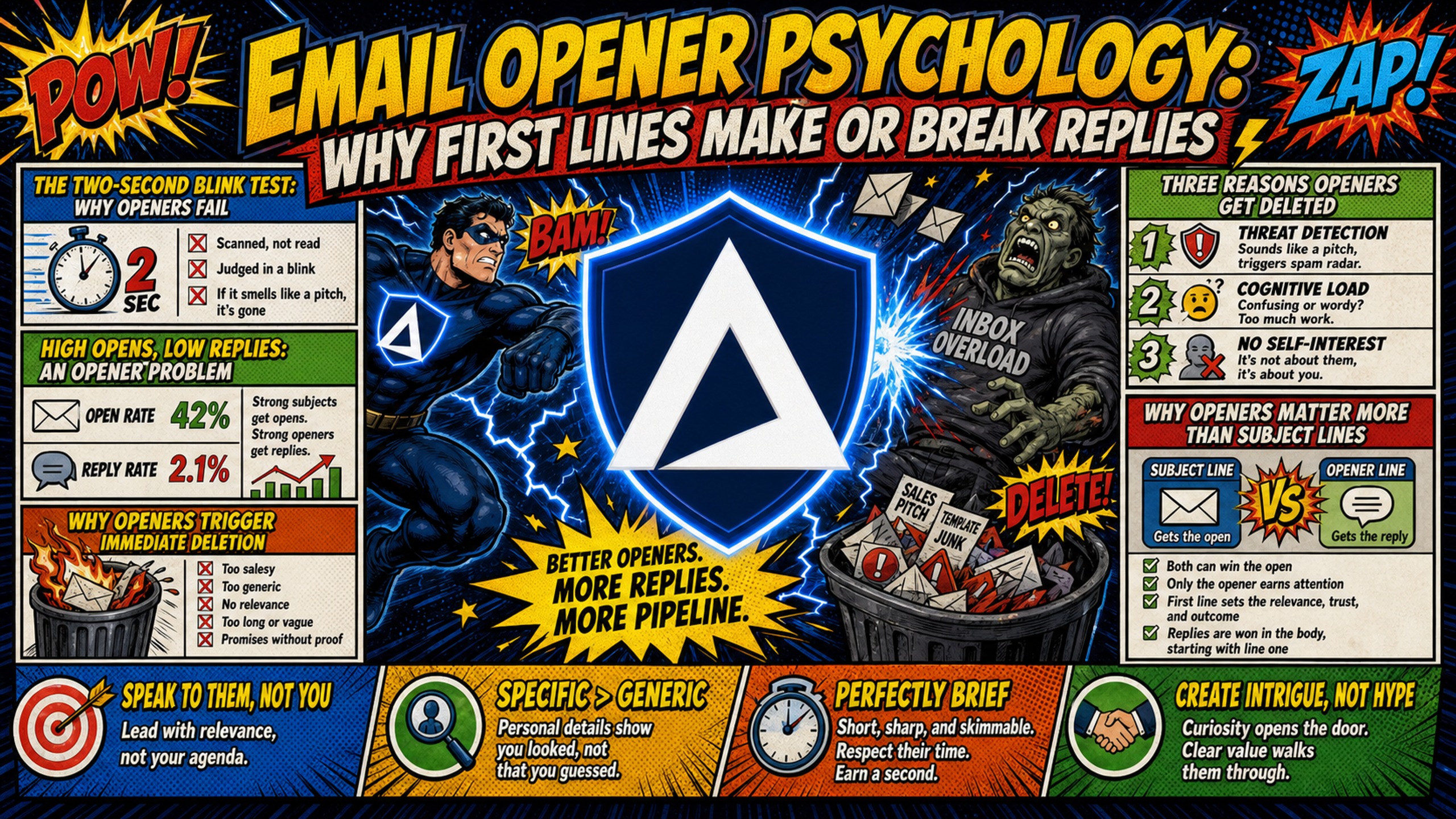
TL;DR: Cold email openers are triaged, not read. Prospects decide in a couple of seconds whether a first line looks like another sales pitch, and four mechanisms drive that call: pattern recognition, cognitive load, the curiosity gap, and pattern interrupts. Openers that win are short, concrete, and built on a specific observation about the prospect, such as a detail on their pricing page, instead of stock lines like "I hope this email finds you well." Research depth pays: Sopro's data shows advanced personalization lifting response rates to 18%, compared to 9% for generic emails. To find what works for your list, test one psychological trigger per variant and judge on reply rate, not opens. Confirming a lift from 3% to 4.5% takes roughly 2,500 sends per variant, and none of it counts if the emails land in spam.
Cold email openers typically get only a few seconds of attention before a prospect decides to reply or delete. The decision often happens faster than a conscious evaluation of your offer, driven by how quickly the first line reads as familiar or fresh.
Campaign managers often treat openers as a writing problem. They tweak word choice, add personalization tokens, and test subject lines. But email opener psychology is a triage problem, not a writing problem.
Prospects are not reading your email. They are filtering it, and categorization speed and offer relevance both shape the decision. If the first line cannot be categorized quickly as relevant, the offer does not get evaluated. This article breaks down the four psychological mechanisms that determine whether an opener passes the filter, then gives you a testing framework to measure what moves replies.
The two-second blink test: Why openers fail
Pattern recognition runs before conscious evaluation. The opener either passes the filter or triggers the delete reflex before the prospect reads another word.
High opens, low replies: an opener problem
High open rates with low reply rates often signal an opener problem, not a deliverability problem. If your opens are strong and replies stay weak, the prospect saw your subject line, opened the email, and likely deleted it within seconds. The bottleneck is the first line.
The blink test is the first couple of seconds of reading, when the prospect's brain runs a rapid pattern-matching scan. It asks: "Have I seen this before?" If the answer is yes, and the pattern matches a sales pitch, the email often gets deleted.
There is no conscious decision. It is a reflex.
The two-second window is a practical heuristic for inbox triage, not a lab-measured constant. One widely shared inbox triage method caps it at a couple seconds per item, because a couple of seconds of attention is itself an implicit decision to keep reading. And modern B2B buyers reportedly scan mobile messages in seconds, so the filtering window is even tighter on phones.
Why openers trigger immediate deletion
Pattern recognition is the brain's shortcut for categorizing incoming information. Most B2B prospects process dozens or hundreds of cold emails over time, and openers like "I hope this email finds you well" or "I came across your profile" quickly get categorized as sales messages. The delete happens fast, often before the reader consciously weighs the offer.
The cost of this reflex shows up in campaign data. Sopro's prospecting data shows advanced personalization lifting response rates to 18%, compared to 9% for generic emails. A first line that reads like a generic pitch puts the email on the wrong side of that gap.
Three reasons openers get deleted
Three reactions drive the delete reflex, and all of them fire before the prospect weighs the offer.
- Habituation: Repeated exposure to the same stimulus reduces attention to it. A first line that sounds like every other cold email gets categorized as noise.
- Affect heuristic: The first emotional impression drives the decision. If the opener feels like a sales pitch, the prospect deletes before evaluating the offer.
- Effort avoidance: Prospects often delete to avoid the effort of reading a pitch, especially when inbox volume is high.
Why openers matter more than subject lines for replies
Why do email openers matter more than subject lines once the email is opened? Because the subject line earns the open, but the first line earns the reply. Opens and replies measure different stages of engagement, and confusing them is how campaign managers end up optimizing the wrong variable.
Optimizing snippet text for higher opens
The snippet text is the first line preview that appears in the inbox next to your subject line. It is the opener's first impression, and many campaign managers overlook it. They write a subject line, then let the snippet default to whatever the first line of the email happens to be.
Write snippet text that complements the subject line without repeating it. If your subject line is "Quick question about [Company]," your snippet should not say "I wanted to reach out about [Company]." Instead, try "Noticed your team is hiring SDRs" or "Your pricing page caught my attention." Chris Bussing's video on B2B subject lines covers the P.E.G. prospecting framework that pairs well with this approach.
Setting your minimum reply standards
Woodpecker's benchmarks treat a 5-10% reply rate as good and 10%+ as excellent, depending on list quality and offer. Sopro puts the average cold email response rate at 5.1%, with most campaigns falling between 1% and 5%, though figures vary widely by list definition. Strict cold outreach to net-new contacts often sees lower baseline rates. Below 2% on a verified list, results may point to an opener or targeting problem.
Set a baseline before testing. If your current reply rate is 1.5%, your first goal is 3%. Do not aim for 10% until you have a proven opener pattern. For a deeper benchmark breakdown, Inframail's guide to B2B cold email response rates covers realistic ranges and eight tactics to improve them.
Measuring opener effectiveness vs reads
Opens measure subject line performance. Reads measure engagement depth after the open. Replies measure the outcome of the full email. Campaign managers should track all three, but opener tests must use reply rate as the primary metric.
Reads are harder to track. Some sending platforms show time-on-email or scroll depth, and if your platform supports it, use reads as a secondary metric.
If not, reply rate is your signal. Inframail's infrastructure monitoring guide sets alert thresholds for inbox placement and bounce rates, so you can rule out spam placement before you blame the copy.
Cognitive load: How your opener taxes attention
Every word in an opener costs the prospect mental effort. How much effort the first line demands shapes whether they keep reading or close the email.
Why complex openers kill reply rates
Cognitive load is the mental effort required to process information. Working memory is the brain's short-term holding space for information. Prospects read email while doing other things: sitting in meetings, walking between calls, scanning their phone. A first line that requires parsing a complex sentence, an unfamiliar term, or a multi-clause structure burns working memory.
When cognitive load is high, the brain defaults to delete. John Sweller's cognitive load theory explains that working memory can only hold and manipulate a small number of information elements at any given time. Sweller introduced the theory in his 1988 paper. His work frames overload as a design problem, not a reader problem: when material exceeds working memory, comprehension drops. An opener that exceeds that capacity gets deleted before the value appears.
Your prospects are triaging aggressively, and every extra word in your opener raises the tax they pay to keep reading. A systematic review of 62 studies identifies regular triage as one of only four "super actions" linked to both better work performance and well-being.
Optimizing openers for fast processing
Processing fluency is how easy a sentence feels to read. High processing fluency means short words, active voice, and concrete nouns. Alter and Oppenheimer's fluency research shows that how easily people process information reliably shapes their judgments across a broad range of social dimensions.
Before: "I wanted to reach out because I noticed that your company has been expanding its sales development team and I thought there might be an opportunity for us to explore potential synergies."
After: "Your SDR hiring caught my attention."
The shorter version processes faster. It uses concrete nouns, active voice, and a fraction of the words. This is first line psychology in practice: the easier the first line feels, the more credible the sender seems.
Why short openers earn more replies
Short openers connect directly to the blink test. A short first line processes within the triage window, while a long, multi-clause opener risks losing the prospect before the value appears.
There is no published word-count rule for first lines, so treat brevity as a heuristic grounded in processing fluency research, not a hard law. The broader pattern is well supported: Boomerang's analysis of over 40 million emails found messages of 50 to 125 words drew the highest response rates. That data covers all email, not only cold outreach, so treat it as directional. Test opener length against your own list, because list quality and offer strength shift the numbers.
Cognitive load audit checklist:
Use this checklist to audit any opener before it enters a sequence:
- Pain point: Does the first line address a specific pain point or observation?
- Length: Is the first line short enough to read in one glance?
- Concreteness: Does it use concrete nouns instead of abstract terms like "synergies" or "solutions"?
- Voice: Is it written in active voice?
- Pattern check: Does it avoid the five stale patterns listed in the pattern interrupt section below?
- Snippet: Does the snippet text add information instead of repeating the subject line?
Using the curiosity gap to boost replies
A prospect who wants to know more keeps reading. The opener's job is to create that want without satisfying it.
Triggering replies with a specific, unanswered observation
The curiosity gap is the space between what a prospect knows and what they want to know. George Loewenstein's information gap theory, from his 1994 paper, explains that curiosity arises when attention focuses on a gap in knowledge. People feel a gap between what they know and what they want to know, and they act to close it.
Curiosity peaks with moderate knowledge and diminishes when someone knows too little or too much. Your opener's job is to hand the prospect that small amount of knowledge, then stop.
A curiosity gap email opener names a specific, relevant problem without solving it.
Example: "Your pricing page does not mention setup fees." The prospect knows their pricing page but does not know why you are pointing it out. The gap pulls them forward into the second sentence.
Avoiding the curiosity trap in cold email
Clickbait promises something the email does not deliver. Value-driven curiosity names a real problem the prospect has and implies the email contains the solution. The distinction matters for reply rates and for sender reputation, because prospects who feel tricked may mark emails as spam. Google's sender guidelines ask senders to keep reported spam rates below 0.1% and never reach 0.3%.
| Opener type | Example | When to use |
|---|---|---|
| Clickbait | "You won't believe what I found" | Avoid in professional B2B outreach |
| Curiosity | "Your pricing page is missing one detail" | When you have a specific, relevant observation |
| Clarity | "I help SaaS companies reduce churn" | High-stakes, compliance-heavy industries |
Choosing the right opener type is only half the decision. Each approach carries a different deliverability risk profile, and the mitigation strategy changes depending on how much ambiguity the opener introduces.
| Curiosity approach | Deliverability risk | Mitigation |
|---|---|---|
| Aggressive curiosity (vague hooks, hype) | Higher spam complaints, spam-folder placement | Avoid entirely |
| Value-driven curiosity (specific observation) | Lower risk when the email delivers on the hook | Deliver the answer in sentence two or three |
| Clarity (direct value statement) | Lower risk profile | Use for compliance-heavy or executive audiences |
When to reveal vs conceal data
Reveal enough to prove relevance, conceal enough to create a gap. "Your pricing page does not mention setup fees" reveals the observation and conceals the implication. The prospect knows you looked at their pricing page. They do not know what you think is wrong with it.
Use full clarity instead when the stakes are high or the industry is compliance-heavy. A CFO at a healthcare company does not want to decode a curiosity gap. Senior buyers tend to respond to signals tied to their role, company, or measurable outcomes, so clarity is the safer default for executive audiences.
The answer is not clarity or curiosity. It is matching the trigger to the audience, which is exactly what A/B testing is for.
Using pattern interrupts to boost reply rates
The delete reflex fires when an opener matches a familiar sales pattern. Breaking that pattern is the first step to keeping the prospect's attention past the first line.
Five opener patterns to retire
A pattern interrupt breaks the expected pattern so the brain stops the automatic delete reflex. Stale openers are patterns prospects have seen hundreds of times, and each one triggers the sales-pitch category before your value appears.
- "I hope this email finds you well"
- "I came across your profile"
- "I wanted to reach out"
- "My name is [Name] and I work at [Company]"
- "I know you're busy, so I'll be brief"
Cold email psychology shifts fast, and openers that worked last year can go stale overnight. Taylor Haren's teardown of a dead $6M copy style is a useful case study in how quickly patterns stop working when every sender adopts them.
Why odd openers drive higher replies
Odd does not mean unprofessional. It means unexpected in a relevant way. Open with a specific number, a contrarian statement, or a direct observation.
Example: "Your competitor just raised their prices 15%." This is odd because it is specific, relevant, and unexpected. It triggers attention because it breaks the pattern of generic openers.
Novelty triggers attention, but only when relevance is clear within the first two lines. If the prospect cannot connect the odd opener to their situation within the triage window, they delete. The curiosity gap still applies: odd for its own sake is clickbait.
Why familiar openers drive engagement
Some familiarity builds trust. A first line that mirrors the prospect's own language processes faster and feels less like a pitch. Use their job title, their industry term, or their stated pain point.
The balance: familiar content, unexpected framing. "Your SDR team is hiring" is familiar content. "Your SDR team is hiring for the wrong role" is familiar content with unexpected framing.
The first version blends in. The second creates a gap while staying grounded in something the prospect already knows.
A/B testing openers with psychological triggers
Psychological triggers are not interchangeable. Testing them against each other with clean controls shows which one moves reply rates for a specific audience.
Test one psychological trigger per variant
Testing multiple changes at once makes it hard to isolate what drove the result. Each variant should change one psychological variable so the result can be traced back to a single cause. For example, test "Your pricing page is missing one detail" against "Your pricing page does not list setup fees" to isolate curiosity from clarity, and change nothing else.
Variant naming template: [Trigger] - [Specific change]. Example: "Curiosity - pricing page observation" or "Pattern interrupt - competitor price increase."
Determining minimum test volume
Reply rates in the 2-5% range need large samples. Detecting a lift from 3% to 4.5% takes roughly 2,500 sends per variant, so treat results at 200 to 500 sends as directional. Small samples produce false winners. Run your own numbers through Evan Miller's sample size calculator before calling a result.
Track reply rate, not just opens
Opens tell you if the subject line worked, and replies tell you if the opener worked. Track both, but make opener decisions on reply rate. Reply rate is the most copy-and-targeting-sensitive metric in a campaign, but it has a floor set by deliverability: a reply rate can only be as high as the share of mail that reaches a human.
That floor is why opener testing requires clean infrastructure. A properly warmed domain with correct setup tends to support higher inbox placement and reply rates, while the same emails from an unwarmed domain risk landing in spam.
If your emails land in spam, you are not testing openers. You are testing nothing. Nick Abraham's breakdown of 2026 deliverability rules and Lead Gen Jay's walkthrough of 100,000 cold emails per day both show how infrastructure decisions set the ceiling for every copy test.
Quantify what drives your reply rates
Use a simple tracking sheet (example figures):
| Variant name | Trigger tested | Sends | Open rate | Replies | Reply rate | Notes |
|---|---|---|---|---|---|---|
| Curiosity - pricing | Curiosity gap | 250 | 45% | 12 | 4.8% | Directional, keep testing |
| Clarity - direct | Low cognitive load | 250 | 42% | 8 | 3.2% | Directional, keep testing |
Log results over time to build a library of proven opener patterns. After 10-15 tests, you will see which triggers work best for your audience. Pair your testing log with clean list data, because any personalization, manual or AI-generated, is only as good as the data behind it.
One caveat before you scale any test: opener results only mean something on clean infrastructure, because a well-written email from a misconfigured domain goes straight to spam.
Inframail provisions unlimited Microsoft-based inboxes on dedicated US-based IPs (1 dedicated IP on the Unlimited Plan, 3 dedicated IPs on the Agency Pack), with SPF, DKIM, and DMARC configured automatically. Because inboxes run on a dedicated IP rather than a shared pool, sender reputation is not affected by other customers' sending behavior.
For teams scaling tests across dozens of inboxes, infrastructure health checks and alerts can help catch deliverability issues before they distort test results. Once your openers pass the blink test, Inframail co-founder Kidous Mahteme's video on reply-boosting CTAs covers the next step in the email.
Get started with Inframail
Testing opener variants across multiple inboxes requires infrastructure that does not add cost per inbox. Inframail's flat-rate unlimited inbox plan keeps testing costs predictable. The Unlimited Plan costs $129/month and includes 1 dedicated US-based IP, while the Agency Pack costs $327/month and includes 3 dedicated US-based IPs. Both plans include automated SPF, DKIM, and DMARC configuration.
Inframail reports a 98%+ deliverability rate and a 68.3% blacklist delisting success rate within 48 hours. Domain costs and external warmup tools ($15-50 per inbox per month) apply on top of the platform fee.
"I’ve been using Inframail for a couple of months and the experience has been really good. I can set-up inboxes in 5mins while saving money on Google Workspace subscriptions and benefit from great deliverability. All of my campaigns on Inframail are on a >10% reply rate, which is really good." - Verified user review of Inframail
See how Inframail helped a client scale to 1,500+ inboxes with fast customer support and reliable infrastructure in this case study video, ultimately contributing to a six-figure cold email deal worth around $100,000.
Sign up to Inframail and get started today.
FAQs
How long should an email opener be?
Short enough to read in one glance, typically one sentence. There is no published word-count rule for first lines, so treat brevity as a heuristic from processing fluency research and test length against your own list.
Do personalized openers always perform better?
No. Personalization works when it proves relevance, not when it inserts a name or company. A specific, non-personalized observation often outperforms a generic personalized line.
Should I A/B test openers or full emails?
Fix deliverability and targeting first, because those set the foundation for every copy test. Once mail lands in the inbox for the right audience, test openers before the body and CTA, because the first line is often the highest-leverage copy variable for reply rate.
How many opener variants should I test at once?
Two to three variants maximum. Each variant should change one psychological trigger. More variants split your volume and push reliable results further out.
Can I reuse high-performing openers across campaigns?
Yes, when adjusted for context. An opener pattern that works in one campaign can often be adapted to another by changing the specific observation or reference to match the new prospect's situation.
Key terms glossary
Cognitive load: The mental effort required to process information. High cognitive load in an opener forces the prospect to work harder, which increases the chance of deletion.
Curiosity gap: The space between what a prospect knows and what they want to know. A well-designed opener creates a small, relevant gap that the prospect wants to close by reading further.
Pattern interrupt: Breaking an expected pattern to stop an automatic response. In cold email, a pattern interrupt stops the prospect's reflex to delete a sales pitch.
Processing fluency: How easy a sentence feels to read. High processing fluency means short words, active voice, and concrete nouns. Fluent openers process faster and feel more trustworthy.
Working memory: The brain's short-term holding space for information. Openers that require holding multiple ideas in working memory at once increase cognitive load and reduce reply rates.