
Do you need cold email? A diagnostic for SaaS founders
: Cold email fits some SaaS startups and not others, depending on ACV, buyer clarity, and available time. It fits when your ACV justifies outbound effort, your
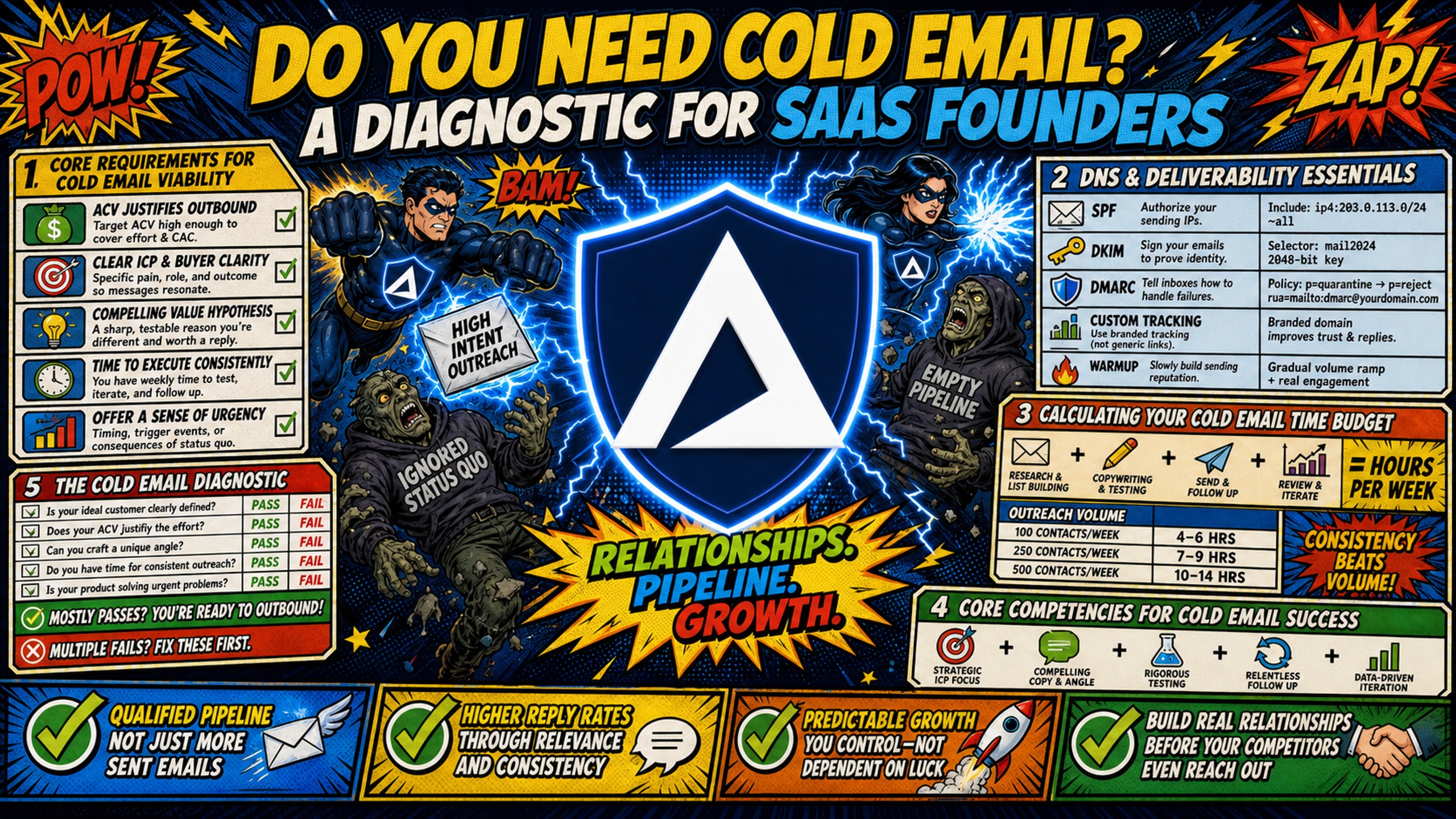
TL;DR: Cold email fits some SaaS startups and not others, depending on ACV, buyer clarity, and available time. It fits when your ACV justifies outbound effort, your buyer persona is clear, and someone can dedicate 5-8 hours weekly to execution after an initial setup of 8-12 hours. Backward-plan from revenue targets to required send volume using your own demo-to-close rate, and use 10% as a rule of thumb until you have one. Flat-rate infrastructure at $147/month lowers the minimum viable ACV threshold. If cold email does not fit, LinkedIn outreach, content, referrals, or paid retargeting may be better first channels.
About 95% of cold emails fail to generate replies, and the average response rate sits between 1% and 5% according to Martal Group data. The reason is rarely the copy or the list. It is that the channel was never the right fit for the product or the sales motion. Many founders spend months and thousands of dollars on cold email that was never right for their situation.
This article provides a diagnostic framework to determine whether your startup fits the cold email profile, what alternatives exist if it does not, and how to launch properly if it does. You will learn the five qualifying criteria, the backward-planning math that determines viability, and the infrastructure requirements that protect your sender reputation.
Core requirements for cold email viability
Cold email works when three elements align: technical infrastructure that protects deliverability, sufficient time budget for execution, and the skills to manage campaigns effectively. Missing any one of these creates a bottleneck that kills results before you start.
DNS and deliverability setup essentials
SPF, DKIM, and DMARC records form the foundation of email authentication. Gmail has required bulk senders to use all three since February 1, 2024, based on Gmail's email sender guidelines. SPF verifies the sending server is authorized, DKIM confirms the email was not tampered with in transit, and DMARC enforces what happens when these checks fail, according to Digital Applied's authentication guide.
Dedicated IPs versus shared IP pools determine whether your sender reputation stays isolated. Shared pools work like carpool lanes where one bad actor spamming gets the whole range flagged. Dedicated IPs work like private lanes where your behavior alone determines reputation.
Inframail automates SPF, DKIM, and DMARC configuration so you never touch a DNS panel. This eliminates the 12+ hours of manual setup that 50 domains typically require.
Warmup requires external tools at $15-50 per month per inbox. This cost applies regardless of your infrastructure provider, except on Inframail's DFY package, which includes warmup. It factors into the total cost calculation.
Calculating your cold email time budget
Founder-led campaigns typically require 5-8 hours weekly across five activities: list building, copywriting, sequence management, reply handling, and deliverability monitoring, after an initial setup of 8-12 hours. ReachKit's founder guide estimates 2-4 hours weekly for lean operations after initial setup, while Puzzle Inbox data shows 5-8 hours weekly for writing copy, reviewing replies, and taking calls.
Time is a hard cost that competes with product development and sales. Using a $150/hour opportunity cost assumption, 10 hours weekly equals $6,000 monthly. Add roughly $181 in monthly infrastructure costs for 50 inboxes (platform fee plus domains) and the total reaches about $6,181 monthly before warmup tools and before you book a single meeting.
Manual prospect research takes 28-50 minutes per prospect when you account for research, personalization, and follow-up scheduling, according to automation analysis. For 50 prospects, that is 23-42 hours, a full work week for one outreach batch.
Core competencies for cold email success
Five skills determine cold email performance: copywriting that earns replies, list research that finds the right prospects, data hygiene that protects sender reputation, deliverability monitoring that catches problems early, and sequence optimization that improves conversion over time.
Founders can learn these skills, but they take consistent execution over time to develop. Agencies and done-for-you services exist for teams without these competencies, typically at several thousand dollars monthly for managed campaigns.
Inframail's help center provides guidance on diagnosing deliverability issues when they arise. This resource helps founders build the monitoring competency without hiring specialists.
The cold email diagnostic for SaaS founders
This diagnostic determines whether cold email fits your specific situation. Answer each question honestly. This is a practical rule of thumb, not an established industry threshold. If you answer no to two or more, consider testing other channels first, because cold email may not be your best first channel.
Scaling email by business stage
Pre-seed companies without product-market fit should use cold email only as small-scale, founder-led outreach focused on learning and market research, not as a scaled hard-sell channel. You need validated learning from customer conversations before scaling outreach. Cold email at this stage generates noise, not signal.
If you're at seed stage with ACV above $10,000 and clear buyer intent, cold email fits. You typically lead sales at this stage, making cold email a natural extension of your founder-led outreach.
If you've raised a Series A, you can scale cold email with dedicated resources. You have proven unit economics and can invest in infrastructure, team capacity, and optimization without betting the company on results.
Evaluating channel fit for your SaaS
Channel fit means your buyer checks email regularly, responds to cold outreach, and buys through a sales process. Product-led tools with self-serve buyers, such as many developer tools, often fail this test because My Outreach notes that product-led and sales-led SaaS need almost opposite playbooks: PLG wants volume and self-serve activation, so SEO and paid search do the heavy lifting, while sales-led SaaS wants fewer, bigger, warmer conversations served by outbound, ABM and events. Sales and marketing tools often pass because decision-makers actively seek solutions and respond to relevant outreach.
Product-led growth products with purely self-serve motions do not need cold email for signups. They need it only if targeting enterprise deals that require sales involvement. Dreamdata's LinkedIn strategy shows how some SaaS companies build pipeline without cold email entirely.
Ask yourself: does my ideal customer wake up thinking about the problem I solve, and will they engage with a stranger who emails them about it? If yes, cold email fits. If they need education or trust-building first, content or referrals may work better.
Matching cold email to your sales motion
Cold email works for founder-led sales and SDR-driven motions. It does not work for purely self-serve or product-led motions without a sales touchpoint.
The 10% demo-to-buy conversion rate is a practical rule of thumb, not a sourced benchmark, and it shapes volume requirements. If you close 10% of demos and each customer is worth $20,000, you need 10 demos to land one customer and generate $20,000 in revenue. If your meeting-to-demo rate is 50% and your reply-to-meeting rate is 25%, you need 80 replies to book 10 demos.
Instantly's benchmark report shows top performers exceed 10% reply rates, top quartile achieve 5.5%, and average sits at 3.43%. At 3.43% reply rate, you need to send 2,332 emails to generate 80 replies. That volume requires proper infrastructure and warmup.
Validating if cold email fits your current funnel
Four factors disqualify cold email for otherwise promising startups. Recognizing these early saves months of wasted effort.
Why cold email fails for low-ACV products
Low ACV products cannot absorb the cost per meeting or cost per acquisition. At $50 ACV, even a 10% conversion rate means each customer costs more in time than they generate in revenue.
The math: 10 hours weekly at $150 per hour equals $6,000 monthly. Add $181 monthly infrastructure costs (before warmup tools). At 3.43% reply rate and 25% reply-to-meeting conversion, 2,000 emails monthly generate 68 replies and 17 meetings. At an assumed 10% demo-to-buy rate (a rule of thumb), you close 1.7 customers representing $85 in annual contract value. You lose $6,100 monthly.
Cold email requires ACV high enough that a single customer justifies the monthly investment. The threshold matrix below shows minimum viable ACV at different infrastructure cost levels.
Why complex deals need more than email
Enterprise deals with multiple stakeholders and long sales cycles need relationship building. Cold email can start the conversation but cannot close complex deals alone.
Frame cold email as one touchpoint in a multi-channel motion. Combine it with LinkedIn engagement, content sharing, and event participation. Alex Berman's channel analysis notes that meetings from LinkedIn tend to close faster because social proof is baked in.
For deals over $100,000 with 6+ month cycles, cold email serves as an opener, not a closer. Budget for additional channels that build trust over time.
Missing clear buyer personas
Without a clear ICP, cold email targeting is guesswork. List quality drives reply rates more than copy quality. Mailforge data shows smaller targeted campaigns of 50 recipients or fewer average 5.8% response rates versus 2.1% for larger lists.
Define your ICP before launching: title, company size, industry, trigger event, and pain point. If you cannot name all five, you are not ready for cold email.
Apollo's insights confirm that below-average performance under 2% signals deliverability issues, poor targeting, or generic messaging. Poor targeting is one of several common causes, alongside deliverability problems and poor data quality.
Scaling outreach without a closing team
If the founder is both sending emails and closing deals, volume is limited. Replies require follow-up, and follow-up requires time. The bottleneck appears when you generate more replies than you can handle.
At 5% reply rate, 1,000 weekly emails generate 50 replies. Each reply needs a response within 30 minutes, because conversion falls from 80-90% within 30 minutes to 30-45% within 24 hours, according to Puzzle Inbox. Add meeting scheduling and follow-up, and reply management time grows with volume. Manual handling takes several hours weekly at this scale, while automation and exception-based review can cut it to 1-2 hours.
Team capacity is a prerequisite for scaling beyond founder-led volume. Manual reply checking becomes unmanageable once you cross a few hundred emails daily across multiple mailboxes, and sorting replies turns into a full-time job. Hire an SDR or outsource reply management before you reach that daily volume.
5 criteria to qualify your cold email strategy
Use these five criteria to determine whether cold email deserves your investment. Score each yes or no. This scoring is a practical rule of thumb, not an industry-standard threshold. Four or five yes answers suggest cold email is worth testing, while three or fewer (two or more no answers) mean exploring alternatives first.
Define your ideal customer profile
Criterion 1: Can you name the title, company size, and pain point of your buyer?
Use this ICP template: Title, company size, industry, trigger event, pain point. Example: VP of Sales, 50-200 employees, B2B SaaS, recent funding announcement, cannot scale outbound without hiring.
Without this clarity, your lists will be too broad and your reply rates will suffer. Inframail's template guide emphasizes that template quality depends on list quality first.
Is your core value proposition clear?
Criterion 2: Can you state your value proposition in one sentence that a stranger understands?
Use this formula: We help [ICP] achieve [outcome] without [pain]. Example: We help sales leaders book 20% more meetings without hiring more SDRs.
Unclear value propositions kill reply rates. If you cannot explain what you do in one sentence, cold email recipients will not figure it out for you.
Is high-ticket SaaS your focus?
Criterion 3: Is your ACV high enough to justify outbound cost?
The ACV versus Outbound ROI threshold matrix shows minimum viable ACV at different infrastructure cost levels:
| Infrastructure Cost Per Inbox | Minimum Viable ACV | Example Products |
|---|---|---|
| $8.40 (Google Workspace) | $25,000+ | Enterprise software, complex services |
| $2.94 (Inframail at 50 inboxes) | $12,000+ | Mid-market SaaS, professional services |
| $0.74 (Inframail at 200 inboxes) | $5,000+ | SMB SaaS, vertical software |
Flat-rate infrastructure at $147/month lowers the minimum viable ACV threshold. At 50 inboxes, Inframail costs $2.94 per inbox monthly versus $8.40 for Google Workspace Flexible Plan. This difference shifts the math in your favor.
The 10% demo-to-buy rule of thumb means you need 10 demos per customer. Replace it with your own demo-to-close rate when you have one, and factor it into your volume calculations.
Do you have the staff to manage leads?
Criterion 4: Can someone dedicate 5-8 hours weekly to campaign management?
Cold email requires daily monitoring, reply handling, and iteration. It cannot run unattended. Done-for-you services exist for teams without capacity, typically at several thousand dollars monthly.
Inframail offers a DFY email campaign setup at $797 monthly with a 3-month minimum, including warmup, sending platform, and coaching. This bridges the gap for founders who want results without building internal competency.
Is your runway long enough for cold email?
Criterion 5: Can you commit 90 days before judging results?
Instantly's warmup guide puts the standard timeline at 4-6 weeks before full campaign volume. New Lead's analysis shows five weeks from warmup start to first fair verdict: 14 days of warmup, then three weeks for the sequence.
If you need pipeline in 30 days, cold email is not the answer. Referrals or paid channels deliver faster results with less setup time.
Beyond email: diversifying your outreach
If cold email does not fit your situation, these alternatives may work better. Each has different cost, time, and skill requirements.
LinkedIn outreach as a cold email alternative
LinkedIn works for founders with strong personal brands or relevant networks. Volume is lower but trust per touchpoint is higher. Dreamdata built $5M in SaaS revenue using LinkedIn-led social selling without cold email.
Meetings from LinkedIn tend to close faster because social proof is baked in, according to Alex Berman's analysis. Founder-led content outperforms company pages by roughly 10 to 1 in reach, as My Outreach data shows.
LinkedIn and cold email can work together as a multi-channel motion. Use LinkedIn for connection building and cold email for direct asks.
Choosing content paths for SaaS leads
Content marketing builds inbound pipeline but takes 6-12 months to compound, according to Alex Berman's B2B SaaS article. It works for founders who can write or create video consistently.
Content is a long-term asset versus cold email's short-term pipeline. Right Left Agency's channel guide notes that SEO, content, email, and referrals can lower customer acquisition costs over time.
For most B2B SaaS companies in their first 2-3 years, the optimal stack combines SEO, founder content on LinkedIn, personalized outreach, and partnerships, according to BAI Marketing's analysis.
Using existing network referrals
Referrals convert 20-30% higher than most outbound channels, according to The Lead Lab. Founders should exhaust warm introductions before cold outreach.
Use this referral ask template: "Do you know any [title] at [company type] who struggles with [pain point]? I would appreciate an introduction."
Referrals work best post-product-market fit when you have happy customers willing to vouch for you.
When to pivot to paid retargeting
Paid works when you have a clear ICP and a landing page that converts. Cost per lead is higher but feedback is faster than content.
Paid serves as a complement to cold email, not a replacement. Use paid for retargeting website visitors and cold email for net-new prospecting.
Annrai de Bazelaire's video on cold email vs paid ads comparison helps founders decide which channel fits their stage and budget.
Launching your first cold email campaign properly
If you qualified through the diagnostic, follow this launch sequence to protect deliverability and generate results.
Diagnostic checks for sending domains
Purchase separate domains for cold email. Smartlead's secondary domain guide explains that sending from your primary domain kills deliverability, and 38% of B2B companies have experienced deliverability issues on their primary domain due to cold email campaigns, according to Validity's Sender Intelligence Report 2026, as cited by Smartlead.
Configure SPF, DKIM, and DMARC records. Inframail automates this configuration, eliminating manual DNS panel work.
Set up dedicated IPs. Inframail's Unlimited Plan includes 1 dedicated US-based IP, and Agency Pack includes 3 dedicated US-based IPs.
Warm up inboxes before sending. Inframail's help center provides specific guidance for warming inboxes after migration.
Filtering contacts for higher reply rates
List hygiene protects sender reputation. Verify emails, remove catch-alls, and segment by ICP fit. List quality drives reply rates more than copy quality.
SalesHive's benchmark data shows average B2B cold email reply rates of 3-5% in 2025-2026, with top-quartile campaigns at 5.5%+ and elite senders above 10%.
Targeted campaigns of 50 recipients or fewer average a 5.8% response rate versus 2.1% for lists over 1,000 recipients, according to Mailforge research.
How to write high-reply cold sequences
Use this 3-email sequence structure: problem statement, proof point, soft ask. Emphasize specificity over personalization.
Inframail's opener frameworks provide tested approaches for different list warmth levels. Email opener psychology explains why first lines determine whether prospects engage.
Test and iterate sequences rather than setting once. Inframail's A/B testing framework shows how to isolate variables without breaking what works.
Defining your cold email success metrics
Track these metrics: reply rate, positive reply rate, meeting booked rate, and cost per meeting.
Benchmark ranges: targeted campaigns of 50 recipients or fewer average a 5.8% response rate versus 2.1% for lists over 1,000 recipients, according to Mailforge. For demo-to-buy conversion, use 10% as a rule of thumb, not a sourced benchmark. Calculate cost per meeting by dividing total monthly costs by meetings booked.
At $181 monthly infrastructure cost (before warmup tools) and 20 meetings monthly, cost per meeting is $9.05. Add founder time at $6,000 monthly and cost per meeting rises to $309. Factor this into your unit economics.
Instantly's ROI calculator helps model these costs before launching.
Set up cold email infrastructure with Inframail
Inframail is a flat-rate Microsoft email infrastructure provider for teams running cold email across 50-200 domains. The Unlimited plan costs $147/month for unlimited inboxes and includes 1 dedicated US-based IP and automated SPF, DKIM, and DMARC configuration. Domains ($5-16 per year each) and warmup tools ($15-50 per inbox per month) are additional costs.
Watch this case study video and see how Inframail helped a client scale cold email outreach to 15,000 emails per day with infrastructure built for high-volume sending, making campaigns cheaper and faster to scale, including one coaching campaign that generated $18,000 in collected revenue within 35 days.
Sign up to Inframail and get started today.
FAQs
How much does it cost to run cold email properly?
Platform fee is $147 monthly flat for unlimited inboxes on Inframail. Domains cost $5-16 yearly each. Warmup tools run $15-50 monthly per inbox. Total for 50 inboxes: approximately $181 monthly for the platform and domains, plus $750-$2,500 monthly for warmup tools at $15-50 per inbox.
Can I use my main domain for cold outreach?
No. Use separate domains to protect your primary domain reputation. Purchase 3-5 secondary domains for cold email. Smartlead's research shows 38% of B2B companies have experienced deliverability issues on their primary domain due to cold email campaigns, according to Validity's Sender Intelligence Report 2026, as cited by Smartlead.
How long before I see results from cold email?
Allow 4-6 weeks for warmup. New Lead's timeline shows five weeks from warmup start to first fair verdict: 14 days of warmup, then three weeks for the sequence.
Do I need a dedicated person for cold email?
Yes, or a founder willing to dedicate 5-8 hours weekly after an initial setup of 8-12 hours. Cold email requires daily monitoring and iteration, and it cannot run unattended. Done-for-you services exist for teams without capacity.
What's a good reply rate for cold email?
Targeted campaigns of 50 recipients or fewer average a 5.8% response rate versus 2.1% for lists over 1,000 recipients, according to Mailforge benchmarks.
Key terms glossary
SPF: Sender Policy Framework. DNS record that verifies the sending server is authorized to send email for your domain.
DKIM: DomainKeys Identified Mail. Digital signature that verifies the email was not tampered with in transit.
DMARC: Domain-based Message Authentication, Reporting and Conformance. Policy that enforces what happens when SPF or DKIM checks fail.
Dedicated IP: An IP address used exclusively by your sending domains, isolating your reputation from other senders.
Shared IP pool: Multiple senders sharing the same IP addresses, where one sender's behavior affects all users' deliverability.
Warmup: The process of gradually increasing send volume on a new domain or inbox to build positive sending reputation.
Inbox placement rate: The percentage of sent emails that reach the recipient's primary inbox rather than spam or promotions folders.
Reply rate: The percentage of sent emails that receive any response, positive or negative.
ACV: Annual Contract Value. The average yearly revenue per customer.
ICP: Ideal Customer Profile. The specific title, company size, industry, and pain point that defines your best-fit buyer.
Demo-to-buy conversion rate: The percentage of product demonstrations that result in a closed sale. This article uses 10% for B2B SaaS as a rule of thumb, not a sourced benchmark.