
Cold email ROI: How to build the business case for outbound
: Cold email ROI is (Revenue - Costs) / Costs x 100, and a defensible business case counts every cost line item: platform fees, domains, warmup tools, labor, an
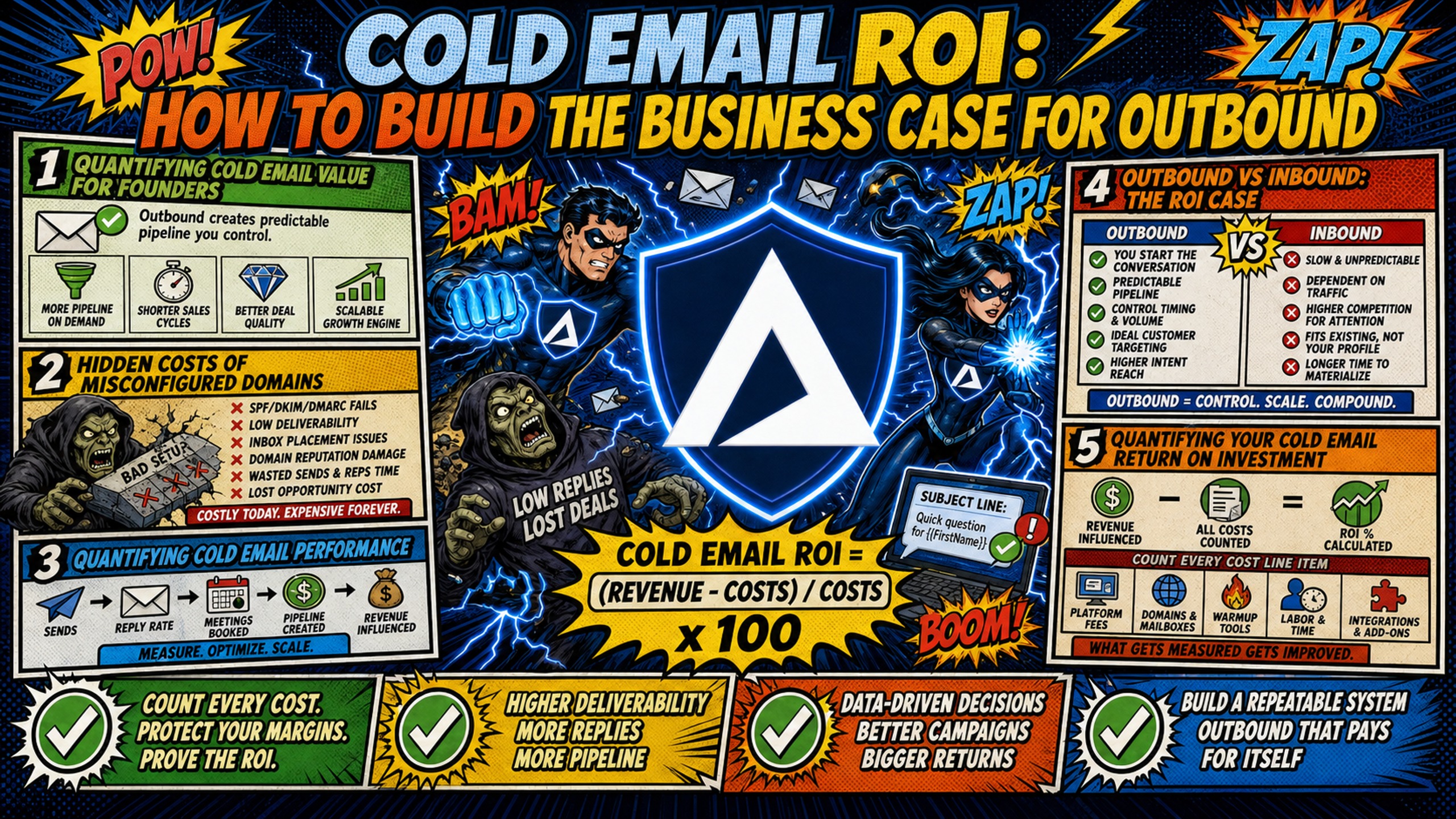
TL;DR: Cold email ROI is (Revenue - Costs) / Costs x 100, and a defensible business case counts every cost line item: platform fees, domains, warmup tools, labor, and data, not just the platform fee. 2026 benchmarks set expectations at a 3.4-5.8% reply rate (Empra, across 70M+ emails) and 1-3% meeting rates of contacts touched. Track four KPIs to defend the budget: cost per meeting (agency-run benchmark $150-400), cost per opportunity, pipeline contribution, and payback period. A campaign that reaches the 60-90 day payback window recycles capital 5-8x faster than the 16-month median SaaS CAC payback period, and flat-rate infrastructure ($147/month for unlimited inboxes) keeps the cost side fixed as volume scales, which is the variable founders can actually control.
Most founders can quote their CAC from paid ads but can't tell you their cost per meeting from cold email. That gap is why outbound budgets get cut first.
This article gives you the complete framework: four KPIs with formulas, honest cost accounting that includes domains, warmup, and labor, benchmarked performance ranges, and a one-page template for presenting the case to co-founders or investors.
Quantifying cold email value for founders
Cold email value starts with understanding what you're actually measuring. Too many founders track sends and replies without connecting those numbers to pipeline and revenue.
Hidden costs of misconfigured domains
Manual DNS setup creates hidden labor costs that inflate your true cost per meeting. Setting up SPF, DKIM, and DMARC records manually across dozens of domains consumes a full workday or more. Every hour spent in a DNS panel is an hour not spent on targeting, copy, or follow-up sequences.
Inframail's automated DNS configuration eliminates that bottleneck by provisioning domains with zero manual panel work. The platform handles SPF, DKIM, and DMARC record creation automatically, so the labor line item in your ROI calculation drops from days to minutes.
Quantifying cold email performance
The output side of your ROI equation depends on four conversion metrics working in sequence. Reply rate measures what percentage of sent emails generate a response.
Reply-to-meeting conversion rate tracks the percentage of replies that turn into booked calls. Overall meeting booking rate measures the percentage of contacts reached who book a meeting. Opportunity rate measures how many meetings become qualified pipeline. Close rate determines how many opportunities become revenue.
For broad B2B cold email, typical reply rates fall in the 3.4-5.8% range, and a strong meeting booking rate sits at 1-3% of contacts touched. These are your numerator inputs. If your reply rate drops below 3%, the problem is usually list quality or offer fit, not infrastructure.
Outbound vs inbound: The ROI case
Cold email shows results in days to weeks. Inbound channels like SEO and content marketing take months to generate pipeline. For early-stage founders managing cash flow, that speed difference matters.
A properly warmed cold email campaign can book its first meetings within the first month or two. Compare that to content strategies, which typically take many months before generating meaningful organic traffic. When your CAC payback period on cold email runs 60-90 days, you're recycling capital faster than almost any other channel. That's the argument that gets co-founders to approve the spend.
Quantifying your cold email return on investment
The ROI formula itself is simple: (Revenue - Costs) / Costs x 100. The hard part is honest accounting on the cost side.
4 KPIs for your outbound business case
These four metrics form the core of any cold email business case that survives scrutiny:
- Cost per meeting: Total monthly cold email spend divided by meetings booked that month. This is your primary efficiency metric.
- Cost per opportunity: Total monthly spend divided by qualified opportunities created. This accounts for meeting quality, not just volume.
- Pipeline contribution: Total dollar value of opportunities created from cold email as a percentage of total pipeline. This shows whether outbound is a meaningful growth lever or a side channel.
- Payback period: Total cold email investment divided by monthly gross margin from cold email-sourced deals. This tells you when the channel pays for itself.
For a worked example using these KPIs, the cold email sequence strategy framework shows how to connect campaign structure to measurable outputs.
90-day vs. annual ROI models
Ninety-day models validate whether the channel works. Annual models justify ongoing budget allocation. Both matter, but they answer different questions.
A 90-day model captures one full cycle: 2-3 weeks of warmup, 4-6 weeks of active sending, and the remaining weeks for booked meetings to turn into pipeline. The time that conversion takes depends on your sales cycle, so track it in your own CRM instead of assuming a fixed window. If your cost per meeting in month 3 is trending toward benchmark range, you have a validated channel.
An annual model spreads upfront costs (annual domain registrations, initial setup labor) across 12 months. Domains are yearly registrations that renew, so the setup labor is the only truly one-time item. A $250 annual domain spend that looks heavy in month 1 works out to about $21/month when spread across the year. Run both models in your business case to show the full picture.
Baseline metrics for cold email ROI
Industry benchmarks give you calibration points for evaluating your own performance. Belkins' analysis of 16.5 million cold emails found an average reply rate of 5.8% in 2024, down from 6.8% in 2023.
| Metric | Benchmark Range | Source |
|---|---|---|
| Reply rate | 3.4-5.8% | Empra |
| Meeting rate (of contacts) | 1-3% | Cactus Marketing |
| Cost per meeting (agency) | $150-400 | GTMBud |
| Cost per meeting (in-house SDR) | $150-250 | SkipCall |
Treat these as ranges, not guarantees. Your specific numbers depend on list quality, offer strength, and how well your emails avoid spam folders.
Evaluating your cost per booked meeting
The cost side of the ROI equation is where most founders undercount. Platform fees are the obvious line item, but the full stack includes domains, warmup tools, labor, and sending platform subscriptions.
Budgeting for domain and warmup fees
Domains cost $5-16/year each through Inframail. For a 50-inbox setup running roughly 15-20 domains, that's $75-320/year, or about $6-27/month when amortized.
Warmup tools are the bigger hidden cost. Third-party warmup services range from $0.60 to $96 per inbox per month. At 50 inboxes, that spread works out to $30-4,800/month, so price the specific tool you plan to use before you finalize your infrastructure stack.
Here's what the platform fee comparison looks like at 50 inboxes:
| Provider | Monthly Platform Fee | Notes |
|---|---|---|
| Inframail Unlimited | $147 | Flat rate, unlimited inboxes |
| Google Workspace (Flexible) | $420 | 50 x $8.40 per seat |
| Maildoso | $2.50/mailbox (30-mailbox tier, $75/mo) | Custom quantities available. ~$125/mo at 50 mailboxes if the 30-mailbox rate applies |
Domain costs and warmup tools apply on all three. Google Workspace Business Starter runs $8.40 per user per month on the Flexible Plan, which is what most agencies use since they scale inboxes up and down.
Calculating monthly personnel and tool fees
Your fully loaded cost per meeting must include labor. A simple formula:
Fully loaded cost per meeting = (Platform fees + Domain costs + Warmup costs + Sending platform + Data provider + Labor) / Meetings booked
For a founder-led campaign, estimate your time at $100-200/hour. If you spend 10 hours/month on campaign management, that's $1,000-2,000 in labor cost. Add a data provider like Apollo at $49-$119/month (annual billing) and a sending platform like Instantly starting at $37.60/month on annual billing, and your estimated monthly cost reaches approximately $1,087-$2,157 before inbox infrastructure, domains, and warmup tools.
Automated infrastructure reduces the labor line item. When DNS configuration takes minutes instead of an hour, you reclaim those hours for revenue-generating work.
Standard metrics for cold email ROI
A healthy cost per meeting for B2B outbound in 2026 runs roughly $150 to $400 for agency-run programs and $150 to $250 for in-house SDR teams targeting US decision makers.
If your cost per meeting exceeds $400, examine three variables: infrastructure spend (are you overpaying per inbox?), list quality (are you targeting the right prospects?), and offer strength (does your message give people a reason to reply?). The cold email outreach templates guide covers the messaging side of that equation.
From booked meetings to closed revenue
Meetings booked don't pay bills. Opportunities created and revenue closed do. The conversion from meeting to opportunity is where ROI calculations get honest.
Meeting-to-opportunity conversion rate
Not every booked meeting becomes a qualified opportunity. Average B2B cold email conversion benchmarks show 0.15-0.5% opportunity rate from total emails sent. Benchmark meeting-to-opportunity conversion runs 20-35% on average, with well-qualified programs reaching 35-50%.
Track this rate separately from your meeting booking rate. A high meeting rate with a low opportunity rate means you're booking calls with the wrong prospects, which wastes both your time and your prospect's. That insight should feed back into your list-building criteria.
Calculating ROI on high-value leads
Average contract value (ACV) changes what you can afford to spend per meeting. A $50,000 ACV deal justifies a $400 cost per meeting. A $5,000 ACV deal does not.
Sample revenue-based ROI calculation at $50,000 ACV:
- 1,000 sends, 5% reply rate = 50 replies
- 30% reply-to-meeting conversion rate = 15 meetings
- 40% opportunity rate = 6 opportunities
- 25% close rate = 1.5 deals
- Revenue: $75,000
- Total monthly costs: $2,500
- ROI: ($75,000 - $2,500) / $2,500 x 100 = 2,900%
Same calculation at $5,000 ACV:
- Revenue: $7,500
- Total monthly costs: $2,500
- ROI: ($7,500 - $2,500) / $2,500 x 100 = 200%
Both are positive, but the lower ACV scenario has far less margin for error.
Benchmarking cold email ROI by ACV
CAC payback benchmarks shift by deal size. Companies selling higher ACV deals can tolerate longer payback periods, while low-ACV deals need faster payback to stay healthy. The table below sets target guardrails by ACV range.
| ACV Range | Max Cost per Meeting | Target Payback | Rationale |
|---|---|---|---|
| Under $5,000 | $100-150 | Under 60 days | Low margin for acquisition cost |
| $5,000-$25,000 | $150-300 | 60-90 days | Balanced efficiency and growth |
| $25,000+ | $300-500 | 90-120 days | Higher tolerance, longer sales cycle |
Use your ACV to set the guardrails before you start spending, not after you've already committed budget.
Mapping pipeline growth to your payback period
Pipeline contribution and payback period are the two numbers that turn a cold email program from an experiment into a budgeted channel.
Attributing revenue to cold email
Keep attribution simple. Track the source of every lead in your CRM and attribute closed-won deals to the first touchpoint. If a prospect first engaged through a cold email and later converted through a demo or referral, cold email gets credit for sourcing the deal.
Multi-touch attribution models add precision but also complexity that most early-stage teams don't need. The question you're answering is binary: did cold email source this deal or not? Save the nuanced models for when you're running five channels simultaneously and need to allocate budget across them.
The cold email payback period formula
Payback period = Total cold email investment / Monthly gross margin from cold email-sourced deals
If you've invested $6,000 over three months and your cold email-sourced deals generate $3,000/month in gross margin, your payback period is 2 months. That 60-90 day target compares favorably to the broader SaaS market, where the median CAC payback period sits at 16 months and even high-performing SaaS companies average 5-7 months.
Evaluating cold email budget efficiency
Track infrastructure spend as a percentage of the revenue cold email generates. For agencies running outbound on behalf of clients, calculate infrastructure spend as a percentage of billings and set a ceiling based on your own target net margin. In-house teams can do the same with cold email-sourced revenue and set their own ceiling. Published benchmarks cover total overhead, not infrastructure alone, so your own numbers are the best guide.
Flat-rate pricing keeps this ratio stable as volume scales. When your platform fee stays at $147/month whether you run 50 or 500 inboxes, the infrastructure percentage shrinks as campaigns grow. Per-seat pricing pushes the ratio in the opposite direction: every new inbox adds cost at the same rate it adds capacity. For a deeper look at how plan selection affects your sending economics, the sending capacity calculator helps match plan tier to actual volume.
Quantifying outbound ROI for stakeholders
Numbers alone don't get budgets approved. Presentation does. Stakeholders want to see that you've accounted for all costs, benchmarked your projections, and identified the risks.
Quantifying outbound ROI in one page
Structure your one-page ROI summary with five sections:
- Current metrics: Sends per month, reply rate, meeting rate, cost per meeting.
- Cost breakdown: Platform fees, domains, warmup, sending platform, data provider, labor. Show every line item.
- Projected 90-day ROI: Based on benchmarked conversion rates applied to your list size and ACV.
- Projected annual ROI: Amortized costs with steady-state performance assumptions.
- Benchmark comparison: Your numbers next to industry ranges so stakeholders can calibrate.
This format answers the questions co-founders and investors actually ask: what does it cost, what does it return, and how do you know?
Adapting ROI data for investors
Investors care about three things in a growth channel business case: capital efficiency, scalability, and predictability. The often-cited SaaS standard of LTV:CAC above 3:1 with payback under 12 months gives you the frame.
Cold email clears that bar when infrastructure costs are controlled. A 2-3 month payback period is 5-8x faster than the SaaS median. A flat-rate infrastructure model means the cost side doesn't scale with volume, which makes the channel more profitable as it grows. Present those two facts together and the business case builds itself.
How to map your ROI defense
Follow this sequence when presenting the case:
- Lead with the cost model. Show every line item and how it compares to per-seat alternatives.
- Show benchmarked performance. Place your metrics next to industry ranges to prove they're realistic.
- Project pipeline contribution. Connect meetings to opportunities to revenue using your ACV and close rate.
- Address risks directly. Deliverability depends on list quality, warmup schedules, and sender reputation. Acknowledge these variables and show your mitigation plan.
- Close with the payback period. This is the number that makes the decision easy.
One founder who switched to flat-rate infrastructure put it plainly:
"The ROI on this is stupid good. We're saving cash and more importantly, we're saving time." - Verified user review of Inframail
Fix these four critical business case flaws
Even well-built ROI models fall apart when founders make these four mistakes.
Avoid revenue leaks from early sending
Sending before domains complete warmup damages sender reputation and reduces reply rates from day one. After turning on SPF and DKIM, allow DNS records to propagate before enabling DMARC, then run a 2-3 week warmup schedule before sending a single cold email.
Reply rates have already fallen from 8.5% in 2019 to 5% in 2025 due to tighter ESP filtering. Starting with a damaged reputation puts you below that declining baseline, which inflates every downstream cost metric.
Calculating real cold email setup costs
The full setup cost includes domain purchases, DNS configuration time, inbox provisioning, warmup tool setup, and sending platform configuration. Manual DNS setup across dozens of domains consumes a full workday or more. Automated provisioning through Inframail reduces that to minutes, with customer testimonials reporting 10 inboxes operational in 2 minutes.
That labor difference belongs in your ROI model. A full 8-hour workday of founder time at $150/hour equals at least $1,200 in hidden setup costs that most business cases ignore entirely. Automated infrastructure eliminates that line item and accelerates time to first meeting.
Overvaluing vanity metrics
Open rates and reply rates feel good but don't pay for themselves. A 10% reply rate with $800 cost per meeting is worse than a 4% reply rate with $150 cost per meeting. Focus on the four KPIs: cost per meeting, cost per opportunity, pipeline contribution, and payback period.
Inbox saturation and tightening bulk-sender rules mean reply rates will likely stay under pressure. The founders who maintain positive ROI are the ones controlling the cost side of the equation, and infrastructure pricing is the most controllable variable in that stack.
Build your cold email infrastructure with Inframail
Inframail is a flat-rate Microsoft email infrastructure provider for agencies and teams running cold email at scale. The Unlimited plan costs $147/month for unlimited inboxes, with automated DNS configuration and a dedicated US IP included. Domains cost $5-16 each per year, and warmup tools are an additional cost.
In this case study video, see how Inframail helped a client send high-volume cold emails with strong deliverability, achieve a 20–35% positive reply rate, and generate 4–5 sales worth approximately $5,000 each, resulting in over 10x ROI.
Sign up to Inframail and get started today.
FAQs
Is cold email worth it for startups?
Yes, when infrastructure costs stay under $180/month and reply rates hit 3% or higher. The 60-90 day payback period is 5-8x faster than the SaaS CAC payback median of 16 months, making it one of the most capital-efficient channels available to early-stage teams.
How long before cold email shows positive ROI?
Most campaigns show positive ROI within 60-90 days when domains are properly warmed and targeting is accurate. The first 2-3 weeks are warmup with no sending, so ROI calculations should start after that period ends.
What's a realistic cost per meeting for B2B SaaS?
$150-400 per meeting is the realistic benchmark range for outbound programs in 2026. Founder-led campaigns can show a lower cash cost per meeting because the founder's time is not paid out of pocket. Fully loaded cost per meeting adds that time at $100-200/hour, so it runs higher and is the number to use in your business case. Infrastructure should stay under $50 per meeting at 50 inboxes in either view.
Should I include founder time in the ROI calculation?
Yes, for honest accounting. Founder time at $100-200/hour adds up quickly across campaign setup, list building, and sequence management. Automated infrastructure reduces the setup and maintenance time cost, which directly improves the ROI calculation.
How do I compare cold email ROI to paid ads?
Compare cost per meeting and payback period side by side. Cold email typically runs $150-400 per meeting for agency-run programs, versus $300-600 for mid-market pay-per-meeting services (a figure GTMBud attributes to Leadriver), with a faster payback window. The trade-off is that cold email requires more upfront infrastructure setup and ongoing list management.
Key terms glossary
Cost per meeting: Total monthly cold email spend divided by meetings booked. The primary efficiency metric for outbound programs.
Cost per opportunity: Total monthly spend divided by qualified opportunities created. Accounts for meeting quality, not just volume.
Payback period: Total cold email investment divided by monthly gross margin from cold email-sourced deals. Tells you when the channel pays for itself.
Inbox placement rate: The percentage of sent emails that land in the recipient's primary inbox rather than spam or promotions folders.
Dedicated IP: An IP address assigned exclusively to your sending, so your reputation isn't affected by other users on a shared pool.
SPF/DKIM/DMARC: Three email authentication protocols that verify sender identity and prevent spoofing. Required for inbox placement at scale.
Warmup schedule: The 2-3 week process of gradually increasing send volume on new domains to build sender reputation before launching campaigns.
ACV (Annual Contract Value): The average annual revenue per customer contract. Determines how much you can afford to spend per meeting.
Reply rate: The percentage of sent emails that generate a response. Industry benchmark is 3.4-5.8% for B2B cold email.
Meeting rate: The percentage of contacts touched that convert to booked meetings. Strong performance is 1-3%.