
Cold email outreach ROI: how to calculate cost per meeting from templates
Cost per booked meeting is total campaign spend divided by meetings booked. To calculate cost per attended meeting, divide that figure by your meeting show rate
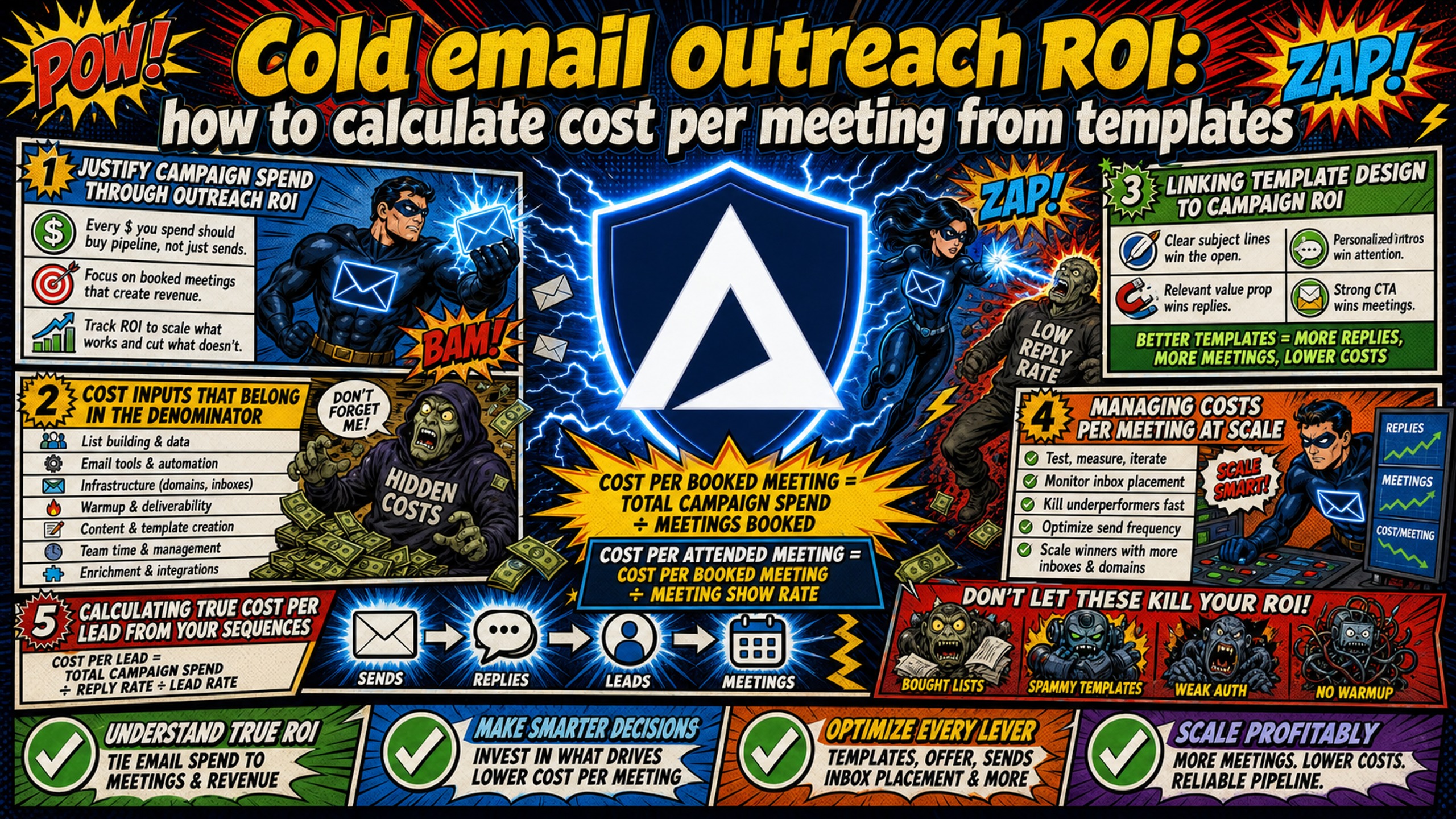
TL;DR: Cost per booked meeting is total campaign spend divided by meetings booked. To calculate cost per attended meeting, divide that figure by your meeting show rate. At 50 inboxes, 10,000 sends and a 3.43% reply rate, that is roughly $58 per booked meeting and $83 per attended meeting on $931 of infrastructure. Template quality moves that number further than any pricing model does: lifting reply rate from 2% to 5% cuts cost per meeting by about 60% with no extra spend. Flat-rate platform pricing holds the infrastructure half of the number steady as inbox count grows.
Cold email ROI discussions stop at reply rates and open rates. Those numbers tell you whether people are engaging, but they do not tell you whether the campaign makes money. For campaign managers who need to justify spend to leadership, cost per meeting is the only metric that connects template work, infrastructure spend, and booked revenue in one defensible number.
This article provides the formulas, benchmarks, and worked examples to calculate cold email outreach ROI from first principles. You will learn how to calculate cost per meeting, how template quality shifts that number, and how infrastructure pricing models create cost divergence at scale.
| Metric Type | Example Metrics | Why It Matters |
|---|---|---|
| Vanity metrics | Open rate, click rate, emails sent | Shows engagement, not profitability |
| Success metrics | Cost per meeting, cost per reply, campaign ROI | Connects spend to revenue |
| Infrastructure cost and health metrics | Cost per inbox, deliverability rate | Tracks platform costs and email delivery performance |
Justifying campaign spend through outreach ROI
Cold email outreach ROI is not a deliverability problem. It is a unit economics problem, and the unit is the meeting, not the inbox. When leadership questions why infrastructure costs $420 a month for 50 inboxes, reply rate alone does not answer the question. Cost per meeting does.
The formula for cold email campaign ROI follows the standard return calculation: ROI equals attributed revenue minus total campaign cost, divided by total campaign cost, multiplied by 100. The cost inputs that belong in the denominator are listed below.
Cost inputs that belong in the denominator
Total campaign cost includes four categories:
- Software costs: Sending platform, data provider, CRM, and add-ons.
- Labor costs: List building, copywriting, personalization, inbox management, and reporting.
- Data costs: Cost per lead, verification fees, and enrichment credits.
- Infrastructure costs: Email platform or hosting fees, domain purchases, and warmup tools.
Infrastructure is where most teams lose track. Domain registration runs $5 to $16 per year through Inframail or comparable rates through external registrars. Email hosting costs $147 per month flat for Inframail Unlimited versus $8.40 per seat for Google Workspace on the Flexible Plan.
External warmup tools such as Warmbox or Lemwarm add $15 to $50 per inbox per month, and this cost applies on both per-seat and flat-rate infrastructure. Track this number separately because it scales linearly with inbox count on any platform.
Linking template design to campaign ROI
Template quality is the highest-impact ROI input you control. Going from a 2% reply rate to a 5% reply rate on the same infrastructure cuts your cost per meeting by roughly 60%, and reply rate is almost entirely a function of targeting precision and offer clarity, not subject line tricks.
The math is straightforward. This article models a 14.1% positive-reply share (positive replies as a percentage of all replies, not of emails sent) and a 33% meeting conversion rate as fixed assumptions. Neither the 14.1% positive-reply share nor the 33% meeting conversion rate is a published benchmark, so substitute your own ratios because they vary widely by offer and list quality. At $500 per month in total infrastructure cost and 10,000 emails sent, the economics shift with reply rate:
- 2% reply rate: 200 replies, 28 positive replies (14.1% positive-reply share), approximately 9 meetings (33% of positive replies book a meeting), cost per meeting approximately $54 ($500 divided by 9.3 meetings).
- 5% reply rate: 500 replies, 70 positive replies (14.1% positive-reply share), approximately 23 meetings (33% of positive replies book a meeting), cost per meeting approximately $21 ($500 divided by 23.3 meetings). That is roughly a 60% reduction in cost per meeting with zero increase in infrastructure spend. For a deeper look at how opener quality shifts these numbers, see email opener psychology.
Managing costs per meeting at scale
Cost per meeting tells you exactly what you pay to get a prospect in a meeting, regardless of whether the deal closes. The formula is total monthly campaign cost divided by total meetings booked.
As domain count grows, per-inbox pricing models create cost divergence. Google Workspace charges $8.40 per seat on the Flexible Plan, so 50 inboxes cost $420 per month and 200 inboxes cost $1,680 per month. Inframail charges $147 per month whether you run 50 inboxes or 200, so platform cost per meeting stays flat while per-seat models inflate linearly. Domain and warmup costs apply on both sides and are not included in this comparison.
For more on how infrastructure setup time factors into total campaign economics, see the email sequence strategy framework.
Calculating true cost per lead from your sequences
Before you can calculate cost per meeting, you need to calculate cost per lead. A lead is any prospect who replies positively and enters your pipeline. Cost per lead is total campaign spend divided by positive replies.
Calculating total per-inbox expenses
Per-inbox cost is the sum of platform fee, domain cost, and warmup cost divided by inbox count. The comparison below uses 50 inboxes with $15 per inbox warmup on both sides.
| Cost Component | Inframail (50 inboxes) | Google Workspace (50 inboxes) |
|---|---|---|
| Platform fee | $147/month | $420/month |
| Domain costs (amortized, 50 domains at ~$8.16 per year each) | ~$34/month | ~$34/month |
| Warmup costs (50 inboxes at $15 per inbox per month, provider range $15 to $50) | $750/month | $750/month |
| Total monthly (platform + domains + warmup) | ~$931 | ~$1,204 |
| Cost per inbox | ~$18.62 | ~$24.08 |
The per-inbox cost difference is approximately $5.46, and it comes entirely from the platform fee ($8.40 per inbox on Google Workspace versus $2.94 on Inframail at 50 inboxes). Domain and warmup costs are the same on both sides. The gap widens as inbox count grows because Inframail's flat fee spreads across more inboxes.
Converting cost per lead into cost per meeting
Cost per lead feeds directly into cost per meeting. If your cost per lead is $19.25 ($931 divided by 48.36 positive replies) and your positive reply to meeting conversion rate is 33%, your cost per meeting from infrastructure alone is roughly $58. Add sending platform costs, data costs, and labor, and the fully loaded cost per meeting climbs higher.
This is why understanding healthy campaign metrics matters before you report numbers upward.
Quantifying campaign cost per meeting
Cost per meeting that actually happens requires adjusting for show rate, but show rates for outbound-booked meetings are poorly measured. The most-cited figure is a 20% dropout rate, meaning roughly 80% of booked meetings are held, from Operatix's own book of over 500 B2B SaaS campaigns, and it covers multi-channel SDR meetings rather than cold email specifically. This model uses 70% as a conservative assumption, so to calculate cost per attended meeting, multiply cost per booked meeting by 1.43.
On $931 of monthly infrastructure cost, 343 replies produce 48.36 positive replies and 15.96 expected meetings. That makes cost per booked meeting $58.33 and cost per attended meeting at a 70% show rate $83.33, and the attended figure is the number that matters for ROI calculation because revenue only materializes when the prospect shows up. These figures use unrounded meeting counts and round only the final outputs.
How to calculate cost per reply
Cost per reply is a diagnostic metric that reveals whether template quality or infrastructure cost is the bottleneck. The formula is total spend divided by total replies.
Reply rate benchmarks by data source
Reply rate benchmarks vary by source and methodology. Instantly's Cold Email Benchmark Report 2026 puts the platform average near 3.43% based on data through December 2025. Saleshandy's October 2026 analysis reports 4.5% across 30.3 million emails.
Instantly's benchmark report puts the top quartile at 5.5% or higher and the top 10% at 10.7% or higher, and Saleshandy calls 3% to 5% a healthy benchmark, with 7% or higher outperforming the market and its top 1% of campaigns at 15% to 30%. For current benchmarks and what qualifies as competitive, see cold email reply rate benchmarks.
Calculating infrastructure cost per reply
Infrastructure cost per reply equals total infrastructure spend divided by total replies. At $931 per month and 343 replies, infrastructure cost per reply is $2.71. This number isolates infrastructure from labor and data costs.
If infrastructure cost per reply is high but reply rate is low, the problem is template quality or targeting. If infrastructure cost per reply is high and reply rate is strong, the problem is infrastructure pricing.
Managing costs for large-scale sends
At scale, small changes in reply rate produce large changes in cost per reply. At 80,000 emails per month (the cap on Inframail's $147 Unlimited plan), a 3.43% reply rate produces 2,744 replies. A 5% reply rate produces 4,000 replies. The same infrastructure spend divided across more replies lowers cost per reply proportionally. Volume above 80,000 per month, up to 300,000, requires the $387 Agency Pack, so price that tier into any model above this cap.
This is why template quality matters more at scale. The infrastructure cost is fixed, but the reply rate is variable. Improving reply rate is the largest lever on cost per reply, and it adds no spend.
Why refined templates lower cost per lead
Template quality is the ROI lever with the largest effect, and it improves without increasing spend. Infrastructure costs are fixed once you pick a pricing model, and data costs scale with volume. Template quality drives reply rate, which lowers cost per lead and cost per meeting simultaneously.
Calculating template cost per meeting
Template cost per meeting isolates the impact of copy quality on meeting economics. The formula is total campaign cost divided by meetings booked, segmented by template variant.
In A/B testing, apply the 2% versus 5% reply rate example from "Linking template design to campaign ROI" to each template variant. Template A produces roughly 9 meetings and Template B roughly 23 from the same 10,000 sends. The infrastructure cost is identical, but the cost per meeting for Template A is 2.5 times higher than Template B. For a structured approach to template iteration, see the A/B testing framework.
How copy quality drives reply rates
Reply rate is a function of targeting precision and offer clarity. The opener determines whether the prospect reads the second line, and the value proposition determines whether they reply. The call to action then determines whether they book.
Personalized openers that reference specific company details or recent events require more research time per email. At scale, the ROI calculation must include labor cost per personalized email versus reply rate lift. For the data on when personalization pays off, see personalized versus generic openers.
Why the model holds positive-reply share flat
In this model, template quality shifts meeting rates only through reply rate lift. The positive-reply share stays at 14.1% of all replies and meeting conversion stays at 33% as fixed assumptions. In practice, a template that attracts better-fit prospects may also raise the positive-reply share, so the model is conservative on that input. Substitute your own ratios once you have campaign data.
How domain volume affects ROI
Domain volume affects ROI through send capacity and deliverability distribution. More domains spread send volume across more sending identities, reducing per-domain reputation risk. The trade-off is higher domain and warmup costs.
Inframail's sending capacity model recommends 40 emails per inbox per day for optimal deliverability. With one inbox per domain, 50 domains send about 2,000 emails per day (roughly 60,000 per month), which fits within the 80,000 monthly cap of the $147 Unlimited plan. 200 domains send about 8,000 per day (roughly 240,000 per month), which exceeds that cap and requires the $387 Agency Pack (up to 300,000 per month). Spreading volume across more domains keeps per-domain volume lower, which reduces spam trap hits and improves inbox placement rate, so the ROI question is whether the deliverability lift justifies the incremental domain cost and the higher plan tier.
Worked examples
The following worked examples apply the formulas to three common agency scenarios. Each uses these modeling assumptions: a 3.43% reply rate (Instantly 2026 average), 14.1% positive-reply share (of all replies), 33% meeting conversion rate, 70% show rate, and 200 sends per inbox per month, well under the 40 per day the help center recommends, to model a conservative ramp.
Calculating ROI for 5 agency clients
An agency runs 5 clients with 10 domains each, totaling 50 domains and 50 inboxes. This model uses one inbox per domain as a conservative assumption, because Inframail's help center recommends 3 to 5 inboxes per domain, which would need only 10 to 17 domains for 50 inboxes and lower the domain line to roughly $7 to $12 per month. Monthly infrastructure cost on Inframail is $147 platform fee plus approximately $34 domain costs plus $750 warmup, totaling approximately $931.
At 10,000 sends per month and a 3.43% reply rate, the agency generates 343 replies. At a 14.1% positive-reply share and 33% meeting conversion, that is approximately 15.96 expected booked meetings. Adjusted for 70% show rate, approximately 11.17 meetings are attended.
If average deal value is $5,000 and close rate is 20%, expected revenue per attended meeting is $1,000. Across approximately 11.17 attended meetings (unrounded), monthly attributed revenue is approximately $11,172. Monthly infrastructure-only ROI is ($11,172 minus $931) divided by $931, multiplied by 100, equals approximately 1,100%. This figure excludes software, labor, and data costs, so fully loaded campaign ROI is materially lower.
Calculating ROI for 30 active domains
A B2B SaaS company runs 30 domains for a single product line. On Google Workspace, 30 inboxes at $8.40 per seat cost $252 per month.
Domain costs are approximately $20 per month amortized (30 domains at ~$8.16 per year each). Warmup for 30 inboxes at $15 per inbox per month (the low end of the $15 to $50 provider range) is $450 per month. Total infrastructure is approximately $722 per month.
At 6,000 sends per month and a 3.43% reply rate, the company generates 206 replies. At a 14.1% positive-reply share and 33% meeting conversion, that is approximately 9.58 expected booked meetings. Cost per booked meeting is approximately $75.40. Adjusted for 70% show rate, cost per attended meeting is approximately $107.71.
The same infrastructure on Inframail costs $147 plus approximately $20 plus $450, totaling approximately $617 per month. Cost per attended meeting drops to approximately $92.05, a roughly 15% reduction from the Google Workspace scenario.
Calculating ROI for 100+ inboxes
An agency scales to 100 inboxes across multiple clients, sending 20,000 emails per month (200 per inbox, the same rate as the 50-inbox example). On Google Workspace, platform cost is $840 per month, and on Inframail it remains $147. Domain costs for 100 domains at ~$8.16 per year each are approximately $68 per month. Warmup at $15 per inbox is $1,500.
| Metric | Google Workspace | Inframail |
|---|---|---|
| Platform fee | $840/month | $147/month |
| Domain costs (amortized, 100 domains at ~$8.16 per year each) | ~$68/month | ~$68/month |
| Warmup costs (100 inboxes at $15 per inbox per month, provider range $15 to $50) | $1,500/month | $1,500/month |
| Total monthly (platform + domains + warmup) | ~$2,408 | ~$1,715 |
| Meetings attended (est.) | 22.34 | 22.34 |
| Cost per attended meeting | ~$107.78 | ~$76.76 |
The infrastructure savings compound with scale, producing approximately 29% lower cost per meeting at 100 inboxes.
"Compared to what you would spend making your own infrastructure with google workspace accounts, you are genuinely saving hundreds or even thousands of dollars a month on software costs." - Verified user review of Inframail
Lowering infrastructure costs per booked meeting
Infrastructure pricing is the input you control outright in the cost per meeting formula. Unlike reply rate, which depends on market response, infrastructure cost is determined by pricing model selection.
Adding setup labor to per-inbox cost
True per-inbox expense includes platform fee, domain cost, warmup cost, and labor cost for setup and maintenance. Labor is often excluded from ROI calculations, but manual DNS setup consumes real hours.
Setting up 50 domains manually takes 12 or more hours. At a $50 per hour fully loaded labor rate, that is $600 in setup labor. Automated DNS configuration reduces this to near zero.
Lowering cost per inbox at scale
Flat-rate pricing lowers cost per inbox as scale increases. At 50 inboxes, Inframail's $147 platform fee is $2.94 per inbox, and at 200 inboxes, it is $0.74 per inbox. Google Workspace remains $8.40 per inbox on the Flexible Plan regardless of scale.
At 50 inboxes, Google Workspace costs $420 versus Inframail's $147, a monthly platform savings of $273. At 200 inboxes, Google Workspace costs $1,680 versus Inframail's $147, a monthly savings of $1,533, or $18,396 annualized. Domain and warmup costs apply on both sides and are not included in this comparison.
Andy, an agency operator, compares the flat price against Google Workspace:
"Unlimited inboxes on a flat price? That alone saves me hundreds every month compared to Google Workspace or similar." - Verified user review of Inframail
Calculating breakeven per active inbox
Breakeven per active inbox is the reply rate required to cover infrastructure cost. The formula works backward from revenue:
At approximately $18.62 cost per inbox per month and $100 revenue per attended meeting, you need approximately 0.19 attended meetings per inbox per month to break even. At a 70% show rate, that means approximately 0.27 booked meetings per inbox. The $100 figure is a deliberately conservative floor for this breakeven test, well below the $1,000 expected revenue per attended meeting in the 5-client example. At 200 sends per inbox per month, a 33% meeting conversion rate, and a 14.1% positive-reply share, that requires approximately a 2.86% reply rate (about 2% only if $100 were earned per booked meeting, which ignores the show rate).
Any reply rate above breakeven generates positive ROI. The goal is widening the spread between actual reply rate and breakeven reply rate.
The real cost of manual inbox setup
Manual inbox setup carries hidden costs beyond labor hours. DNS propagation delays can push campaign launches back by days. Misconfigured SPF or DKIM records can damage sender reputation before the first send.
Automated DNS configuration eliminates these risks. Inframail configures SPF, DKIM, and DMARC records automatically without DNS panel access. Setup time drops from hours to minutes.
Watch this case study video and learn how Inframail helped a client run cold email campaigns with reliable, cost-effective infrastructure across multiple domains for over a year without issues, supporting a steady increase in responses over 60 days and $42,000 in new sales in just 4 weeks.
Sign up to Inframail and get started today.
FAQs
What is a good ROI for cold email campaigns?
Email marketing is often quoted at $36 to $42 returned per $1 spent, but that figure covers all email marketing, not cold outbound. Litmus publishes it as a distribution rather than an average: 35% of marketing leaders report $10 to $36 back, 30% report $36 to $50, and 5% clear $50. Calculate your own return from cost per attended meeting instead.
How do you track cold email ROI across multiple domains?
Track cold email ROI by aggregating total infrastructure spend across all domains and dividing by total meetings booked from all campaigns. Use per-domain tracking to identify underperforming domains that inflate average cost per meeting.
What's the typical cost per meeting for B2B cold email?
No neutral cost-per-meeting benchmark exists for B2B cold email, so use your own numbers. The $58 to $108 figures in this article cover infrastructure only, and adding sending platform, data and labor costs moves the total higher. For context on a related metric, Instantly's cold email metrics analysis puts fully loaded cost per lead for cold email at $152.73, against $2,777.78 for cold calling. Teams on flat-rate infrastructure can achieve lower costs per meeting compared to per-seat pricing models when running at scale.
How long does it take to see positive ROI from cold email?
No neutral benchmark defines how long a cold email campaign takes to reach positive ROI, so plan the timeline around your own numbers. Warmup comes first, and during that period infrastructure and warmup costs accumulate while send volume is restricted. Track cumulative spend against attended meetings and expected revenue each week to find your own breakeven point.
Should I calculate ROI per campaign or per inbox?
Calculate ROI at the campaign level for client reporting and at the inbox level for infrastructure optimization. Campaign-level ROI connects spend to revenue. Inbox-level ROI reveals whether infrastructure pricing is efficient at scale.
Key terms glossary
Cost per booked meeting: Total campaign spend divided by meetings booked.
Cost per attended meeting: Total campaign spend divided by meetings attended, or cost per booked meeting divided by show rate.
Cost per reply: Total campaign spend divided by total replies. Measures the spending required to generate a reply.t.
Infrastructure cost per inbox: Platform fee plus domain cost plus warmup cost divided by inbox count. The unit cost that determines scalability.
Reply rate: Total replies divided by delivered emails, multiplied by 100. Delivered equals sent minus hard bounces.
Meeting show rate: Percentage of booked meetings that actually occur. Show rates for outbound-booked meetings are poorly measured, and this article uses 70% as its working assumption.
Total cost of ownership: Sum of platform fees, domain costs, warmup tools, labor, and data costs across all campaigns and domains.