
Cold email opener mistakes that kill reply rates
A cold email opener is the first one to two sentences of the email, and when replies drop while inbox placement stays healthy, the opener is the first place to
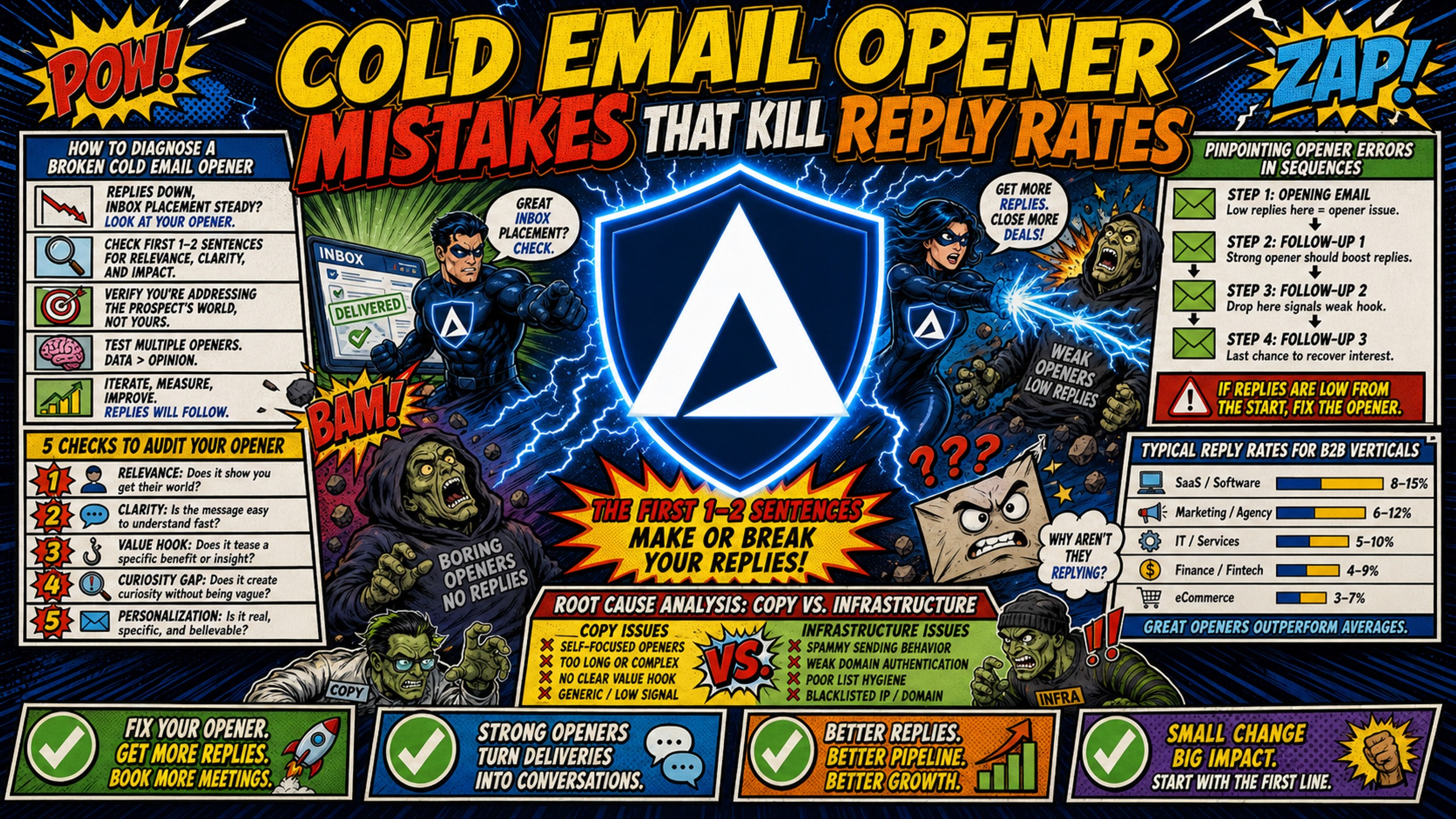
TL;DR: A cold email opener is the first one to two sentences of the email, and when replies drop while inbox placement stays healthy, the opener is the first place to look. Fix three mistakes first: fake merge tags, self-focused intros, and openers that give the prospect no reason to reply. Specificity pays: advanced personalization averages about 17-18% reply rates versus 7-9% for basic or no personalization across 20M+ emails (Woodpecker), against B2B averages of 4.1% to 5.8% in the Hunter and Belkins datasets (Prospeo). Before rewriting, run an inbox placement test and check Inframail's deliverability monitoring dashboard, which tracks domain and IP health with blacklist monitoring, to rule out a blacklisting, then test one opener change at a time.
Your reply rate dropped and everyone is blaming the infrastructure. The opener is often the real culprit. Most advice about bad email openers tells you what to avoid but never shows you how to prove which mistake is costing you replies. This guide covers the ten most common cold email opener mistakes, gives before/after rewrites for each, and shows how to separate copy problems from deliverability problems before you rewrite anything.
How to diagnose a broken cold email opener
Low reply rates have two possible root causes: the copy in the opener or the infrastructure delivering the email. Diagnosing them separately saves hours of wasted rewriting and prevents unnecessary infrastructure changes. This is the core of low reply rate troubleshooting: isolate the variable before you fix it.
5 checks to audit your opener
Run every opener through these five questions before you send:
- Does the first sentence mention the prospect's problem, not your company? Self-focused intros kill engagement.
- Is the personalization specific and verifiable? Fake merge tags are worse than no personalization.
- Does the opener ask for one thing, not three? High-friction openers suppress replies.
- Is the tone matched to the prospect's seniority and industry? Casual openers with formal buyers cost replies.
- Does the opener set up a reason to reply? An opener that names no problem leaves the CTA with nothing to point back to.
Pinpointing opener errors in sequences
Check your sending platform's step-level analytics. If Step 1 has a strong open rate but a weak reply rate, the opener may be the bottleneck. If Step 1 has a weak open rate, the subject line or deliverability may be the bottleneck.
Open rates are an unreliable signal in isolation: Apple Mail Privacy Protection and disabled open tracking inflate or hide open counts. Use an inbox placement test (for example GlockApps) as the primary infrastructure check, and treat opens as a secondary signal. Inframail's guide to healthy campaign metrics shows how to read these signals without guessing.
Typical reply rates for B2B verticals
Published cold email datasets report different averages: Belkins' 2024 dataset (16.5M emails) reported a 5.8% average reply rate, and Hunter's analysis (11M emails) found 4.1%, per Prospeo's benchmark roundup. Top-performer reply rates also vary by industry, from 10-12% in SaaS and technology to 5-8% in financial services, per the same roundup.
Inframail's own breakdown of realistic B2B response rates adds eight tactics for moving from average to top quartile. Use these as directional guides, not absolute targets.
Root cause analysis: copy vs. infrastructure
Before rewriting openers, confirm the problem is actually the copy. This table separates the two problem types:
| Symptom | Likely cause | Where to check | Fix type |
|---|---|---|---|
| High opens, low replies | Opener copy | Sequence step analytics | Copy rewrite |
| Low opens, low replies | Subject or deliverability | Sequence and infrastructure | Copy or infrastructure |
| High bounces, low replies | List quality | Data provider verification | List cleaning |
| Replies dropped suddenly | Blacklist or spam trigger | Inframail blacklist monitoring | Infrastructure |
Note: open rates in this table are a secondary signal only. Privacy features like Apple Mail Privacy Protection inflate recorded opens, and some senders disable open tracking to protect deliverability. Confirm placement with an inbox test before drawing conclusions from open rate alone.
Good placement plus weak replies may point toward offer, targeting, or copy issues, while poor inbox placement combined with provider deferrals points to a sending reputation problem. Inframail's deliverability monitoring dashboard tracks domain and IP health with blacklist monitoring and auto-submits delisting requests when domains are flagged, so you can rule out a blacklisting before touching the copy. For a deeper look at monitoring workflows, see Inframail's infrastructure monitoring guide.
Mistake 1: Canned praise that reads as insincere
Canned praise ("I love your company!") reads as insincere and suppresses replies. Advanced personalization averages reply rates of about 17-18%, versus 7-9% for basic or no personalization, across more than 20 million sales emails, according to Woodpecker's cold email statistics. Prospects see a steady stream of cold email, and a generic compliment signals you did not do the work.
Canned praise: before and after
In your sequence analytics, look for Step 1 emails with open rates above 30% but reply rates under 3%, then check whether the opener leads with a generic compliment.
Before: "I came across your company and I'm really impressed with what you're doing!"
After: "I noticed your team just expanded into the healthcare vertical. Companies making that move usually see a sharp increase in compliance requirements around how they store and handle prospect data."
Audit question: Does this compliment reference a specific, verifiable fact about the prospect's business, or could it apply to any company?
Mistake 2: Self-focused intros that ignore the prospect
Self-focused openers underperform prospect-focused ones because the prospect's first question when reading any cold email is "why should I care?" A company-first intro delays that answer. Your company name in the first sentence tells the prospect this email is about you, not them.
Self-focused intro: before and after
In your sequence analytics, flag any Step 1 email where the first word is 'I,' 'We,' or your company name.
Before: "Hi, I'm [Name] from [Company]. We help companies like yours with..."
After: "Your recent job posting for a VP of Sales suggests you're scaling the team quickly. Most companies at that stage find the first bottleneck is time-to-hire, not headcount budget."
Audit question: Does the first sentence mention the prospect's name, company, or problem before mentioning yours?
Mistake 3: Fake personalization tokens that read as mail merge
Advanced personalization lifts reply rates when it references something the prospect would recognize as specific to them. The depth threshold matters: too shallow reads as a mail merge, too deep reads as creepy. If the merge tag could apply to hundreds of other prospects without changing a word, it is fake personalization. Real personalization references a specific trigger event, mutual connection, or recent company news.
Fake personalization: before and after
Search your template for merge tags that use only industry, job title, or company size fields. Any tag that applies to thousands of prospects without changing meaning is fake personalization.
Before: "I noticed you're in the SaaS industry and thought you'd be interested in..."
After: "Your team's recent Series B announcement mentioned plans to double the sales team. That usually means onboarding and enablement fall behind headcount growth."
Audit question: Could this exact sentence be sent to many other prospects without editing? If yes, rewrite it.
Mistake 4: High-friction questions that ask for too much
High-friction openers that stack multiple qualifying questions suppress replies because they demand work before the prospect has a reason to engage. Prospeo's cold pitch guide recommends lowering the ask when opens are strong but replies are weak. Limit yourself to one question per opener when possible. If you need three pieces of information, spread them across the sequence or ask the most important one first.
High-friction questions: before and after
Count the question marks in your opener. More than one in the first two sentences is the signal.
Before: "What's your current outbound process, how many SDRs do you have, and what tools are you using?"
After: "Who owns the sales enablement decision on your team, you or your VP of Revenue?"
Audit question: Does this opener ask for one piece of information or multiple? If multiple, cut it down to one.
Mistake 5: Vague questions with no clear reason to reply
Vague opener questions ("How are things going?") give the prospect no reason to reply, and they are common in sequences where deliverability is clean but replies are absent. Specific qualification questions ("Are you still using X for Y?") give the prospect a clear reason to engage. Questions that can be answered quickly with a yes, no, or short phrase lower friction and improve reply rates.
Vague opener questions: before and after
Read the opener question aloud and ask whether a prospect could answer it in under 10 seconds. If the answer requires thought or research, the question is too vague.
Before: "How's your outbound strategy going?"
After: "Are you still running sales training in-house, or have you moved to an external program?"
Audit question: Can the prospect answer this question in under 10 seconds with a yes, no, or short phrase?
Mistake 6: Openers that delay the value proposition
Pleasantries like "I hope this email finds you well" use up the two sentences that decide whether the prospect keeps reading. In most inboxes, the opening line also shows as preview text, so a generic greeting is often the only thing the prospect sees before choosing to open. Put the reason for the email in the first sentence. If the prospect has to reach the third line to understand why they should care, they won't.
Delayed value proposition: before and after
Paste your opener into any inbox preview tool and check what shows as preview text. If a pleasantry fills that preview line instead of a reason to care, the value proposition is delayed.
Before: "I hope this email finds you well. I wanted to reach out because we've been working with companies in your space and..."
After: "Your team just opened three new SDR seats. New reps usually spend their first month building lists instead of booking calls, and [Product] gives them a ready-made list on day one."
Audit question: Does the prospect know what's in it for them within the first two sentences?
Mistake 7: Tone mismatches with the prospect's world
Formal industries (legal, finance, healthcare) tend to expect formal openers. Casual industries (startups, creative agencies) often tolerate casual ones. Match tone to the prospect's seniority and industry, and the fix is cheap: read their LinkedIn posts and mirror their register.
Tone mismatch: before and after
Pull three recent LinkedIn posts from the prospect and compare the vocabulary and formality level to your opener. A clear gap in register is the signal.
Before (to a CFO): "Hey! Love what you're doing. Quick question..."
After (to a CFO): "I noticed your firm expanded into enterprise accounts last quarter. Companies at that stage typically see infrastructure costs scale faster than billings, and most CFOs we speak with are looking for ways to bring cost-per-client back under control."
Audit question: Does this opener match the tone the prospect uses in their own public writing?
Mistake 8: Apologetic framing that undersells the email
Heavy apologetic framing ("Sorry to bother you, I'll keep this short") positions the email as an interruption and gives the prospect permission to delete it. The nuance matters here: a lightly unsure opener ("Not sure if this is on your radar, but...") reads like a person offering a hypothesis rather than a pitch. The mistake is apology, not humility. Cut the groveling but keep the honest hedging.
Apologetic framing: before and after
Search your template for phrases like 'sorry,' 'I know you're busy,' 'I'll keep this short,' or 'I won't take up much of your time.' Any of these in the first two sentences is the signal.
Before: "I know you're probably swamped, so I'll keep this short..."
After: "Not sure if this is on your radar, but your team's recent hiring spree usually means onboarding costs spike before productivity does. Most teams that scale past 20 reps find the first 90 days cost more than they planned."
Audit question: Does this opener apologize for existing, or does it lead with an honest, relevant hypothesis?
Mistake 9: Trigger events that don't connect to your offer
Trigger events (funding announcements, job postings, product launches) only work if they align with your offer. A funding announcement is relevant if you sell infrastructure, not if you sell office furniture. Misaligned triggers confuse prospects and suppress replies because the opener proves you found a fact but not a reason.
Trigger freshness matters as much as alignment, so send while the event is still recent. A funding round from eight months ago is no longer a trigger. It's company history.
Misaligned trigger events: before and after
Write one sentence explaining how the trigger event connects to the problem you solve. If you cannot complete that sentence clearly, the trigger is misaligned.
Before: "Congrats on the recent funding! We help companies with their office design."
After: "Congrats on the Series B. Companies at that stage usually find their RevOps stack needs a rebuild before the new headcount can hit quota."
Audit question: Does this trigger event logically connect to the problem I solve, or am I forcing it?
Mistake 10: Openers that don't set up a reason to reply
A CTA only works if the opener has already given the prospect a reason to answer. When the first two sentences name no problem, "Let me know if you're interested" has nothing to point back to. Name a specific problem in the opener, then close with a small ask tied to that problem. The video breakdown of hard vs. soft CTAs covers CTA formats that lift reply rates.
Opener with no setup: before and after
Read only the first two sentences of the email and ask whether they name a specific problem. If they do not, the opener gives the CTA nothing to point back to.
Before: "Hope you're doing well. Let me know if you'd like to chat sometime."
After: "Your team is hiring two SDRs this quarter, which usually means onboarding eats into selling time. Worth a 10-minute call this week to see how other teams handle it?"
Audit question: Does the ask at the end point back to a problem named in the first two sentences?
Cold email opener mistakes ranked by fix priority
Use this table to prioritize fixes. Priority reflects how often each mistake shows up in underperforming sequences and how directly it blocks a reply:
| Mistake | Priority | One-line fix |
|---|---|---|
| Fake merge tags | High | Use trigger events or specific company news |
| Self-focused intro | High | Lead with the prospect's problem, not your company |
| No reason to reply | High | Name a problem in the opener that the ask can point back to |
| Canned praise | Medium | Replace with specific, verifiable relevance |
| High-friction questions | Medium | Ask one question, not three |
| Vague opener questions | Medium | Make the question specific and easy to answer |
| Delayed value prop | Medium | State the reason for the email in the first sentence |
| Misaligned triggers | Medium | Only use triggers that connect to your offer |
| Tone mismatch | Low | Match the prospect's LinkedIn tone |
| Apologetic framing | Low | Replace apology with an honest hypothesis |
Note: reply-rate costs vary by industry, list quality, and offer strength. Treat these priorities as directional guidance based on common practitioner observations rather than controlled studies.
How to A/B test opener fixes in your sequence
Once you've identified the opener mistake, test the fix before rolling it out to your full list.
Required sample sizes for reliable tests
Reply-rate tests need far larger samples than most teams expect. At a 1.5% reply rate, proving a 50% lift takes about 4,400 recipients per variant at 95% confidence and 80% power, per Woodpecker's A/B test calculator. The common 100-to-500 rule of thumb only holds for open-rate tests. Plug your own baseline into a calculator such as Evan Miller's sample size calculator before you launch.
Control variables in your tests
Your control version is your baseline, and the test version changes one specific variable. If you are testing the opener, everything else (subject line, send time, sender name, CTA) must remain identical.
Deliverability is the most common hidden confound in cold email testing, per Unify's A/B testing guide. If one variant lands in spam more often, the test measures inbox placement rather than copy. Verify both lists and send both variants from mailboxes with similar warmup and health.
Determining the ideal rollout timing
Run the test for 7-14 days to account for day-of-week variation. Roll out the winner only when the result reaches 95% confidence, and if the result is inconclusive, test a different opener variable rather than declaring a winner too early.
Inframail's flat-rate pricing at $129/month for unlimited inboxes (before domain and warmup costs) removes per-inbox cost pressure from A/B testing, so campaign managers can provision test domains for each variant without calculating marginal cost. The platform configures SPF/DKIM/DMARC (the authentication records that tell email providers the sending domain is legitimate) on new test domains automatically. Warm them with an external tool before sending test variants.
The deliverability dashboard tracks domain and IP health with blacklist monitoring, so you can rule out a blacklisting before trusting test results. For the full workflow, see Inframail's infrastructure monitoring guide. For deliverability fundamentals, Gmail's email sender guidelines set the authentication requirements, and Kidous Mahteme's video on how to get your cold emails delivered covers warmup and safe sending practices.
Start sending with Inframail
Inframail is a flat-rate Microsoft email infrastructure platform built for agencies and teams running cold email across 50 to 200 domains. The platform automates SPF/DKIM/DMARC configuration, provides dedicated IPs, and includes blacklist monitoring with automated delisting requests (68.3% delisting success within 48 hours). The Unlimited plan is $129/month regardless of inbox count, and the Agency Pack is $327/month. Domain costs ($5 to $16 per domain per year) and warmup tools apply separately.
See how Inframail helped this client build reliable cold email infrastructure, scale outreach over more than a year without problems, and generate $42,000 in new sales in just four weeks in this case study video.
Sign up to Inframail and get started today.
FAQs
What cold email opener mistakes kill reply rates the fastest?
Fake personalization, self-focused intros, and openers that don't set up a reason to reply commonly suppress reply rates. Fix these three first, then address tone and trigger alignment.
How do I know if low reply rates are caused by the opener?
Check your sending platform's step-level analytics. If Step 1 has strong opens but weak replies, the opener is likely the problem. If opens are also low, check deliverability first using an inbox placement test. Inframail's dashboard tracks domain and IP health with blacklist monitoring, so you can rule out a blacklisting.
What's a good reply rate benchmark for cold email?
Belkins' 2024 dataset (16.5M emails) averaged a 5.8% reply rate and Hunter's (11M emails) averaged 4.1%, per Prospeo's benchmark roundup, which calls 3-5% realistic for a competent team at scale. Top performers clear 10%, with SaaS and technology top performers at 10-12%, per the same roundup.
How long should I test an opener before changing it?
Run the test for 7-14 days to account for day-of-week variation. Roll out the winner only when the result reaches 95% confidence, and if the result is inconclusive, test a different opener variable rather than declaring a winner too early.
Can a bad opener hurt deliverability too?
Yes. Mailbox providers build sender reputation partly from how recipients interact with your messages, including opens, clicks, replies and spam reports, per Mailgun's deliverability guide. Openers that get ignored or reported add up over time.
Key terms glossary
Reply rate: The percentage of delivered emails that receive a reply. Calculated as replies divided by delivered emails, multiplied by 100.
Opener: The first one to two sentences of a cold email, designed to capture attention and establish relevance.
Merge tag: A placeholder in an email template that auto-populates with prospect data (name, company, industry).
Fake personalization: Generic merge tags built on shallow data (industry, job title) that could apply to hundreds of prospects without meaningful customization.
Trigger event: A recent, verifiable event at the prospect's company (funding, hiring, product launch) used to establish relevance in the opener.
Call to action (CTA): The specific ask at the end of a cold email. Strong CTAs include a time commitment and a reason to reply now.
Inbox placement rate: The percentage of successfully delivered emails that land in the primary inbox rather than spam or promotions folders. It is calculated on delivered emails, so bounces are excluded.
Sender reputation: A score assigned by email providers based on engagement signals (opens, replies, complaints). Low engagement from weak openers erodes it over time.
A/B test: A controlled experiment comparing two versions of an email to determine which performs better. Reply-rate tests usually need thousands of recipients per variant to detect modest lifts.