
Cold email myths that are costing you meetings
Four cold email beliefs do not survive the data. Gong's analysis of 28M+ cold emails found the highest reply rates come from emails of 3-4 sentences and 100 wor
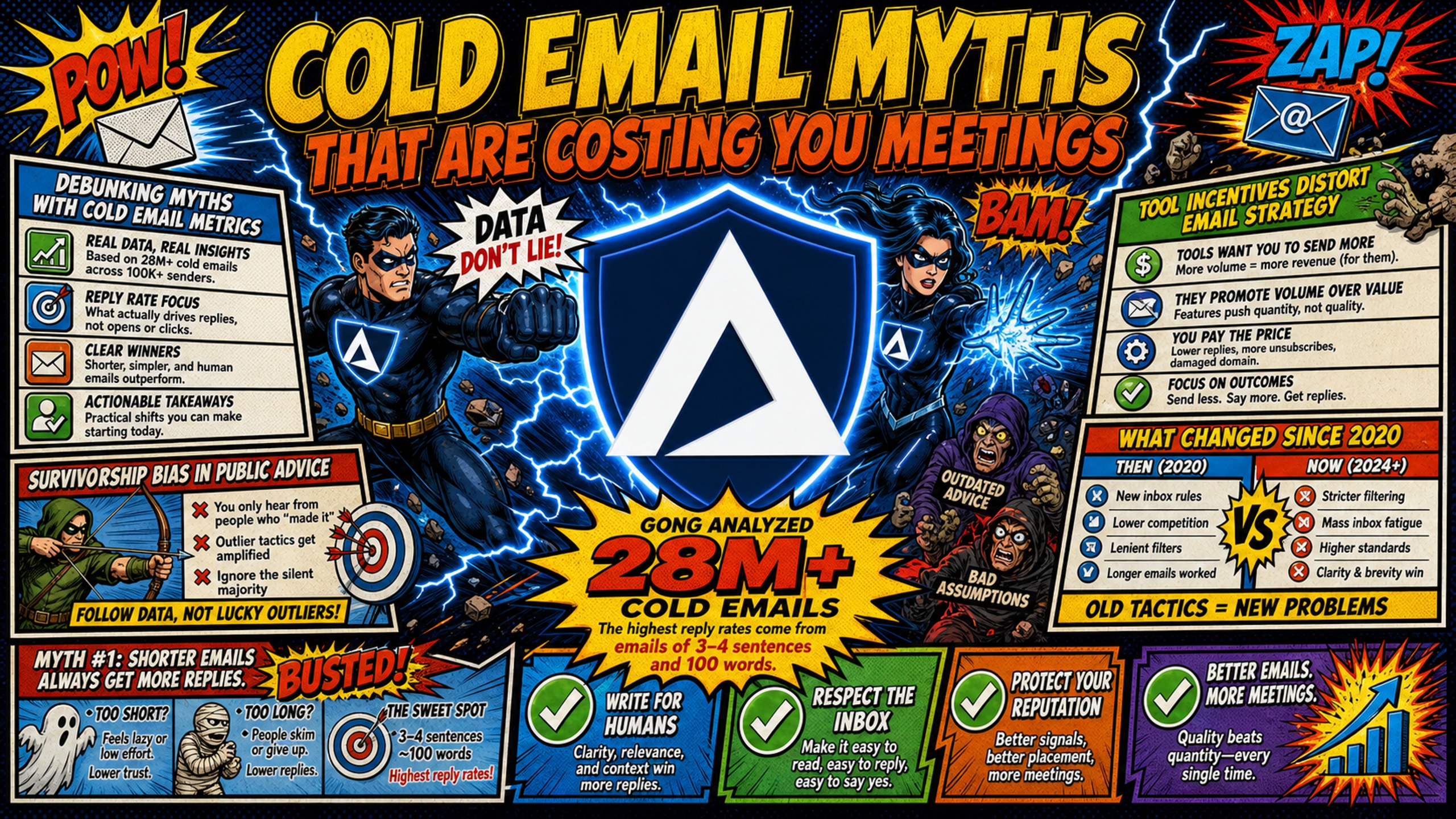
TL;DR: Four cold email beliefs do not survive the data. Gong's analysis of 28M+ cold emails found the highest reply rates come from emails of 3-4 sentences and 100 words or fewer. Backlinko and Pitchbox measured personalization lift at 32.7% for message bodies, which does not scale with research depth. Their study of 12 million outreach emails also found a single follow-up lifts replies by 65.8% while three or more messages perform best. Google caps Postmaster Tools spam rates at 0.10%, and AWS recommends shared IPs for irregular senders, which is why steady multi-domain volume is the condition for dedicated IPs to pay off. Inframail, a flat-rate Microsoft email infrastructure platform, provisions unlimited inboxes on dedicated IPs with automated SPF, DKIM, and DMARC configuration at $147 per month, before domain and warmup costs.
Most cold email advice is backwards. Short emails, light personalization, and conservative send limits are not the universal best practices they are sold as. Most of these playbooks were written before the 2024 and 2025 authentication rules.
Your reply rate is not stuck because your emails are too long. It is stuck because you are improving the wrong metrics and copying playbooks shaped by distorting pressures. This article breaks down four specific myths with data and testing frameworks, then shows how infrastructure choices determine whether you can implement revised practices at scale.
Debunking myths with cold email metrics
Before dissecting specific tactics, understand why bad advice proliferates. Three distorting pressures shape the cold email guidance you read online.
Survivorship bias in public advice
Public playbooks come from winners, and survivorship bias hides how many succeeded despite their tactics rather than because of them. Losers do not publish their failure data. Forums and communities surface failure stories that teach more than polished success case studies.
Tool incentives distort email strategy
Sending platforms profit from feature differentiation, whether or not those features improve your reply rates, and long sequences get promoted as best practice by the tools that benefit from them. Google states this directly in their email sender guidelines: the activity of any senders using a shared IP address affects the reputation of all senders for that shared IP address, and a negative reputation can impact your delivery rate.
What changed since 2020
The requirements are now published, not inferred. Google's sender guidelines require SPF or DKIM from every sender and SPF, DKIM, and DMARC from anyone sending 5,000 or more messages a day to Gmail. Microsoft Outlook's new requirements applied the same 5,000-a-day threshold from May 5, 2025, routing non-compliant mail to Junk and then rejecting it outright. A 2020 playbook written before either rule existed is optimizing against filters that no longer work that way.
Myth 1: Shorter emails always get more replies
The reality: Word count is a proxy variable. The emails in the 50-125 word band perform well because they tend to be direct and specific, not because they are short. A 200-word email built around a precise pain point will outperform a 60-word email that could apply to any prospect in any industry.
Data trends on cold email length
The "short emails work best" advice came from a specific era of spam filtering, not from controlled tests. Gong's analysis of 28M+ cold emails found the highest reply rates come from emails of 3-4 sentences, with an ideal word count of 100 words or fewer. Boomerang's analysis of more than 40 million emails its customers flagged for follow-up found the 50-125 word band produced a response rate above 50%, falling to roughly 44% at 500 words. Both describe correlation, not a controlled test of length in isolation.
That correlation reflects content quality, not word count. Emails in the shorter band are more direct and specific, while emails in the longer band pad thin offers with filler. Cutting words does not cause the lift. Cutting vagueness does.
Why seniority changes the email, not the word count
Seniority raises the bar on relevance, not on length. Gong's analysis of 1M+ executive sales cycles found C-level executives are 30.2% less likely to reply to cold emails than non-executives, and that reply rates drop sharply once emails exceed 100 words, with the best performers landing between 50 and 100 words. Treat that band as a symptom of directness, not a target. The adjustment for a senior buyer is a sharper, better-evidenced 50 to 100 words, not a longer email.
Testing optimal body copy length
Test different lengths of the same offer rather than guessing, and isolate the length variable while keeping subject line, offer, and targeting constant.
Calculate the required sample size before you send. The number depends on your baseline reply rate, the lift you want to detect, your significance level, and your statistical power. Use the standard formula for comparing two proportions rather than picking a round number, because at cold email reply rates a one or two point lift needs thousands of sends per variant, not hundreds.
Myth 2: Every email needs deep personalization
The reality: Personalization has diminishing returns. The first token lifts reply rates, but the fifth adds little.
Measuring ROI on hyper-personalization
Personalization pays, and the measured lift is smaller than the effort usually assumed. Backlinko and Pitchbox, across 12 million outreach emails, found personalized message bodies got a 32.7% better response rate and personalized subject lines a 30.5% boost. Neither figure scales with research depth, and the time spent on deep research comes directly out of send volume.
What lifts replies across recipient segments
Lavender's Cold Email Benchmark Report sampled the most recent 231,818 cold emails analyzed as of February 4, 2026, excluding out-of-office and bounce notifications and counting both positive and negative replies.
The report breaks results down by department, seniority, and industry. Content patterns vary by segment, but four axes recur across all of them.
| Axis | What works | What does not |
|---|---|---|
| Relevance | Openers tied to the recipient's actual context or priorities | Generic templates and broad claims with no real relevance |
| Focus | One outcome-first value proposition | Vague positioning, feature dumps, or several value propositions at once |
| The ask | One low-friction next step | Multiple asks or a weak CTA like "thoughts?" |
| Length | Brevity and skimmable structure | Long, dense emails that bury the point |
The four axes above summarize the per-segment lists Lavender publishes under "View content insights" in each row of the report. They are not a standalone figure published by Lavender.
Calibration is where the segments diverge, and the differences are more pronounced than most playbooks acknowledge. Engineering recipients respond to technical specificity, while product recipients are put off by detail introduced too early. Sales recipients prefer a direct ask, while HR, legal, and research recipients favor a low-pressure approach.
A salesy tone appears as a failure mode for every segment in the report except sales itself.
The arithmetic that makes deep research expensive
Deep research does not necessarily reduce reply rates. It reduces send volume, and total replies equal reply rate multiplied by send volume. Thirty minutes of research per prospect caps a day at a dozen or so sends, which no plausible lift in reply rate is likely to recover.
Length compounds the problem. Gong's analysis of 28M+ cold emails found that the highest reply rates come from emails of 3-4 sentences, with an ideal word count of 100 words or fewer.
Lavender's report identifies long, dense emails that bury the point as a failure mode across recipient segments. Research that ends up in the email can push its length beyond both guidelines.
What to do instead of more research
Spend the effort on segment fit and formatting rather than research depth per prospect.
Match the four axes above to the segment you are emailing, then check that the email renders cleanly on a phone. Lavender reports that mobile-optimized emails produce 83% more replies on average, with the strongest effects among sales, product, marketing, operations, individual contributors, and frontline managers.
Testing which variables matter for your own list requires sufficient send volume, and per-seat pricing can turn that into a budget problem. Inframail's flat-rate, unlimited-inbox model helps prevent the inbox count needed to run tests from becoming an additional per-inbox cost.
Myth 3: Extra follow-ups cost nothing
The reality: Follow-ups are among the highest-return tactics in cold email, but only up to the point where additional messages create more risk than value. Woodpecker's email analysis identifies 4-7 emails in total as the optimal sequence length. Beyond the fourth follow-up, returns diminish while the risk of spam complaints and unsubscribes triples. The real cost of an excessively long sequence is the potential damage to sender reputation, which can reduce deliverability and suppress replies across future campaigns.
Analyzing reply volume per follow-up
Follow-ups work, up to a point. Backlinko and Pitchbox, across 12 million outreach emails, found a single follow-up boosts replies by 65.8% and that three or more messages produce the best overall response rate.
Woodpecker's analysis of 20 million emails reports a 3.43% reply rate for initial emails, increasing to 8.4% after the first follow-up, with the second follow-up adding approximately 3% more.
However, both Pitchbox and Woodpecker sell outreach software, and their studies analyze emails sent by their own users. The exact figures should therefore be treated as directional benchmarks rather than universal averages. The stronger signal is that both studies point to the same conclusion: follow-ups can substantially improve reply rates.
When over-sequencing triggers blacklists
High complaint rates from aggressive sequences damage sender reputation and trigger blacklist placement. When recipients mark emails as spam, that signal feeds back into how providers filter future sends. Prevention through conservative follow-up cadences is better than delisting.
A blacklisted domain does not just lose replies from the affected send. It keeps losing them while reputation recovers, and neither Google nor Microsoft publishes a recovery timeline. That is the real cost of over-sequencing.
Where the sequence stops paying
Woodpecker's cold email statistics reports that returns diminish after the fourth follow-up, while spam complaints and unsubscribe risk triple.
The limiting factor is not simply reply rate, but sender reputation. Google's email sender guidelines recommend keeping Postmaster Tools spam rates below 0.10% and avoiding 0.30% or higher, thresholds that prolonged outreach to cold lists can put at risk.
Test follow-up cadence against your own campaign data rather than assuming more emails always produce better results.
| Sequence position | What Woodpecker reports |
|---|---|
| Email 1 | 3.43% reply rate |
| Follow-up 1 | 8.4% reply rate |
| Follow-up 2 | Adds approximately 3% more |
| Follow-up 3 and later | No per-step figure published |
| Past follow-up 4 | Diminishing returns, and spam and unsubscribe risk triples |
Woodpecker identifies 4–7 emails in total as the optimal sequence length, while also reporting diminishing returns beyond the fourth follow-up (the fifth email).
These findings overlap toward the lower end of the recommended range. As a result, 4–5 emails in total are a reasonable starting point, while extending beyond that should depend on observed reply rates, spam complaints, unsubscribes, and sender reputation.
Myth 4: Never send more than 50 emails a day per inbox
The reality: The "50 per day" rule is a starting point, not a ceiling. Start at 50 emails per inbox, then increase gradually as reputation builds. Modern spam filters look at engagement signals, complaint rates, and infrastructure reputation more than raw volume.
Debunking the 50-message limit myth
According to AWS's dedicated IP documentation, dedicated IPs with proper warmup support higher consistent volumes when sending is steady and predictable, but AWS recommends shared IP addresses for senders who don't plan to send large volumes on a regular and predictable basis. The limit depends on warmup status, engagement signals, and infrastructure type. Inconsistent or bursty sending on a dedicated IP makes reputation harder to build, not easier, because most ISPs only track reputation for an IP if they receive significant volume from it.
What actually triggers spam filters
Google does not publish how its filters are weighted, but it does publish what it requires. Every sender needs SPF or DKIM on the sending domain, and anyone sending 5,000 or more messages a day to Gmail needs SPF, DKIM, and DMARC. Google's email sender guidelines tell senders to keep Postmaster Tools spam rates below 0.10% and to avoid ever reaching 0.30%, and Google warns in the same guidelines page that frequent spam reports lower a domain's reputation over time. Deliverability is rarely one broken setting, more often it is a combination of small trust signals pulling in the wrong direction at once.
Scaling infrastructure over email volume
Scaling send volume requires scaling infrastructure: more domains, more inboxes, dedicated IPs, and proper DNS configuration. Distributing volume across multiple domains on dedicated IPs maintains deliverability as total volume grows. Inframail automates SPF/DKIM/DMARC configuration to make multi-domain scaling practical.
Emergency response for blacklisted domains
If your domain lands on a blacklist, stop sending immediately and check blacklist status through your sending platform or deliverability monitoring tool. Submit delisting requests to the specific blacklist operators. Inframail reports a 68.3% blacklist delisting success rate within 48 hours.
Removal mechanics differ by list. Spamhaus CSS's FAQs state that listings expire roughly three days after the last spam detection and allow limited self-service removal, but re-list quickly on re-detection. Spamhaus SBL has no automatic expiry, according to its FAQs page. The ISP responsible for the listed IP has to submit the removal request once the underlying abuse has stopped. Removal from a list is not the same as recovered deliverability, and no major provider publishes how long rebuilding sender reputation takes.
Scaling beyond the 50 email limit
Start with 50 emails per day per inbox, monitor engagement, and increase gradually as reputation builds.
For 50 inboxes, Google Workspace costs $420/month at $8.40 per seat on the Flexible Plan. Inframail's platform fee is $147/month flat. Domain costs ($5 to $16 per domain per year) and warmup tools ($15 to $50 per inbox per month) apply on both sides and are not included in this comparison.
Cold email compliance and list hygiene
These are the core compliance and hygiene checks that protect sender reputation and keep campaigns running.
Stay compliant and maintain deliverability with this checklist:
- CAN-SPAM unsubscribe: Include a clear, conspicuous opt-out, keep it working for at least 30 days after you send, and honor requests within 10 business days.
- GDPR erasure: For EU recipients, respond to an erasure request without undue delay and within one month of receipt (Article 12(3)), extendable by two further months for complex or high-volume requests.
- List cleaning: Remove invalid addresses before sending to maintain deliverability.
- Authentication: Verify SPF, DKIM, and DMARC records are properly configured before launching campaigns.
- Monitoring: Track spam complaint rates and engagement metrics to catch deliverability issues early.
Measure actual reply rates to verify best practices
Do not copy public playbooks blindly. Design valid tests for your specific audience.
Designing valid A/B email tests
Change exactly one element between Version A and Version B. If you change the subject line and the CTA at the same time, you cannot attribute the result to either. Follow this framework:
- Define the variable: Choose one element to test (length, personalization depth, or follow-up timing).
- Set sample size before you send: Required sample size depends on your baseline reply rate, the lift you want to detect, your significance level, and your statistical power. Calculate it with the standard formula for comparing two proportions rather than picking a round number, because at cold email reply rates a one or two point lift needs thousands of sends per variant, not hundreds.
- Randomize: Assign prospects randomly to each variant.
- Run for 1-2 weeks: Long enough to cover two full business cycles.
- Measure reply rate: Not open rate. Open rates are not just a weak metric, they are an unreliable one. Apple Mail Privacy Protection loads remote content in the background whether or not the recipient engages, which Apple states prevents senders from seeing whether an email was opened.
Sample size and statistical significance
An underpowered test reads as "no difference" even when a real difference exists. At typical cold email reply rates, the required sample size per variant depends on your baseline rate, the lift you want to detect, your significance level, and your statistical power. Picking a round number like 50 or 100 sends per variant will almost always leave the test underpowered. Calculate the number for your specific baseline and target lift using the standard two-proportion sample size formula before you start. Inframail's flat-rate pricing lets you run large-sample tests without worrying that the test itself will increase your infrastructure bill, unlike per-seat platforms where a properly powered test requires paying for more inboxes.
Beyond opens: measuring lead quality
Open rates are a weak and unreliable metric, while reply rates and meeting-booking rates are what determine pipeline. Track reply rate, positive reply rate, meeting-booking rate, and cost per meeting.
Inframail's dedicated IPs and automated DNS setup free up time to focus on measuring these metrics rather than firefighting infrastructure issues. With high deliverability, you can trust that your test results reflect content performance, not inbox placement failures.
Start sending with Inframail
Inframail is a flat-rate Microsoft email infrastructure platform built for agencies running cold email at scale. The Unlimited plan costs $147/month for dedicated IP infrastructure and automated SPF/DKIM/DMARC configuration across unlimited inboxes, with a 98%+ deliverability rate and 68.3% blacklist delisting success within 48 hours.
Check out this case study video and see how Inframail helped a client send high-volume cold emails cost-effectively with strong deliverability, achieve a 20–35% positive reply rate, and generate 4–5 sales with over 10x ROI.
Sign up to Inframail and get started today.
FAQs
What are common cold email myths?
Four recur: that short emails always win, that heavy personalization is required, that extra follow-ups are free, and that daily send volume must stay under 50 emails.
How do I know which cold email advice to trust?
Trust advice backed by controlled tests with published methodology and sample sizes. Be skeptical of advice from vendors whose pricing model benefits from the recommended practice.
Will changing these practices hurt my sender reputation?
Not if you test on a small scale first and monitor engagement metrics. Sudden large changes to volume or cadence trigger filters, so ramp gradually.
How long does it take to see results from revised practices?
It depends less on time than on volume. At typical cold email reply rates, detecting a one or two percentage point lift takes thousands of sends per variant, which is usually several weeks rather than one or two. Calculate the number for your own baseline and target lift with the standard two-proportion sample size formula before you start, because an underpowered test will read as "no difference" even when a real difference exists.
What is the ideal follow-up cadence for cold email?
Four to seven emails in total, counting the first send. Woodpecker's analysis of 20 million sales emails puts the optimal sequence in that range and finds that past the fourth follow-up returns diminish while spam and unsubscribe risk triples. Published studies cover sequence length, not spacing, so set spacing against your own reply data. The binding constraint is Google's guidance to keep Postmaster Tools spam rates below 0.10% and never reach 0.30%, which a long sequence to a cold list can cross.
Does email length actually affect reply rates?
Length correlates with reply rate, but it is not the lever it looks like. Gong's analysis of 28M+ cold emails found the highest reply rates come from emails of 3-4 sentences and 100 words or fewer. Boomerang's analysis of more than 40 million emails found the 50-125 word band produced a response rate above 50%, falling to roughly 44% at 500 words. Neither Gong nor Boomerang ran a controlled test isolating word count, so treat length as a proxy for directness and test it against your own list.
What actually triggers spam filters in 2026?
Modern spam filters work as a multi-factor system, not a single-trigger checklist. Authentication (SPF, DKIM, DMARC), sender reputation (complaint rates, bounce history), content patterns, and recipient engagement all feed into filtering decisions together.
Deliverability problems are rarely caused by one broken setting. More often they are a pileup of small trust signals. Even with authentication fully configured, high complaint rates or low engagement can still push emails to spam.
How do I scale send volume without triggering blacklists?
Scale by distributing volume across multiple domains on dedicated IPs rather than increasing volume on a single domain.
Key terms glossary
Reply rate: The percentage of sent emails that receive a reply. The primary metric for cold email effectiveness, distinct from open rate or click rate.
Sender reputation: A score assigned by email service providers that determines inbox placement and filtering decisions. Influenced by sending history, engagement, and complaint rates.
Inbox placement rate: The percentage of emails that land in the primary inbox rather than spam or promotions folders. A key deliverability metric.
Personalization token: A variable field in an email template that automatically inserts prospect-specific data. Used to customize emails at scale.
Follow-up cadence: The number of emails in a sequence and the spacing between them. Most effective sequences contain 4-7 emails in total, including the initial send. The largest gains in reply rates typically come from the first two follow-ups, with diminishing returns from additional messages.
Dedicated IP: An IP address used exclusively by one sender. Isolates reputation from other senders on shared IP pools.
SPF/DKIM/DMARC: Email authentication protocols that verify sender identity. SPF, DKIM, and DMARC help prevent spoofing and improve deliverability.
Warmup schedule: The process of gradually increasing email volume on a new domain or IP. Required to build sender reputation before launching full campaigns.