
15 Cold Email Sequence Examples With Reply Rates
Cold email reply rate is set more by who you target than by what you write. Across 7.5 million cold emails sent in 2025, Belkins found founders and owners reply
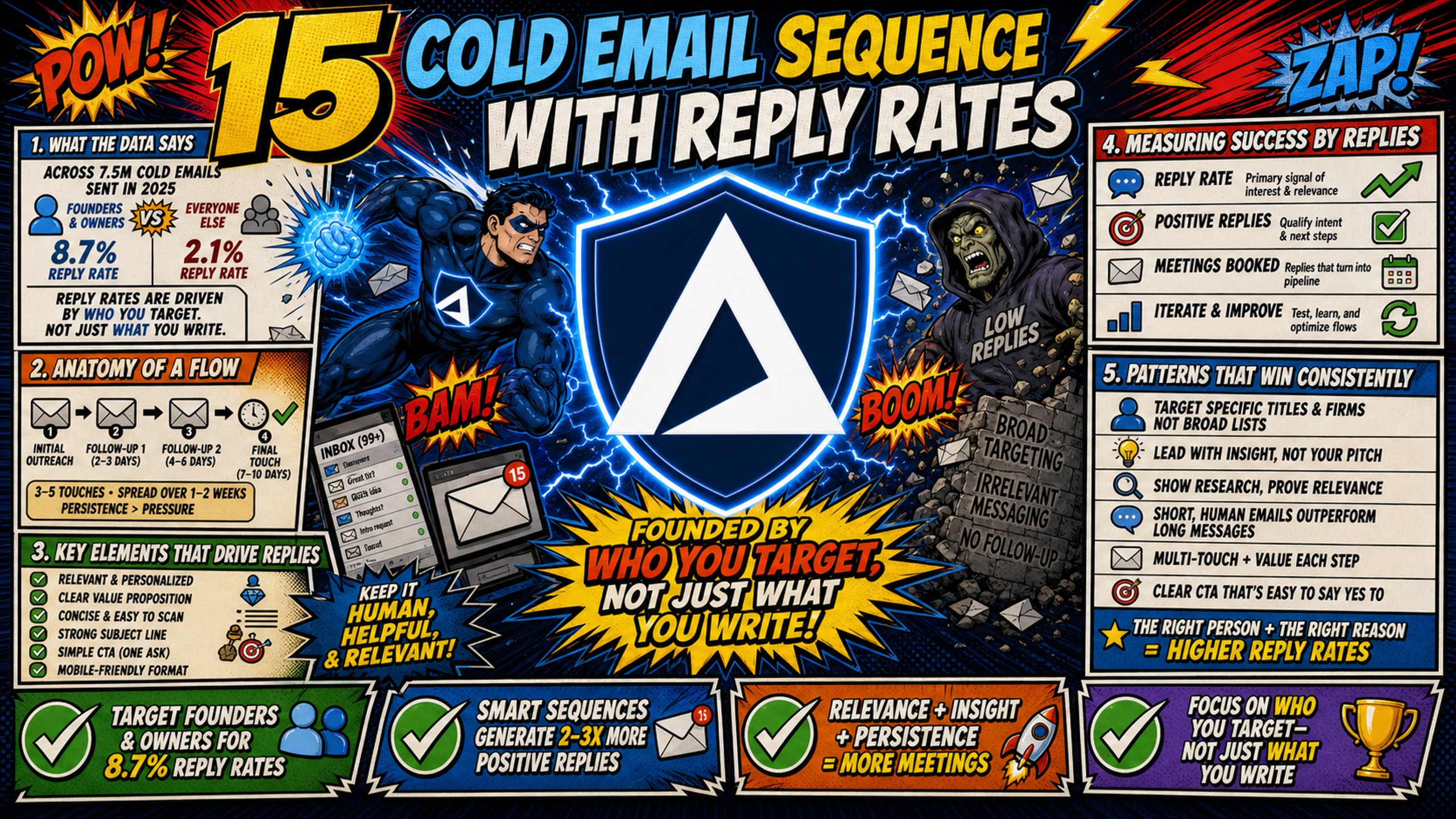
TL;DR: Cold email reply rate is set more by who you target than by what you write. Across 7.5 million cold emails sent in 2025, Belkins found founders and owners reply at 0.57%, C-level at 0.42%, and VPs at 0.32%, measured against total emails sent, so read those as the gap between segments rather than a rate to match against your own dashboard. Sequence structure is the second lever: Woodpecker recorded 8.3% reply rates on campaigns running 3 to 5 follow-up steps against 4.1% with none. The 15 sequences below each carry the published benchmark for their ICP, their copywriting framework, and full copy. RAIN Group puts a first meeting at 8 touchpoints, so SPF, DKIM, and DMARC records have to hold across weeks of sending. Inframail provisions unlimited inboxes on a dedicated US-based IP at a flat $129 per month, with domains from $5 to $16 a year.
Most campaign managers spend days tweaking subject lines while their domain health determines whether those emails ever reach the inbox. The fastest path to better reply rates is combining proven copy frameworks with automated infrastructure that removes DNS configuration as a bottleneck.
This guide breaks down 15 sequences across SaaS, agency, and recruiting campaigns. They span more sender types than any one reader will use, treat them as cross-industry patterns to adapt rather than scripts to copy. Each is annotated with its copy structure, its ICP, and the published reply-rate benchmark for that segment. These are benchmarks to measure your own campaign against, not results from a single recorded campaign.
What the published data says about reply rates
Six variables determine where a sequence's reply rate lands. The table below maps each one to its published finding and the dataset behind it.
| Driver | Published finding | Dataset |
|---|---|---|
| ICP seniority | Founders and owners 0.57%, C-level 0.42%, VPs 0.32% | Belkins, 7.5M cold emails sent in 2025 |
| ICP company size | Under 10 employees 0.72%, 11-50 employees 0.49%, 10,000+ employees 0.22% | Belkins, 7.5M cold emails sent in 2025 |
| Sequence length | 3-5 follow-up steps 8.3%, no follow-ups 4.1% | Woodpecker, 20M+ emails |
| Personalization depth | Advanced 17-18%, basic 7-9% | Woodpecker, 20M+ emails |
| CTA type | Interest-based CTAs outperform meeting requests at the cold stage | Gong Labs, 304,174 emails |
| Touches to a first meeting | 8 on average, 5 for top performers | RAIN Group's top performance analysis |
Belkins counts unique replies against total emails sent, which is why its figures sit lower than platform averages calculated against a narrower base. Read the Belkins numbers as the gap between segments, not as a rate to compare against your own dashboard. Woodpecker counts replies per campaign. The two scales are not interchangeable.
Anatomy of a cold email flow
Understanding what separates high-reply sequences from average ones starts with three structural elements that hold across industries and ICP types, plus the technical foundation that keeps emails reaching the inbox through every touchpoint.
Key elements in successful cold emails
Three elements drive high-performing cold emails: a highly specific hook that names a real pain, a value proposition tied to an outcome the reader already wants, and a low-friction call to action that asks for a reaction rather than a commitment.
The three copywriting frameworks that appear most often in the sequences below are:
- PAS (Problem-Agitate-Solve): Name the problem, describe what it costs the reader, then present your solution in one clear line.
- BAB (Before-After-Bridge): Describe the current state, paint the target state, then bridge to how you get there. This framework works best when you have a customer result to reference.
- AIDA (Attention-Interest-Desire-Action): Grab attention with a sharp opener, build interest with specifics, create desire with an outcome, and close with a single action. AIDA maps to how buyers process new information and continues to produce results in B2B cold outreach.
Measuring cold email success via replies
The three metrics campaign managers track are open rate, reply rate, and positive reply rate. Open rate signals whether your subject line cleared the spam filter. Reply rate signals whether the copy was relevant enough to prompt a response. Positive reply rate filters for genuine interest by stripping out unsubscribes.
As Inframail's spam metrics guide explains, a sudden drop in reply rate on an established campaign often signals a deliverability issue rather than a copy issue, which is why monitoring domain health in parallel with campaign performance is standard practice for experienced operators.
What the sequence patterns have in common
The sequences below span SaaS, agency, and staffing contexts, selected for how clearly they illustrate each framework and ICP type.
Common sequence template patterns
| Sequence type | Goal | Common framework | Typical touchpoints | Example ICP |
|---|---|---|---|---|
| Product-led SaaS outreach | Trial sign-ups or demos | BAB | 3-4 emails | Marketing Managers |
| Enterprise SaaS outreach | Qualified discovery calls | PAS | 4-5 emails | IT Directors, CISOs |
| Agency to ecommerce | Audit or strategy call | BAB | 3 emails | Ecommerce founders |
| Lead gen agency to consulting | Qualified meetings | PAS | 4 emails | Managing Directors |
| Recruiting to hiring managers | Intro calls on candidates | PAS | 3-4 emails | Engineering VPs |
SaaS cold email sequences
The five sequences below cover product-led, enterprise, sales intelligence, vertical SaaS, and customer success contexts, each annotated with its framework, target ICP, and the structural decisions behind each example.
Example 1: Product-led SaaS to marketing managers
This sequence targets marketing managers at product-led SaaS companies, using recent feature usage or sign-up activity as the primary outreach trigger.
- Sample ICP: Marketing Managers at B2B SaaS companies with 50-500 employees
- Framework: BAB
- Focus: Product-led growth sign-up or recent feature usage data
- Segment benchmark: Manager-level ICP, below the 0.32% VP tier. Belkins does not publish a manager-level figure.
The three emails below apply the BAB framework across nine days, leading with a specific pipeline outcome before asking for a low-friction reaction.
Email 1 (Day 1): Subject: {Company} traffic Body: "Most marketing teams at {Company}'s stage generate more pipeline from organic than they're currently capturing. {First name}, similar companies have added over 1,000 demo requests per quarter without increasing ad spend. Worth a 10-minute look?"
Email 2 (Day 4): Subject: quick follow-up Body: "Sent you a note last week on capturing pipeline from organic. Did it land in the right place, or should I send it to someone else on the team?"
Email 3 (Day 9): Subject: closing the loop Body: "I'll stop filling your inbox after this one. If organic pipeline capture isn't a priority right now, no problem. If timing changes, reply 'later' and I'll reach back out in 90 days."
Why it works: Specific outcome in Email 1 (demo requests, not "more pipeline"), low-friction CTA, and a clean exit in Email 3 that often generates a "not yet but keep me posted" reply. The expected return benchmarks for SaaS cold email depend heavily on reply volume, which this sequence protects by staying out of spam.
Example 2: Enterprise SaaS to IT directors
This sequence targets IT directors at large enterprises, where annual compliance review cycles create a repeatable and time-bound pain point.
- Sample ICP: IT Directors at enterprise companies with 1,000+ employees
- Framework: PAS
- Focus: Security and compliance pain points
- Segment benchmark: 0.22% at companies of 10,000+ employees, the nearest published band above this ICP's size, and the weakest band in the Belkins dataset.
The four emails below apply the PAS framework across 17 days, opening with the compliance review bottleneck before presenting the solution.
Email 1 (Day 1): Subject: {Company} vendor risk Body: "IT teams managing 50+ SaaS vendors run a compliance review for every vendor on the stack each year, and evidence collection is the primary bottleneck. {First name}, we built a tool that cuts review time by automating the evidence collection process. Would a 15-minute demo make sense this week?"
Emails 2-4 follow a similar low-pressure cadence spaced over Days 4, 9, and 17, with a fresh angle per email covering compliance audit costs, breach liability context, and peer references.
What made it work: The PAS structure names a recurring, time-bound bottleneck before presenting the solution. IT Director ICPs respond to time and liability framing, not feature lists.
Example 3: Sales intelligence SaaS to sales ops
This sequence targets sales operations managers at companies with active sales teams, using pipeline data quality as the primary pain point.
- Sample ICP: Sales Operations Managers at B2B companies with 20-100 sales reps
- Framework: PAS
- Focus: Data quality and pipeline accuracy
- Segment benchmark: Manager-level ICP, below the 0.32% VP tier. Belkins does not publish a manager-level figure.
The three emails below apply the PAS framework across nine days, opening with a quantified data quality cost before narrowing to a binary question.
Email 1 (Day 1): Subject: {Company} pipeline data Body: "{First name}, sales ops teams managing 20+ reps often find that [X]% of pipeline data is stale or incomplete. Companies using automated data enrichment report [X]% fewer dead leads and [X]% faster close rates. Worth 15 minutes to see how that applies to {Company}?"
Email 2 (Day 4): Share one data point on how bad data impacts quota attainment.
Email 3 (Day 9): Binary question: "Is pipeline data quality on your radar this quarter, or is it further out?"
Why it works: The opener names a metric sales ops teams are measured on rather than a product capability. Email 3 converts the ask into a binary question, the low-friction format Gong Labs found outperforms meeting requests at the cold stage. Manager-level ICPs sit below the 0.32% VP tier, so account selection carries more weight here than in the founder-targeted sequences.
Example 4: Customer success platform to CS leaders
This sequence targets VP-level customer success leaders at SaaS companies where net retention is the primary performance metric.
- Sample ICP: VP Customer Success at SaaS companies with $5M-$50M ARR
- Framework: BAB
- Focus: Churn reduction and expansion revenue
- Segment benchmark: 0.32%, VPs, the lowest published seniority tier in the Belkins dataset.
The three emails below apply the BAB framework across ten days, naming the outcome CS leaders are measured on before asking for a lightweight next step.
Email 1 (Day 1): Subject: {Company} net retention Body: "Most CS teams at {Company}'s stage rely on manual outreach to drive expansion. {First name}, companies that automate health scoring and renewal workflows typically see [X]% improvement in net retention within [timeframe]. Can I send over a 2-minute walkthrough?"
Email 2 (Day 4): Reference a comparable company in the same ARR range that improved net retention.
Email 3 (Day 10): "Is customer expansion a priority heading into next quarter, or are you focused elsewhere?"
Why it works: It names the outcome CS leaders are measured on, net retention, before asking for time. Email 3 closes with a binary question rather than a meeting request, the format Gong Labs found performs best at the cold stage.
Example 5: Vertical SaaS to finance ops
This sequence targets CFOs and finance directors at mid-market companies where manual invoice processing creates measurable cost and approval delays.
- Sample ICP: CFOs or Finance Directors at mid-market companies
- Framework: PAS
- Focus: Cost reduction
- Segment benchmark: 0.42%, C-level, based on Belkins' analysis of 7.5 million cold emails sent in 2025.
The four emails below apply the PAS framework across 17 days, opening with a processing cost claim and closing with a planning-cycle question.
Email 1 (Day 1): Subject: {Company} AP costs Body: "{First name}, most finance teams at {Company}'s size process invoices manually, which adds cost and approval delays at every step. We've helped finance teams in [vertical] cut processing time and cost by automating the approval workflow. Worth 15 minutes to see the numbers?"
Email 2 (Day 4): Share one benchmark on automated invoice processing cost.
Email 3 (Day 9): Reference a comparable firm in the same vertical that reduced AP costs through automation.
Email 4 (Day 17): Binary close: "Would it make sense to run the numbers on {Company}'s invoice volume before next quarter's planning?"
Why it works: Four steps across 17 days puts this sequence in the range Woodpecker associates with 8.3% reply rates, against 4.1% for single sends. The C-level ICP helps, replying at 0.42% against 0.32% for VPs in the Belkins data. Email 4 ties the ask to the reader's own planning cycle rather than the sender's calendar.
Agency and professional services email templates
The five sequences below cover agency and professional services outreach across ecommerce, B2B SaaS, web development, consulting, and accounting verticals.
Example 6: Marketing agency to ecommerce brands
This sequence targets DTC ecommerce founders who are scaling paid channels but hitting diminishing returns on ad spend efficiency.
- Sample ICP: DTC ecommerce founders doing $1M-$10M revenue
- Framework: BAB
- Focus: Ad spend efficiency and ROAS
- Segment benchmark: 0.57% founders and owners, rising to 0.72% at companies under 10 employees, based on Belkins' 2025 dataset.
The three emails below apply the BAB framework across ten days, leading with a free audit offer that filters for buyers actively evaluating spend performance.
Email 1 (Day 1): Subject: {Company} ROAS Body: "Most DTC brands at {Company}'s revenue stage hit a ceiling on paid ROAS after 12-18 months of scaling the same channels. {First name}, we ran a free audit for a comparable brand in [vertical] and found [$X] in monthly ad spend going to underperforming creatives. Want us to run the same audit for {Company}? No cost, no commitment."
Email 2 (Day 4): Subject: one tactic for {Company} Body: "{First name}, one tactic from audits like yours: pausing the bottom 20% of ad sets by ROAS and reallocating to top performers can recover meaningful spend efficiency within 30 days. Happy to show you what that looks like in {Company}'s account."
Email 3 (Day 10): Subject: quick question Body: "Would it make sense to run the audit for {Company} before you lock in Q4 spend? Takes us a day and costs nothing."
Why it works: The free audit offer in Email 1 lowers friction and filters for buyers actively evaluating ad spend efficiency. Email 2 delivers a tactic at no cost, reinforcing credibility before asking for a meeting. Email 3 uses a binary question to generate a reply even from prospects who are not ready to act.
Example 7: SEO agency to B2B SaaS
This sequence targets VPs of Marketing at B2B SaaS companies spending on paid acquisition, using a competitor keyword gap as the outreach hook.
- Sample ICP: VPs of Marketing at B2B SaaS companies spending on paid acquisition
- Framework: PAS
- Focus: Organic traffic and competitor keyword gaps
- Segment benchmark: 0.32%, VPs, based on Belkins' analysis of 7.5 million cold emails sent in 2025.
The single email below applies the PAS framework, leading with a named competitor before offering pre-built research to generate a low-friction reply.
Email 1 (Day 1): Subject: {Competitor} ranking for your keywords Body: "{Competitor} ranks for keywords in your category that {Company} doesn't appear in the top 20 for. {First name}, I put together a list of the highest-intent terms you could realistically own in 60-90 days. Want me to send it over?"
Why it works: Naming a competitor signals market knowledge, creating immediate credibility before asking for a commitment. The CTA asks for a reaction to information, not a calendar block.
Example 8: Web development agency to service businesses
This sequence targets owners of local service businesses where website conversion directly determines appointment volume.
- Sample ICP: Owners of local service businesses with outdated websites
- Framework: BAB
- Focus: Lead generation from online traffic
- Segment benchmark: 0.57% owners and 0.72% for companies under 10 employees, the strongest combined segment in the Belkins dataset.
The three emails below apply the BAB framework across nine days, leading with a free mockup offer to lower friction and filter for active buyers.
Email 1 (Day 1): Subject: {Company} website traffic Body: "{First name}, most service businesses at {Company}'s stage get [X]%+ of new leads from online search. A site that doesn't convert means lost revenue every month. We've helped comparable service companies turn their sites into lead generation engines that book 30-50% more appointments. Want to see a quick mockup for {Company}?"
Email 2 (Day 4): Send one conversion rate stat for service businesses in their vertical.
Email 3 (Day 9): "Is your current site generating the leads {Company} needs, or is that a gap worth closing this quarter?"
Why it works: The free mockup offer lowers friction and filters for buyers already evaluating their site. The ICP does most of the lifting, though. Owners at companies under 10 employees are the strongest combined segment in the Belkins data at 0.57% and 0.72%.
Example 9: Lead gen agency to consulting firms
This sequence targets managing directors at consulting firms where referral dependency creates pipeline vulnerability when network activity slows.
- Sample ICP: Managing Directors at management and strategy consulting firms
- Framework: PAS
- Focus: Pipeline predictability
- Segment benchmark: 0.42% C-level, or 0.57% where the Managing Director is also an owner, based on Belkins' 2025 dataset.
The four emails below apply the PAS framework across 20 days, opening with a referral dependency question and increasing specificity with each follow-up.
Email 1 (Day 1): Subject: {Company} pipeline Body: "Most consulting firms at {Company}'s stage win the majority of new work through referrals, which makes pipeline unpredictable when referral flow slows. {First name}, comparable firms have booked [N]+ qualified calls in [timeframe] through cold outreach targeting their exact buyer profile. Worth a 15-minute conversation?"
Email 2 (Day 5): Subject: re: {Company} pipeline Body: "{First name}, a quick addition to my last note: we ran a similar outreach program for a [practice area] firm last quarter and generated [N] qualified discovery calls in [timeframe]. All leads matched their target client profile. Does that kind of volume move the needle for {Company}?"
Email 3 (Day 12): Subject: referral dependency Body: "One question, {First name}: what percentage of {Company}'s pipeline came from referrals last year? For most consulting firms, referrals make up the majority of new work. That is fine when the network is active, but it creates real exposure when it is not. We can build a predictable outbound channel alongside it. 15 minutes to talk through the model?"
Email 4 (Day 20): Subject: closing the loop Body: "I will leave it here after this one, {First name}. If predictable pipeline is not the priority right now, no problem at all. If that changes, reply 'later' and I will follow up in 90 days."
Why it works: The pain point (referral dependency) is one every consulting managing director recognizes immediately. Each follow-up increases specificity by referencing practice area and current market dynamics, narrowing relevance with each touchpoint rather than repeating the opener.
Example 10: Accounting services to small business owners
This sequence targets small business owners who handle bookkeeping in-house, using missed deductions as the primary financial trigger.
- Sample ICP: Small business owners with $500k-$3M revenue who handle bookkeeping in-house
- Framework: PAS
- Focus: Tax savings and compliance risk
- Segment benchmark: 0.57% owners and 0.72% for companies under 10 employees, based on Belkins' analysis of 7.5 million cold emails sent in 2025.
The three emails below apply the PAS framework across nine days, leading with a missed deduction estimate before offering a free checklist as a low-friction conversion.
Email 1 (Day 1): Subject: {Company} tax filing Body: "Most business owners at {Company}'s revenue level leave [$X] in deductions on the table each year by handling their own books. {First name}, we specialize in [industry] and typically find [$X]+ in missed deductions in the first review. Can I send over a quick tax optimization checklist for your situation?"
Email 2 (Day 4): Share one common deduction that most business owners in their industry miss.
Email 3 (Day 9): "Is tax planning a priority before year-end, or is it too early?"
Why it works: The free checklist creates immediate value and positions the firm as a specialist rather than a generic provider. As with Example 8, the owner-led SMB ICP is the strongest segment in the Belkins data, which matters more here than any single line of copy.
Recruiting cold email templates
The five sequences below span technical recruiting, executive search, contract staffing, and offshore talent placement, each with the ICP, framework, and specific angles used.
Example 11: Tech recruiting to hiring managers
This sequence targets engineering VPs and hiring managers at tech companies where time-to-hire for senior roles creates direct operational cost.
- Sample ICP: Engineering VPs and Hiring Managers at tech companies
- Framework: PAS
- Focus: Speed-to-hire for engineering roles
- Segment benchmark: 0.32%, VPs, based on Belkins' analysis of 7.5 million cold emails sent in 2025.
The single email below applies the PAS framework, leading with a time-to-hire benchmark before presenting a placement result as proof of speed and quality.
Email 1 (Day 1): Subject: {Company} engineering hiring Body: "Most engineering managers filling senior roles spend [X] days hiring through standard channels, with no guarantee of quality. {First name}, we placed [N] senior [language] engineers at [comparable company] in [timeframe]. All of them are still there [X months] later. Worth a 10-minute call this week?"
Why it works: Placement speed and retention are the two things a hiring manager is judged on, so leading with both puts the proof where the reader is already looking. The single-touch structure is the weakness. Woodpecker recorded 4.1% reply rates on sequences with no follow-ups against 8.3% with 3 to 5 steps, so this opener needs a cadence behind it.
Example 12: C-suite executive search
This sequence targets CEOs and board members at growth-stage companies, using a confidential search framing to reduce the transactional feel of the outreach.
- Sample ICP: CEOs and Board Members at growth-stage companies
- Framework: Direct, confidential framing
- Focus: Passive candidate networks
- Segment benchmark: 0.42%, C-level, based on Belkins' analysis of 7.5 million cold emails sent in 2025.
The three emails below use a confidential framing across 12 days, asking for a network referral rather than a meeting to reduce friction for senior ICPs.
Email 1 (Day 1): Subject: confidential search Body: "{First name}, I am working on a confidential search for a growth-stage company in [sector]. The role is a [VP Sales / CFO / COO], well-funded team with a strong board and a clear path to exit in 3-5 years. I am not reaching out because I think you are necessarily looking, but because you know this market better than most. Do you know 2-3 people in your network who might fit a profile like this?"
Email 2 (Day 5): Subject: re: confidential search Body: "{First name}, any names come to mind from my last note? Even a loose connection in the right direction would be helpful. Happy to keep this entirely off the record."
Email 3 (Day 12): Subject: one last ask Body: "I will wrap up after this one, {First name}. If the search I described calls anyone to mind, I would appreciate an introduction. If not, no problem at all. I will keep you posted if a search comes through that fits you personally."
Why it works: The confidentiality framing reduces the transactional feel, and the "you may know someone" angle generates responses even from executives who are not personally interested. Asking for a name rather than a meeting lowers friction to near zero for senior ICPs.
Example 13: Contract staffing to operations leads
This sequence targets operations directors and COOs at companies with known seasonal capacity needs, timed ahead of a peak demand window.
- Sample ICP: Operations Directors and COOs at logistics, manufacturing, or seasonal retail companies
- Framework: PAS
- Focus: Seasonal scaling
- Segment benchmark: 0.42%, C-level, based on Belkins' analysis of 7.5 million cold emails sent in 2025.
The four emails below apply the PAS framework across 16 days, using a seasonal trigger and a rate premium data point to create a financial cost to waiting.
Email 1 (Day 1): Subject: {Company} Q4 capacity Body: "Operations teams at companies like {Company} start feeling Q4 pressure around this time of year. {First name}, we placed [N] contract workers for a comparable [logistics / retail / manufacturing] operation last peak season, with all placements on-site within [N] business days of confirmation. Is Q4 capacity something you are planning for now, or is it still too early?"
Email 2 (Day 4): Subject: one placement data point Body: "{First name}, from last peak season: companies that locked in contract headcount 8+ weeks out avoided the last-minute rate premiums that ran [X]% above standard last peak season. We can reserve capacity for {Company} now without a firm commitment. Worth a quick call?"
Email 3 (Day 9): Subject: quick question Body: "Is Q4 capacity on your radar yet, {First name}, or is it too early to start the conversation?"
Email 4 (Day 16): Subject: closing the loop Body: "I will stop following up after this one. If seasonal staffing becomes urgent closer to peak, reply to this email and I will get back to you within the hour. Good luck with the quarter, {First name}."
Why it works: The seasonal trigger makes this sequence effective when sent in advance of a known capacity crunch. The rate premium data point in Email 2 creates a concrete financial cost to waiting, generating replies even from operations leads who were not actively evaluating vendors.
Example 14: Cold outreach for offshore devs
This sequence targets CTOs and engineering VPs at funded startups that have recently posted engineering roles, using a cost comparison as the primary hook.
- Sample ICP: CTOs and Engineering VPs at funded startups that recently posted engineering roles
- Framework: PAS + social proof
- Focus: Cost savings and pre-vetted talent
- Segment benchmark: 0.42% C-level, rising to 0.72% at funded startups under 10 employees, based on Belkins' 2025 dataset.
The single email below combines PAS with social proof, leading with a specific cost comparison before offering pre-vetted candidate profiles as a low-friction next step.
Email 1 (Day 1): Subject: {Company} dev costs Body: "Hiring a senior full-stack engineer in the US typically runs [$X] base. Pre-vetted offshore engineers are available at [$Y] fully loaded, often with replacement guarantees. {First name}, comparable startups have placed [N] engineers this way in the last [timeframe]. Can I send over 3 profiles matching what {Company} is hiring for?"
Why it works: A recent job posting is the strongest relevance trigger available, because it confirms the need exists before the email is written. Offering three profiles asks for a reaction to information rather than a calendar block. Like Example 11 this is a single touch, so it needs follow-ups behind it to reach the sequence length the data rewards.
Example 15: VP Sales cold emails
This sequence targets VPs of Sales and CROs at B2B SaaS companies where pipeline coverage heading into a new quarter is the primary pressure point.
- Sample ICP: VPs of Sales and CROs at B2B SaaS companies with 20-200 person sales teams
- Framework: AIDA
- Focus: Pipeline coverage and quota attainment
- Segment benchmark: 0.32% VPs, 0.42% at CRO level, based on Belkins' analysis of 7.5 million cold emails sent in 2025.
The emails below apply the AIDA framework across 12 days, opening with a pipeline coverage threshold before presenting a quantified pipeline result.
Email 1 (Day 1): Subject: {Company} Q3 pipeline Body: "VPs of Sales heading into Q3 with under 4x pipeline coverage often face difficult decisions in Q4. {First name}, comparable companies have added $2M+ in qualified pipeline in 60 days using cold outbound. 10 minutes to walk through how?"
Email 2 (Day 5), Email 3 (Day 12): Reference specific quota attainment context and end with "Is pipeline coverage a gap heading into next quarter, or are you in good shape?"
Why it works: Pipeline coverage is a number VPs of Sales report upward every week, so naming a specific threshold makes the email read as internal rather than as a vendor pitch. The close is a binary question, the CTA format that performs best at the cold stage. VPs are the weakest published seniority tier at 0.32%, so the CRO variant of this list is worth building separately.
Cold email sequence structure guide
The sections below cover the structural variables that determine sequence performance across any context: subject line patterns, personalization triggers, send cadence, and CTA format.
Cold email subject line patterns
Subject lines of 2 to 4 words hit the highest open rates at 46%, based on Belkins' analysis of 5.5 million B2B emails sent through 2024 in partnership with Reply.io. The same study found longer lines get truncated after 35 to 50 characters on mobile, so keeping subject lines short protects both readability and display.
The five subject line patterns that appear most consistently across the sequences above are:
- Company name only:
{Company} pipeline- looks internal, triggers curiosity. - Quick question:
quick question- the brain resists an unanswered question. - Competitor reference:
{Competitor} ranking for your keywords- signals market knowledge immediately. - Named pain:
{Company} dev costs- addresses a specific problem before the email is opened. - Confidential framing:
confidential search- reduces transactional feel for senior ICPs.
Personalized subject lines open at 46% against 35% for generic ones, and reply rates rise from 3% to 7%, a 133% increase, per Belkins' 5.5 million email study. You can also keep the subject lines in lowercase for a peer-to-peer feel.
Personalization techniques for cold email
Beyond {{first_name}} and {{company}}, the variables that drive reply rates are:
- Recent hire: "Saw {Company} just brought on a new VP of Sales" signals you are paying attention.
- Technology used: "Noticed {Company} is using {tool}" shows research without being invasive.
- Localized pain point: Reference a local market dynamic, competitor move, or industry news item specific to the ICP's region or vertical.
- Recent signal: A funding round, product launch, or job posting creates natural context for your outreach and is the strongest trigger for relevance.
Best cadence for cold email sequences
RAIN Group's Top Performance in Sales Prospecting research puts the average at 8 touchpoints to get an initial meeting or other conversion with a new prospect. Top performers get there in 5, which is the clearest argument for tightening the ICP before adding another follow-up. For email-only sequences, 6 emails spaced over 25 days covers the realistic decision window, and the steps below reflect that model.
- Day 1 - First touch with full value proposition.
- Day 3 - Short follow-up referencing Email 1.
- Day 7 - New angle or data point.
- Day 12 - Social proof or case study reference.
- Day 18 - Binary question ("Is this a priority right now?").
- Day 25 - Final "closing the loop" email with a clean exit.
Sending that volume across 50 to 200 domains over 25 days requires stable DNS configuration from Day 1. An SPF record misconfiguration discovered on Day 7 can drop deliverability to near zero for the remainder of the sequence. Inframail covers calculating your sending capacity before launch, which is worth reviewing before setting volume per inbox.
Sales email CTAs that work
High-friction CTAs ask for a calendar commitment upfront. Low-friction CTAs ask for a reaction to information.
| High friction | Low friction |
|---|---|
| "Are you free for a 30-minute demo?" | "Worth a look?" |
| "Can we schedule a call this week?" | "Mind if I send over a 2-minute video?" |
| "I'd love to connect on a discovery call." | "Is this on your radar right now?" |
Low-friction CTAs outperform high-friction ones at the cold stage, based on Gong Labs' analysis of 304,174 emails measuring meetings booked within 10 days. That reverses once a deal is active, where a specific time request outperforms an interest-based ask. Ask for a reaction while the prospect is cold, ask for the calendar once they are engaged.
Steal this single tactic for better replies
One variable consistently separates high-reply campaigns from average ones, and it comes before subject line testing, framework selection, or cadence spacing.
The single variable that moves reply rates most is ICP specificity. Broad targeting of a job title alone gives the copy nothing specific to work with. Campaigns targeting "VPs of Marketing at Series B SaaS companies who just raised and are running paid acquisition at scale" perform markedly better, because every element of the email can reference something the reader is experiencing right now.
Campaigns using advanced personalization reply at 17-18%, against 7-9% for basic or templated sends, based on Woodpecker's data across more than 20 million emails. Segment choice compounds that effect. Belkins found founders and owners reply at 0.57% against 0.32% for VPs across 7.5 million cold emails sent in 2025, measured against total emails sent, and companies under 10 employees reply at 0.72% against 0.22% at 10,000 or more.
Infrastructure setup before you send
The three checks below apply before the first send on any new domain, regardless of sequence type, ICP, or sending platform.
Validating your first campaign setup
Before sending the first email in any new sequence, check three things:
- DNS authentication: SPF, DKIM, and DMARC records must be confirmed as propagated. When both SPF and DKIM fail, or when they pass but do not align with the "From" domain, the DMARC check fails and receiving servers may quarantine mail based on the DMARC policy. DMARC is no longer optional at volume. Google's email sender guidelines require a DMARC policy for senders of more than 5,000 messages per day to Gmail, effective 1 February 2024, and Microsoft applied the same 5,000 per day threshold to outlook.com, hotmail.com and live.com. Inframail automates SPF, DKIM, and DMARC setup at the point of domain provisioning, removing the most common source of pre-launch delay.
- Inbox warmup: Inframail recommends 14 days of warmup as standard before sending cold outreach at volume, or 7 days for domains that were already warmed before migration. External warmup tools (Warmbox, Lemwarm) typically run $15-50 per month per inbox. Inframail covers the warmup process after migration in its help documentation.
- Blacklist check: Run a pre-send check on the sending domain and IP. Inframail's deliverability dashboard monitors domain and IP health and auto-submits delisting requests when domains are flagged, with a 68.3% blacklist delisting success rate within 48 hours, as published by Inframail.
Step-by-step: Provision 10 testing domains on Inframail
- Purchase or transfer domains through the Inframail platform. Domains cost $5-16 per year.
- Inframail auto-configures SPF, DKIM, and DMARC for each domain. No DNS panel access required. Customers report 10 inboxes operational in 2 minutes.
- Create unlimited inboxes under each domain. The platform generates IMAP/SMTP credentials automatically for each inbox.
- Export to CSV. Download a single spreadsheet with all IMAP/SMTP credentials formatted for direct import.
- Import to Instantly or Smartlead. Inframail's Smartlead integration guide covers the full import process step by step.
The figures below are for whoever controls the infrastructure budget. If that is a campaign manager reading a Google Workspace invoice, the cost-per-inbox math is the relevant column.
12-month infrastructure cost comparison
| Inbox count | Inframail (platform + domains) | Google Workspace (Flexible Plan) | Annual savings |
|---|---|---|---|
| 50 inboxes | $1,956/year ($129/mo + ~$34/mo domains) | $5,040/year ($420/mo) | ~$3,084/year |
| 100 inboxes | $2,364/year ($129/mo + ~$68/mo domains) | $10,080/year ($840/mo) | ~$7,716/year |
| 200 inboxes | $3,180/year ($129/mo + ~$136/mo domains) | $20,160/year ($1,680/mo) | ~$16,980/year |
Warmup tools are separate on both sides, typically $15-50 per month per inbox, and are not included in this comparison. Google Workspace pricing uses the Flexible Plan rate of $8.40 per user per month.
The cost gap explains why shared IP contamination is a bigger operational risk than most campaign managers account for. On a shared pool, one sender generating high complaint rates can degrade the IP score for every other account on that range, as Inframail's infrastructure monitoring guide explains in detail. Inframail's dedicated US-based IPs (1 on the Unlimited Plan at $129/month, 3 on the Agency Pack at $327/month) mean your sending behavior alone determines your sender reputation.
Campaign manager's pre-launch checklist
- SPF record propagated and validated for all sending domains
- DKIM selector created and verified
- DMARC policy set to at minimum
p=nonewith a reporting address - Inbox warmup schedule running for minimum 14 days before cold sends (or 7 days for previously warmed domains)
- Sending volume set to Inframail's recommended 40 emails per inbox per day, of which roughly 30% are campaign sends and 70% warmup
- Blacklist status checked on all sending domains and IPs
- IMAP/SMTP credentials exported to CSV and imported to sending platform
- Test email sent to a seed list with inbox placement confirmed
Start sending on dedicated infrastructure
Inframail is a flat-rate Microsoft email infrastructure platform for agencies and operators running cold outreach across 50 to 200 domains. Inframail automates SPF, DKIM, and DMARC configuration at the point of domain provisioning, provisions unlimited inboxes on a dedicated US-based IP, and exports IMAP/SMTP credentials to CSV for direct import into Instantly or Smartlead.
"I personally have over 1,000 email accounts with Inframail for one flat price. Adding all those records would have probably taken dozens of hours. Instead all records were added within 10 minutes... After that, they give you a clean spreadsheet to upload to your cold email sequencer. Adding over 1,000 accounts literally took a couple of button clicks." - Verified user review of Inframail
Infrastructure runs $129 per month for unlimited inboxes on the Unlimited Plan, or $327 per month for 3 dedicated IPs on the Agency Pack. Inframail reports 98%+ deliverability and a 68.3% blacklist delisting success rate within 48 hours.
Sign up to Inframail and get started today.
FAQs on scaling your cold email sequences
What is the ideal cold email sequence length?
RAIN Group's Top Performance in Sales Prospecting research puts the average at 8 touchpoints, which RAIN counts across channels rather than email alone. For email-only sequences, 6 emails spaced over 25 days covers the realistic decision window. The sequences in this guide use 3-4 emails as the email component when outreach runs alongside phone or LinkedIn touches.
What are the average reply rates by industry?
Reply rate varies more by who you target than by which industry they sit in. Across 7.5 million cold emails sent in 2025, Belkins found founders and owners reply at 0.57%, C-level executives at 0.42%, and VPs at 0.32%, measured against total emails sent. Company size moves it further, from 0.72% at companies under 10 employees down to 0.22% at 10,000 or more. Sequence structure is the other lever. Woodpecker recorded 8.3% reply rates on campaigns running 3 to 5 follow-up steps, against 4.1% with no follow-ups, across more than 20 million emails.
How do you keep deliverability stable across a sequence?
Use automated DNS setup to confirm SPF, DKIM, and DMARC records before sending, and isolate your sending reputation on dedicated IPs rather than shared pools where other senders can contaminate your score. Inframail's deliverability guidelines cover the metrics to monitor across an active sequence.
What should you A/B test first in a cold email sequence?
Test subject lines first to optimize open rate, since no copy change matters if the email is never opened. Once subject lines are stable, test body copy hooks and CTA phrasing to improve reply rate.
How does shared IP contamination affect sequence performance?
On a shared pool your sending reputation depends on the behavior of every other sender using that IP, so a warmup that stalls may have nothing to do with your own list or copy. Dedicated IPs remove this variable entirely, which is why Inframail's flat-rate plans include 1 to 3 dedicated US-based IPs depending on the plan.
What is the full-stack cost for 50 cold email inboxes?
On Inframail's Unlimited Plan, infrastructure runs $129 per month for unlimited inboxes plus approximately $34 per month in amortized domain costs for 50 domains, totaling approximately $163 per month. Google Workspace Flexible Plan costs $8.40 per user per month, putting 50 inboxes at $420 per month plus domain costs, before any warmup tools on either side.
Key terms glossary
SPF (Sender Policy Framework): A DNS record that specifies which mail servers are authorized to send email on behalf of your domain. Missing or misconfigured SPF is one of the most common causes of cold emails landing in spam.
DKIM (DomainKeys Identified Mail): A cryptographic signature added to outgoing emails that allows receiving servers to verify the message was not altered in transit. DKIM must match the signing domain to pass authentication checks.
DMARC (Domain-based Message Authentication, Reporting, and Conformance): A DNS policy record that tells receiving servers what to do when SPF or DKIM fails. A p=reject DMARC policy is the strictest enforcement level and the gold standard for email security.
Dedicated IP: An IP address assigned exclusively to one sender, meaning your sending behavior alone determines the IP's reputation. The alternative is a shared IP pool where other users' complaint rates can affect your deliverability.
IMAP/SMTP credentials: The authentication details (username, password, server address, port) required to connect an email inbox to a third-party sending platform like Instantly or Smartlead. Inframail generates these automatically and exports them to CSV for bulk import.
Inbox placement rate: The percentage of sent emails that land in the recipient's primary inbox rather than spam or promotions folders.
Warmup: The process of gradually increasing sending volume on a new domain or inbox to build sender reputation before launching cold outreach at full volume. External warmup tools typically run $15-50 per month per inbox.